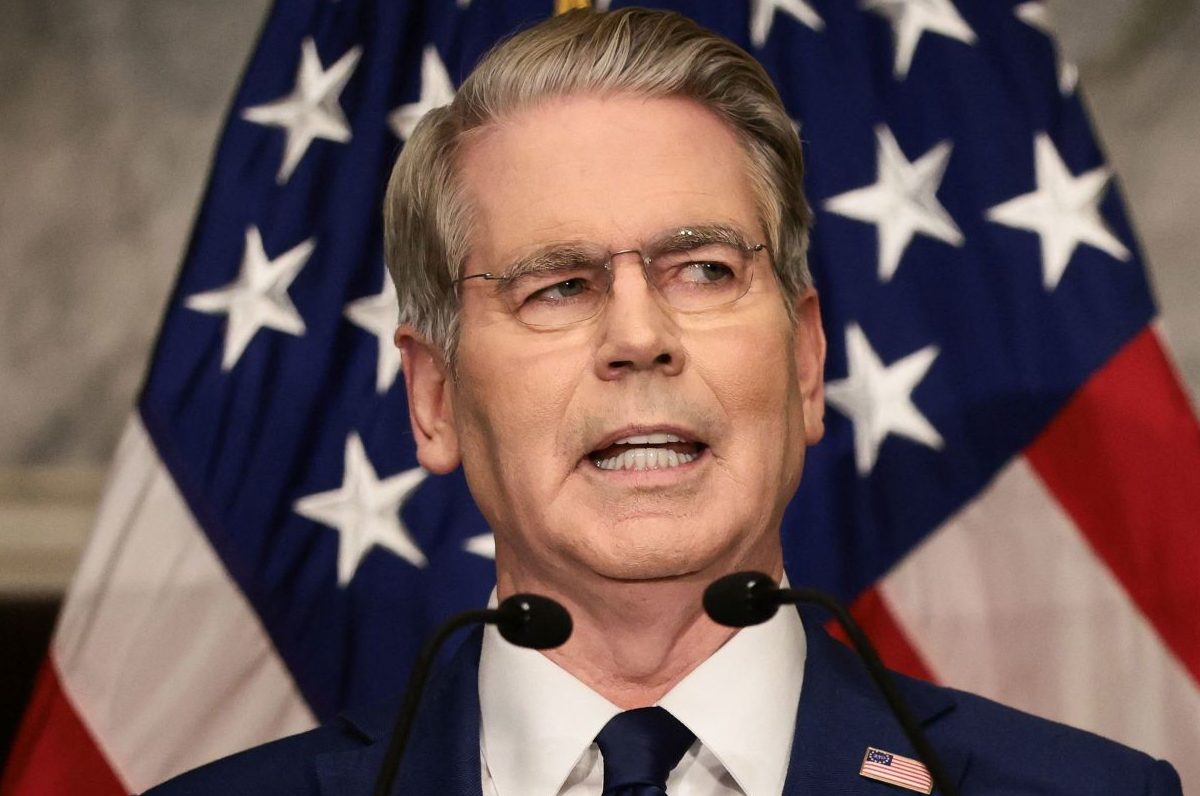
Six months into what critics describe as an illegal U.S.-Israeli war of choice against Iran, the Trump administration has shifted gears from failed military pressure to a sweeping new economic offensive, announcing harsh new secondary sanctions that threaten any global entity continuing commercial ties with Tehran. Treasury Secretary Scott Bessent laid out the details of the new campaign, branded Operation Economic Outcast, during a formal press conference on Monday, framing the initiative as an all-out effort to cut off Iran’s remaining access to hard currency.
During the briefing, Bessent left no room for interpretation about the administration’s stance, stating: “An economic engagement of any kind with this murderous regime will expose those responsible to the full reach of American power.” The campaign, which officials have dubbed an “economic D-Day,” targets five core pillars of Iran’s remaining international economic activity: technology, gold, aviation, shipping, and digital assets. The goal of the wide-ranging action is to choke off virtually every remaining stream of foreign currency flowing into the country.
Bessent emphasized that the era of ambiguous compliance with U.S. policy is over, noting that Washington will no longer tolerate business activity in “gray spaces.” He also confirmed that the Treasury Department plans to announce sanctions against a major global financial institution as early as next week. When pressed on whether Chinese banks that maintain commercial ties with Iran would face penalties, the secretary made clear that “no one is above the reach of U.S. sanctions.” While he declined to name specific countries set for targeting, public trade data identifies China, Turkey, and the United Arab Emirates as Iran’s largest remaining trading partners.
In response to questions about why sanctions are not being imposed immediately, Bessent explained that the administration is granting a “cure period” to allow global actors to wind down existing activity with Iran. “Why would I want to blow up the global financial system?” he said, adding that the grace period will move quickly, and any entity that fails to comply with U.S. demands risks being cut off from the U.S. dollar financial system.
Iranian officials have pushed back hard against the new sanctions threat, dismissing the campaign as an admission of U.S. military failure. Deputy Iranian Foreign Minister Kazem Gharibabadi took to social media to mock the announcement, writing: “Is this a victory or an admission of America’s failure!? You say Iran’s military capability has been ‘dismantled,’ 100% of its military factories ‘destroyed’ and its nuclear program ‘buried’; but for this very Iran, the ‘largest financial assault in history’ and the mobilization of ‘all US institutions and authorities’ have been necessary!”
Despite repeated claims from President Trump that the war is “over” or nearly over, on-the-ground developments confirm Iran holds the upper hand in regional shipping dynamics. Most commercial vessels have avoided the U.S.-supported shipping route through the Strait of Hormuz, instead opting for a corridor controlled by Tehran or steering clear of the waterway entirely.
The escalating conflict is already carrying tangible economic costs for American households, in addition to the devastating toll on Iranian civilians. Disruptions to oil shipments through the key chokepoint have pushed U.S. national average gasoline prices above $4 per gallon, roughly $1 higher than the same period one year prior. Trump has brushed off public concerns about rising fuel costs, claiming $4 per gallon is “not very high” and vowing he will “never apologize” for the economic pain triggered by his administration’s policies.
The impact of higher fuel prices extends far beyond the gas pump, as increased transportation costs push up prices for food and consumer goods, keeping overall U.S. inflation elevated. For Iranians, the economic strain is far more severe: Iran’s national currency, the rial, has already plunged to all-time lows amid a prolonged crisis driven by years of U.S. sanctions and the ongoing war.
Beyond the borders of Iran and the U.S., the new sanctions framework carries major risks for the global economy, as it forces all nations to choose between trading with Iran and retaining access to the U.S.-dominated global financial system. At a press briefing in Beijing on Monday, Chinese Foreign Ministry spokesperson Lin Jian warned that unilateral sanctions only fuel further escalation and benefit no country. “China calls on parties to act rationally and with restraint and avoid taking any measures that may further escalate tensions or deal a blow to global economic growth and financial stability,” Lin said, adding that China will take all necessary steps to protect the legitimate rights and interests of its entities.
International policy experts have widely criticized Operation Economic Outcast, warning that the gambit carries major risks for global stability and will fail to achieve Washington’s stated goals. Ryan Costello, policy director for the National Iranian American Council, described Trump as a “geopolitical gambler doubling down on a bad hand” in Iran. “What we’ve learned is that President Trump can impose extensive economic pain on Iran, but ordinary Iranians overwhelmingly bear the cost. The ruling elite in Iran remains largely insulated, while Tehran has repeatedly refused to capitulate to Washington’s demands,” Costello noted. He added that Trump’s reckless gamble risks further undermining U.S. national security, regional stability, and the global economy.
Sina Toossi, a senior nonresident fellow at the Center for International Policy, observed that the new campaign is as much psychological warfare as it is economic, designed to project an image of inevitable Iranian isolation and amplify economic anxiety within the country. He noted that the administration’s tough rhetoric masks a core weakness: the military campaign failed to force Iran into concessions, and cutting off all of Iran’s economic lifelines requires compliance from major powers like China that openly reject Washington’s strategy. “Washington is effectively betting it can achieve through intensified economic strangulation what six months of war could not,” Toossi said. “The capacity to hurt Iran is clear. The path from pain to capitulation or collapse is not.”
Alan Eyre, a former State Department Iran specialist and current distinguished fellow at the Middle East Institute, argued that the new campaign actually pushes the U.S. toward becoming an economic outcast in global markets. Prominent financial commentator Peter Schiff echoed that criticism on social platform X, noting that the new sanctions are a direct response to the failure of the U.S. military campaign. “However, Operation Economic Outcast will not only fail, but the economic noose that actually tightens may end up being the one wrapped around our neck,” Schiff wrote.