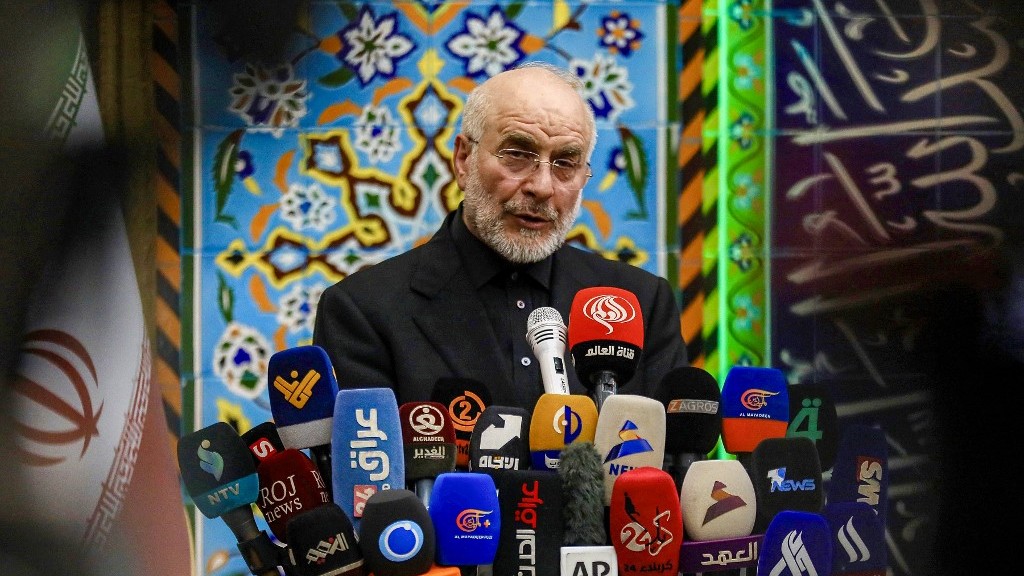
Deepening geopolitical friction in the Middle East moved into a new phase this week, as Iran’s top parliamentary official struck a defiant tone affirming unbreakable ties with neighboring Iraq, even as the Trump administration unveiled plans for sweeping new economic pressure targeting the Islamic Republic and its partners.
Mohammad Bagher Ghalibaf, Speaker of Iran’s Parliament, delivered the remarks Thursday during an Arbaeen religious gathering held in Iraq’s holy city of Karbala. He emphasized that historical connections, shared geographic borders and overlapping religious convictions create an permanent bond between Iran and Iraq that outside efforts to divide the two nations will never succeed in breaking. Far from weakening their alliance, Ghalibaf argued, external interference will only strengthen cooperation between Tehran and Baghdad.
“Our two nations have long rejected being reduced to afterthoughts in other countries’ geopolitical plans, and we have never allowed Western capitals to shape our collective future,” Ghalibaf stated, adding that Iran and Iraq remain committed to keeping control of their national sovereignties out of foreign hands. He called for expanded bilateral security coordination, and urged both governments to align their efforts to drive shared economic growth and broader development across the region. Per Iran’s state-run Tasnim News Agency, Ghalibaf also pushed for joint infrastructure and development projects that would raise living standards for citizens of both countries, strengthen regional economic sovereignty, and limit the ability of outside powers to exert influence across the Middle East.
Ghalibaf’s address came on the heels of aggressive new announcements from the White House, where U.S. President Donald Trump has launched what he calls an “economic D-Day” campaign against Iran, warning that any nation that maintains working ties with Tehran will face severe economic repercussions. The decades-long standoff between Washington and Tehran has escalated sharply in recent weeks, with a de facto ceasefire between the two sides collapsing entirely, and the U.S. still unable to assert full military control over the strategically critical Strait of Hormuz, through which roughly a fifth of global oil supplies pass daily.
U.S. Treasury Secretary Scott Bessent confirmed the administration’s plans Thursday during an interview with CNBC, stating that Washington will roll out “the toughest sanctions in history” against Iran, ramping up economic pressure despite mounting global economic fallout from the ongoing conflict. “This is a one-two punch: we already have a blockade in place, and now we are bringing the strongest sanctions ever enacted,” Bessent said. “This will work in Iran, and we are going to collapse this regime.” He added that full details of the new sanctions package will be released publicly this coming Monday, just one day after Trump first announced the “economic D-Day” initiative.
Iranian officials have dismissed the new sanctions as an act of economic warfare that deliberately targets vulnerable civilian populations, describing the measures as “economic terrorism” and crimes against humanity. The escalating conflict has already sent shockwaves through global commodity markets: international benchmark Brent Crude rose 2% on Thursday to trade at $93.41 per barrel, creating a political headache for the Trump administration as it works to curb rising interest rates and inflation. Disruptions to global shipping have been even more severe, with tanker charter costs skyrocketing amid security risks in key waterways. The BWET Exchange Traded Fund, which tracks global shipping rates, has surged 98% over the past 30 days alone.
When asked about the unexpected spike in energy prices, Bessent claimed that “we have asymmetric information, and I’m not sure why oil has popped up on this.” Tensions remain high across two key maritime chokepoints: Iran continues to target commercial vessels passing through the Strait of Hormuz, while the Ansar Allah movement (commonly referred to as the Houthis), the Iran-aligned group controlling northern Yemen, has enforced a blockade of commercial shipping heading to Saudi Arabia through the Red Sea. Saudi Arabia, which relies on Red Sea shipping to export much of its crude production, has been forced to reroute oil shipments through a pipeline that carries crude to Mediterranean ports via Egypt.
Bessent also called on China to align with the U.S. campaign of sanctions against Iran, arguing that Beijing stands to benefit directly from the reopening of the Strait of Hormuz and a subsequent drop in global energy prices. When asked whether the U.S. would impose secondary sanctions on Chinese entities that continue to do business with Iran, Bessent said such conversations are best held in private, but expressed confidence that the global community broadly shares Washington’s goal of reopening the strategic waterway. “The Chinese get 50 percent of their energy from inside the Gulf,” he noted. “So it would do them a big service to get with the programme.”