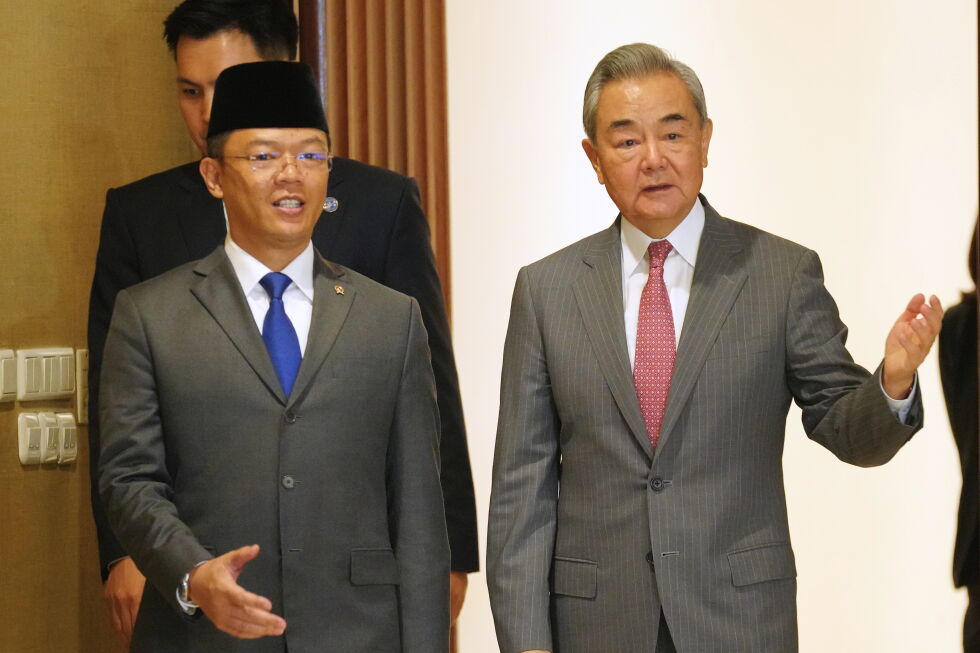
High-stakes diplomatic meetings between top Indonesian and Chinese officials in Jakarta on Friday have opened a new chapter of bilateral cooperation, with the two nations committing to advance collaboration across defense, food security, energy, trade and cutting-edge technology while taking a unified stance against global coercion and historical revisionism.
The talks brought together foreign and defense ministers from both countries, marking a formal step forward for the updated bilateral dialogue mechanism that the two sides have developed to align their policy priorities. Indonesian Foreign Minister Sugiono, who goes by a single name, outlined the broad scope of the talks after the meetings, noting that the new dialogue framework is designed to deliver tangible progress across five core pillars of partnership: political, economic, security, maritime, and people-to-people exchanges.
Chinese Foreign Minister Wang Yi emphasized that both sides have agreed to align their development and security priorities more closely, creating a robust foundation that will support each nation’s modernization goals. In a joint statement issued after the talks, Wang made clear the two countries’ shared commitment to upholding global order. “We will jointly oppose unilateral bullying and power politics. We must also remain vigilant against attempts in the region to challenge the outcomes of victory in World War II and turn back the wheel of history,” Wang said. “We should safeguard international fairness and justice, as well as the legitimate rights and interests of developing countries.”
Beyond diplomatic alignment, the talks covered concrete cooperation across economic and technological domains. Sugiono said ministers discussed strengthening food, energy, and mineral supply security by building strategic domestic industries that boost national resilience. The partnership will expand into new cutting-edge areas in coming years, including artificial intelligence research, co-development of communications satellites, and other advanced technology initiatives. The two sides also reached agreement to expand bilateral trade, with a focus on opening new markets and increasing access for Indonesia’s key commodity exports to China.
Wang noted that the revitalized bilateral dialogue sends a powerful message of unity to the global community. “It [sends] a clear signal to the world of solidarity and cooperation between our two major emerging-market countries,” Wang added.
In a separate meeting held alongside the foreign minister talks, defense ministers from both nations hammered out details for expanded defense cooperation. Indonesia’s Defense Minister Sjafrie Sjamsoeddin said his counterpart, China’s Defense Minister Dong Jun, and he discussed expanding cooperation across multiple areas, including defense equipment supply, personnel training exchanges, and collaboration between the two countries’ domestic defense industries. Sjamsoeddin also extended an invitation to Chinese armed forces to take part in Indonesia’s Heping Garuda joint exercise, a step he described as a tangible demonstration of the growing military ties between the two nations.
Economic relations between Indonesia and China have expanded rapidly in recent years, with total bilateral trade hitting roughly $167 billion in 2024. China has held the position of Indonesia’s largest trading partner for multiple consecutive years, and has invested tens of billions of dollars in large-scale infrastructure projects across Indonesia as part of Chinese President Xi Jinping’s signature Belt and Road Initiative. Notable completed projects include the Jakarta-Bandung high-speed railway, the first high-speed rail line in Southeast Asia, and the Cirata floating solar farm, the largest facility of its kind in the region, located on a reservoir in West Java roughly 80 miles outside Jakarta. While minor disputes over project timelines and pricing have emerged during implementation, China has reaffirmed its commitment to completing all agreed projects in line with bilateral agreements.
Associated Press video producer Olivia Zhang in Beijing contributed reporting to this article.