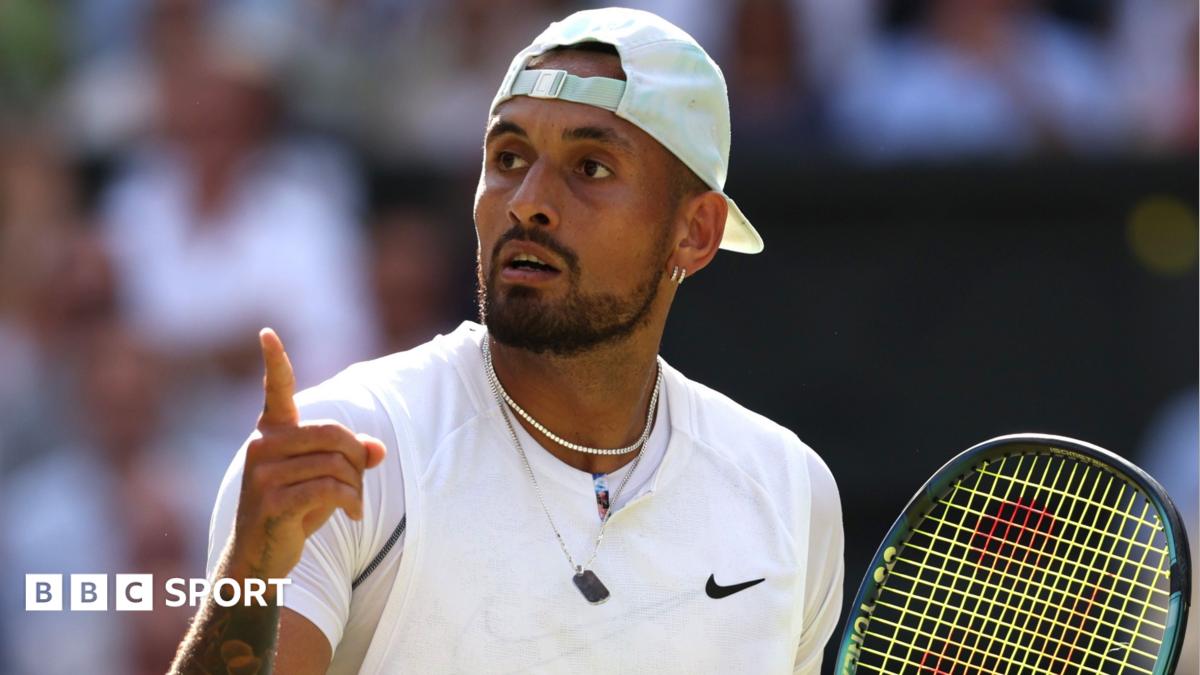
Australian tennis star Nick Kyrgios, whose turbulent career has been marked by spectacular on-court highs and repeated off-court controversies, has been issued a mandatory provisional suspension after testing positive for a cocaine metabolite during June’s Mallorca Open. The 31-year-old, who has spent the past two years battling multiple serious injuries that have sidelined him from consistent competition, is attempting yet another comeback when the positive result was returned.
In a public statement posted to his social media channels, Kyrgios acknowledged the positive test as a “huge mistake” and accepted full accountability for the outcome. He opened up about the intense mental toll that recent years of injury and the reality of approaching the end of his professional tennis career have taken on him, writing, “Coming to terms with being near the end of my career has been harder than I ever imagined.” This admission aligns with a long-stated prediction he made years earlier: that there was “zero chance” he would continue competing on the ATP Tour into his 30s.
Under the anti-doping rules governing professional tennis, Kyrgios is barred from competing in any sanctioned events until his case is fully resolved. While the maximum possible penalty for the violation is a four-year competition ban, regulatory rules cap the suspension at just three months if the player can successfully prove that the cocaine was consumed outside of competition, and not for performance-enhancing purposes.
Kyrgios, a seven-time ATP Tour singles champion and 2022 Australian Open men’s doubles title winner alongside close friend Thanasi Kokkinakis, has long been one of the most polarizing figures in global tennis. He first rose to international prominence at age 19 during his 2014 Wimbledon Centre Court debut, when he pulled off a legendary upset over then-world No. 1 Rafael Nadal. Eight years later, he reached the peak of his singles career, advancing to the 2022 Wimbledon singles final where he finished runner-up to Novak Djokovic.
At his best, Kyrgios is widely regarded as one of the most talented and exciting shot-makers in the sport, renowned for his flamboyant style, explosive serve, and natural on-court athleticism. But his career has been overshadowed by repeated behavioral controversies and well-documented mental health struggles.
The first major public disciplinary incident came in 2015, when Kyrgios received a suspended 28-day ban for making lewd comments about Stan Wawrinka’s girlfriend during a professional match in Montreal. The following year, he was hit with an eight-week ban for unsportsmanlike conduct and a documented “lack of best effort” at the Shanghai Masters, a penalty that was eventually reduced to three weeks after he agreed to undergo counseling with a sports psychologist.
2019 stands as the lowest point of Kyrgios’s professional career, a period he has described publicly as the “nadir” of his time in tennis. That year, he was defaulted mid-match at the Italian Open for throwing a chair onto the competition court, and later fined $113,000 for verbally abusing umpire Fergus Murphy during a tournament in Cincinnati. The ATP eventually issued a suspended 16-week ban for a pattern of verbal abuse directed at officials and spectators over the preceding 12 months.
In interviews for the Netflix documentary series Break Point, Kyrgios opened up about the deep personal struggles that defined that period of his life. “I was drinking, abusing drugs. I lost my relationship with my family, pushed all my close friends away,” he said. He also revealed that childhood bullying over his size and heritage left lasting mental health scars, that he wore long compression sleeves to cover self-harm scars on his arm, and that he spent time in a London psychiatric hospital to work through his mental health challenges.
In the years since that low point, Kyrgios has continued to make headlines for off-court incidents. In 2023, he pleaded guilty to assaulting his ex-girlfriend Chiara Passari during a public argument in Canberra, and was spared a criminal record after a magistrate ruled the incident was a “single act of stupidity or frustration.” Two years ago, he publicly distanced himself from controversial influencer Andrew Tate, who is currently fighting extradition to the UK on charges of rape and sex trafficking, telling the BBC he had taken significant steps to cut ties with Tate.
Kyrgios, currently ranked world No. 919 after extended injury breaks, has announced he will step away from public competition for the next 28 days to focus on personal work, saying he aims to “do the work and come back better.” The formal adjudication of his doping case could take multiple months to complete, a process that comes as Kyrgios has been an outspoken critic of tennis’s current anti-doping system. He has repeatedly called the system “awful,” and publicly argued that top players Jannik Sinner and Iga Swiatek received overly lenient punishments in their recent high-profile doping cases. Following Sinner’s acceptance of a three-month ban for a positive clostebol test, Kyrgios wrote online: “Sad day for tennis. Fairness in tennis does not exist.”
For Kyrgios, who once questioned whether he would ever play into his 30s, the outcome of this ongoing process will determine whether he gets the chance to continue his professional career beyond this point. The BBC notes that support for mental health challenges is available through BBC Action Line and the Samaritans free helpline for anyone affected by the issues raised in this report.