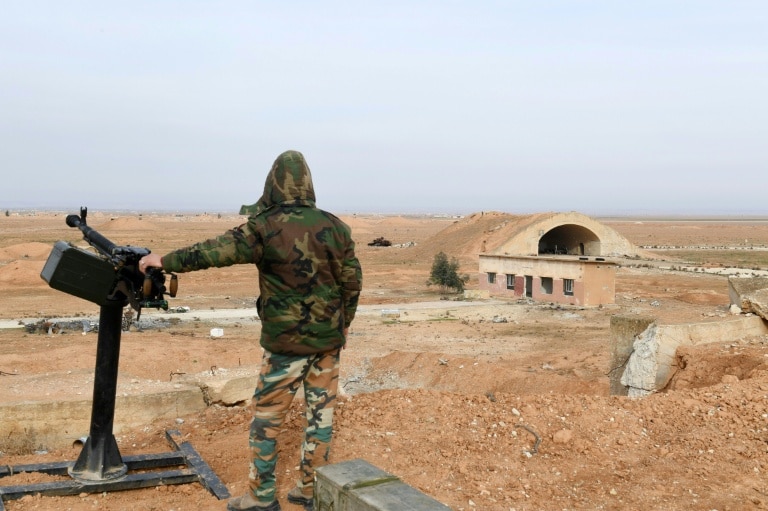
A recent Israeli strike on a Syrian air base in the northwestern province of Idlib has sparked a sharp diplomatic rebuke from Turkey and exposed growing rifts between Israel and the United States over the future of post-Assad Syria. The incident, which US officials have publicly attributed to Israel, marks a significant escalation of Israeli military activity in Syria just months after the collapse of Bashar al-Assad’s long-ruling government, and has further inflamed long-simmering tensions between Ankara and Jerusalem.
After more than 24 hours of official silence following the strike, Israeli Prime Minister Benjamin Netanyahu’s office released a statement defending the action, framing it as a response to an impending security threat. The statement claimed that Israel and Syria had maintained an informal status quo on security arrangements, which Syria was set to violate by allowing Turkish military forces to deploy to the Abu Duhur air base near Aleppo. “Israel repeatedly warned Syria that such a deployment would pose a threat to Israel’s security. Syria chose to ignore these warnings,” the statement read, stopping short of explicitly confirming Israeli responsibility for the attack.
Turkey, which has been a key backer of Syria’s new transitional government led by former jihadist commander Ahmed al-Sharaa, rejected the Israeli claims outright in an official statement released Wednesday and carried by Turkey’s state-run Anadolu News Agency. Ankara slammed the allegations as a cynical attempt to justify an illegal attack that violates Syria’s fundamental sovereignty and territorial integrity. “The frivolous allegations put forward by the Israeli Prime Minister’s office aim to legitimize Israel’s unlawful airstrikes targeting Syria’s sovereignty and territorial integrity,” the Turkish government statement said.
The strike also represents an unusual open defiance of the United States, which has moved to support Sharaa’s new administration as it works to consolidate control across Syria after Assad’s ouster in December 2024. Tom Barrack, the US envoy for Syria and ambassador to Ankara who has close personal business ties to US President Donald Trump, confirmed Israel’s role in the attack in a post on X Tuesday. Barrack called the strike an “unnecessary escalation that does not advance regional stability” and urged all parties to prioritize diplomatic dialogue over further military action. “We encourage all parties to prioritise logical discourse over further military incidents,” he wrote.
Since Assad’s government fell to Turkish-backed Islamist opposition forces led by Sharaa, Israel has launched hundreds of strikes across Syrian territory, stepping up a long-running campaign targeting what it says are Iranian-aligned militant assets in the country. Israel has also deployed troops into the UN-patrolled buffer zone on the occupied Golan Heights that has separated Israeli and Syrian forces since the 1974 disengagement agreement, and has carried out regular ground incursions deeper into Syrian territory. This most recent strike penetrated much further north into Syria than Israel’s typical limited security zone operations near the Golan, a move widely interpreted as Israel seeking to exploit the chaos of Syria’s political transition to advance its own strategic interests before the new government can consolidate power.
Syrian state media, citing a military source, reported that Israeli aircraft carried out eight separate strikes targeting the base’s runway, causing significant damage to infrastructure but no reported casualties. A security source speaking to AFP confirmed that the Abu Duhur facility had been non-operational since 2012 and is currently secured by forces aligned with Syria’s new defense ministry. The UK-based Syrian Observatory for Human Rights, a prominent war monitor, reported that the strikes followed a recent visit by a Turkish military delegation to the airfield as part of international efforts to reactivate the facility for security operations.
Relations between Netanyahu and Turkish President Recep Tayyip Erdogan have deteriorated sharply in recent years, reaching new lows amid Israel’s devastating military offensive in Gaza that Erdogan has repeatedly and vociferously condemned. While Turkey was the first Muslim-majority nation to formally recognize Israel and remains a NATO ally of the United States, ideological differences and competing regional interests have driven a deep wedge between Ankara and Jerusalem in recent years. Tensions spilled into Israeli domestic politics ahead of October’s national elections, when Netanyahu’s Likud party ran campaign billboards that pictured Erdogan alongside Naim Qassem, the leader of Iran-backed Lebanese militant group Hezbollah, framing the two as foreign actors pushing for Netanyahu’s electoral defeat.
Syria’s transitional government joined Turkey in condemning the attack, releasing a statement that labeled the strike “an unjustified act of aggression” and called on the UN Security Council to take formal action to hold Israel accountable. The foreign ministry stressed that Syria’s new administration has exercised deliberate restraint since taking power, working to consolidate domestic stability and avoid regional escalation that could derail its political transition.
Interestingly, despite rising cross-border tensions, Israeli officials and representatives of Syria’s new government have already held multiple rounds of direct bilateral talks, and the two sides have agreed to establish a formal intelligence-sharing mechanism. But core territorial disputes remain unresolved. Last month, Syrian Foreign Minister Asaad al-Shaibani demanded an unconditional full withdrawal of Israeli forces from all Syrian territory occupied since 1974, warning that the continued Israeli presence beyond the 1974 disengagement line poses a direct threat to regional security. Just one week later, Israeli Defense Minister Israel Katz reaffirmed that Israel has no plans to withdraw its forces from Syrian territory, cementing the status quo of occupation.
During a high-profile visit to Damascus last month, UN Secretary-General António Guterres echoed the global majority position, stating that all violations of Syria’s sovereignty and territorial integrity are unacceptable and must end, and explicitly reaffirmed that the Golan Heights is internationally recognized Syrian territory. Israel captured the majority of the Golan Heights from Syria during the 1967 Arab-Israeli War and later formally annexed the territory, a move that has never been recognized by the vast majority of the international community.