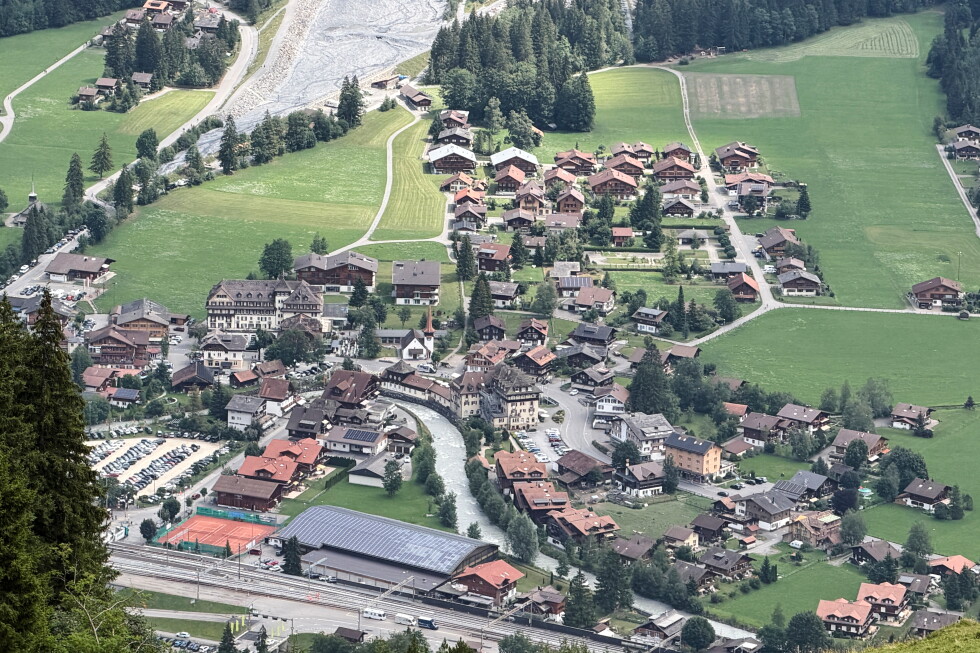
Perched in the dramatic Alpine landscapes of Switzerland’s Bern canton, the postcard-perfect village of Kandersteg — home to 1,300 residents, surrounded by jagged peaks, receding white glaciers and lush green valleys, with the faint, familiar chime of cowbells drifting across mountain air — now faces an imminent existential threat tied to a rapidly changing climate. A massive unstable rock formation known as Spitze Stei, perched thousands of feet above the village, is at growing risk of collapse, a disaster that experts warn could match the scale of last year’s devastating landslide that destroyed the nearby community of Blatten.
The growing risk of large-scale mountain collapses across the Swiss Alps is directly linked to rising global temperatures, which are driving the steady thaw of permafrost — the permanently frozen layer of soil, sediment and rock that acts as natural cement binding mountain slopes together — and shifting glacier dynamics. Climate scientists warn that as this frozen infrastructure melts, once-stable alpine terrain becomes increasingly prone to catastrophic movement.
For residents of Kandersteg, the threat hangs over daily life, balanced between cautious calm and the unavoidable uncertainty of natural forces. “You are aware that it’s happening, but not afraid,” said long-time local Brigitte Jüni, noting that cantonal and federal authorities have implemented every feasible precaution to protect the community. “But then it’s nature. It’s nature and you never know,” she added.
The scale of the potential collapse is staggering: geologists estimate the unstable portion of Spitze Stei holds between 15 and 20 million cubic meters of rock. Should the entire formation collapse at once, it would bury large parts of Kandersteg’s valley under debris. However, constant real-time monitoring of the rock’s movement and preparedness efforts have eased some anxiety among locals. Experts also note that a gradual, incremental breakdown of the formation is far more likely than a single massive collapse. Evacuation routes and emergency protocols are already finalized and updated regularly to ensure residents can move to safety if warning signs escalate.
Many locals draw a clear distinction between their current situation and the 2025 disaster in Blatten, located in the nearby Loetschental valley. In that event, a huge mass of rock and ice broke free from a warming glacier, thundering down the mountainside just weeks after the entire village was evacuated as a precaution. The entire settlement was coated in thick mud, leaving almost no structures undamaged. “This isn’t the same case as in Blatten. It’s a different situation,” said local resident Rudolf Isler. “We are not afraid of the Spitze Stei rock. It’s been many years seeing stones falling from up there. The problem here is about global warming and rising temperatures.”
Markus Stoffel, a professor of climate change and natural risks at the University of Geneva, explained the scientific mechanism behind the growing risk: “In the mountains and in the unconsolidated debris, there is lots of ice. Once this ice is melting, it removes the binding that holds the slope together. These mountain slopes will become increasingly unstable.”
The threat to Kandersteg is part of a broader pattern of escalating natural hazard risk across the European Alps, driven by human-caused climate change. Climate advocates warn that if current warming trends continue, entire Alpine communities may need to be relocated in coming decades. “Climate change means landslides or avalanches will become more common,” said Nathan Solothurnmann, a climate and energy expert for Greenpeace Switzerland. “Maybe even one day we will have to abandon certain valleys or certain villages because it’s becoming impossible to live there. Or the measure you will need to take to protect infrastructure is so expensive, the efforts are so big, that it’s not worthwhile anymore living there.”