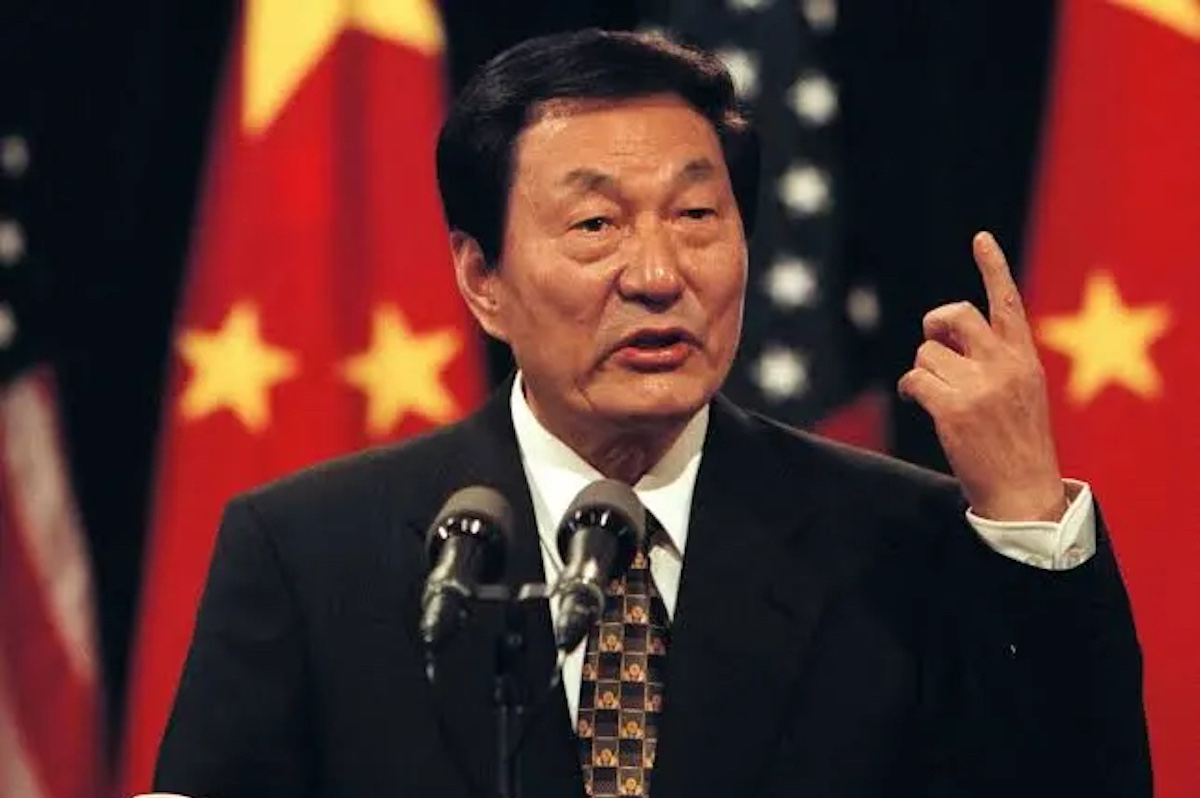
On August 12, former Chinese premier Zhu Rongji passed away in Beijing at the age of 97, closing a chapter that transformed modern China and left a lasting blueprint for economic reform across Asia. Widely remembered as one of the most consequential public servants of 20th-century Asia, Zhu led the push to integrate China into the global economy, culminating in the country’s accession to the World Trade Organization (WTO) in December 2001 after nearly 15 years of grueling negotiations.
While public tributes have rightfully highlighted the sweeping scale of Zhu’s achievements, his most enduring contribution is far from the large economic figures that dominate retrospective coverage: it is a replicable strategy for domestic reform that any government in the region can adapt. Zhu’s approach, often called “reform by treaty,” centered on making binding international commitments, then leveraging that external momentum to break through domestic political deadlocks that had stalled progressive change.
A trained electrical engineer from Tsinghua University, Zhu governed with the pragmatic, problem-solving rigor of his technical background. Rejecting rigid ideological dogma, he focused on identifying broken systems and building stable, functional institutions in their place. As vice premier starting in 1991, he tamed rampant double-digit inflation by cutting off unsustainable credit to loss-making state-owned enterprises. In 1994, he oversaw a sweeping overhaul of China’s tax system that reestablished stable central government revenue flows. When he assumed the office of premier in 1998, he pushed state-controlled banks, airlines, and energy firms to adopt commercial, market-aligned operating practices without full privatization, and built a private residential housing market from almost nothing.
This pragmatism, rather than blind faith in free markets, guided Zhu’s pursuit of WTO membership. While one Chinese negotiator famously compared the 15-year talks to haggling in a street vegetable market, the core prize of accession was never just access to global export markets — it was domestic reform. By locking China’s opening into binding international law, Zhu gained critical political leverage to overcome resistance from domestic officials who protected entrenched state-owned firms and resisted structural change. For domestic reformers, WTO membership created the external pressure needed to advance long-stalled changes to banking regulation, corporate law, and judicial governance that would have been impossible to push through alone.
What set Zhu apart from many fellow leaders was his willingness to embrace the costs of reform openly, rather than hiding them from the public. His restructuring of bloated state enterprises left an estimated 40 million workers without lifetime state employment, a shift critics labeled “surgery without anesthesia.” He cut import tariffs on automobiles and thousands of other goods from over 100% to a maximum of 25%, drawing fierce accusations from domestic hardliners that he was surrendering China’s economic sovereignty. Upon taking office as premier, he famously declared he would push ahead with reform regardless of whether the path ahead was “a minefield or an abyss” — and he kept that promise.
Crucially, Zhu did not abandon displaced workers amid the restructuring. As lifetime state jobs were eliminated, he rolled out a package of support: existing state apartments were sold to sitting tenants at nominal prices, low-interest mortgages were made widely available, and basic social welfare and unemployment insurance systems were established for the first time. The transition was far from perfect, and Zhu himself would have been the first to acknowledge its flaws, but it gave a generation of workers a tangible stake in private property that they had never held before.
Another rare quality defined Zhu’s leadership: a willingness to take public responsibility for failure. After devastating floods killed more than 4,100 people across China in 1998, he publicly lambasted dikes built with embezzled public funds as no stronger than “bean curd.” Three years later, he appeared on national television to accept personal responsibility for a school explosion that killed 42 people, most of them children. For citizens and market actors alike, this willingness to own mistakes sent a clear message: official data and accountability would not be manipulated. It is a simple act that builds trust in government more effectively than any amount of political messaging.
A honest assessment of Zhu’s legacy must also acknowledge that some challenges emerged after he left office, many of which stem from choices made by his successors. The fiscal system he designed left local governments heavily reliant on land sales for revenue, a dynamic that contributed to the 2021 Chinese property sector crisis. The full financial opening promised at WTO accession was never completed, and the open government procurement market pledged in 2001 remains largely closed to foreign firms. It is important to note, however, that Zhu retired from office in 2003; the binding international agreements he put in place only set the framework, and subsequent leaders made their own choices about how to implement policy within that structure.
For China’s Asian neighbors, Zhu’s WTO gamble delivered uneven outcomes, as he always predicted it would. World Bank economists forecast ahead of accession that the largest gains would go to China itself and the countries that supplied its factories with raw materials, components, and machinery, while nations that competed directly with Chinese manufacturers would face economic pressure. That is exactly what came to pass, and it offers a clear lesson for Asian governments: preparation, not just membership in trade blocs, determines which nations gain from global integration.
Today’s debates around Chinese industrial overcapacity and the country’s near-$1.2 trillion annual trade surplus are valid, but these stem from policy choices made in the decades after Zhu left office, not the landmark bargain he negotiated to join the WTO.
The most fitting tribute to Zhu, the article argues, is not nostalgic remembrance — it is putting his strategy to use. Across Asia today, the region’s next wave of economic progress — from deepening the Regional Comprehensive Economic Partnership (RCEP) to expanding the Comprehensive and Progressive Agreement for Trans-Pacific Partnership (CPTPP), to writing new rules for digital trade, green goods, industrial subsidies, and cross-border data flows — hinges on the same question Zhu answered decades ago: do governments have the courage to sign international agreements precisely to break domestic reform deadlocks? This strategy works for Jakarta, Delhi, Hanoi, and Seoul just as it worked for Beijing.
Zhu’s quieter legacy reinforces this path. As the founding dean of Tsinghua University’s School of Economics and Management, he trained a generation of Chinese economists and finance officials who have shaped the country’s policy for decades. People and institutions outlast any tariff schedule or trade agreement.
Zhu once joked that an official portrait made him look like a dead man. The man has passed, and the Asian region is dimmer for his loss. But his idea — that bold, honest reform is possible with the courage to leverage external commitment for internal change — is still alive, waiting for the next generation of reformers with even a fraction of his courage to pick it up and carry it forward.
This commentary is by Y. Tony Yang, Endowed Professor at George Washington University in Washington, D.C.