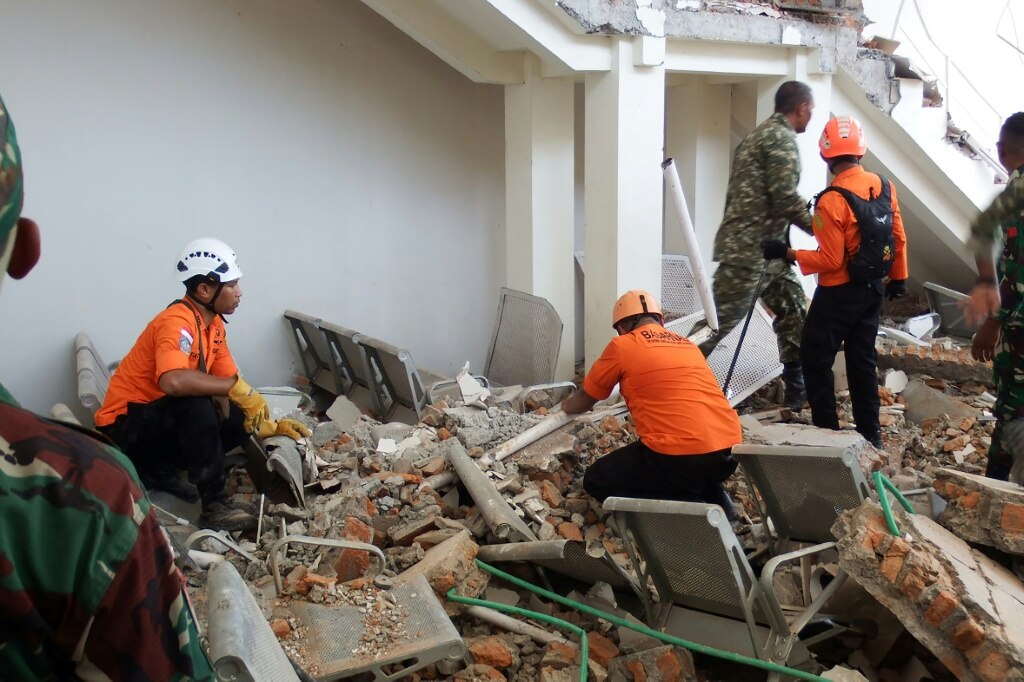
A powerful 7.7-magnitude shallow earthquake has hit off the northern coast of Indonesia’s tourist-popular Flores island, leaving at least 20 people dead, six injured, and two more trapped alive under collapsed structures, with rescue teams racing against time to locate survivors amid challenging terrain conditions.
Saturday’s early morning quake shook residents awake across the island, even in areas more than 100 kilometers from the epicenter. Yulian Juita Ekalia, a 37-year-old university lecturer based in Ruteng, described the intense shaking as feeling like the entire area was bouncing on a trampoline. “I jolted awake at around 5:30 am, and by the time I rushed outside, every shelf and surface in my home had collapsed — the TV, my son’s sports trophies, everything was on the floor,” she told reporters in a phone interview. “When I got outside, my son and neighbors were already there, screaming in fear.”
Witnesses in Nagekeo, the district closest to the quake’s epicenter, reported residents scrambling for higher ground almost immediately after the tremor hit, after the sea suddenly pulled back from the shore — a classic warning sign of an incoming tsunami. Long queues of evacuees fled the coastal area on foot, motorbikes, cars, and packed pickup trucks after Indonesia’s Meteorology, Climatology, and Geophysics Agency issued an urgent tsunami warning. While the warning was later lifted, authorities have warned local residents against returning to damaged structures, as dozens of aftershocks have continued to rattle the island through the day, with the strongest recorded at magnitude 6.1.
Rescue operations focused on clearing rubble and reaching trapped victims by Saturday, but access to hard-hit areas has been severely limited by landslides that have blocked key rural roads, a complication that has slowed search efforts. By midday Saturday, thousands of residents remained outdoors, too afraid of new tremors to go back inside. Ekalia told reporters she had moved her cooking stove outside to prepare meals, and that patients at a local hospital were being treated in emergency tents rather than inside the damaged building. She added that she felt an unexpected sense of relief that the quake struck on a weekend morning: “My university was heavily damaged, but there were no classes or staff on campus Saturday. I can’t imagine how much worse it could have been if it hit during a regular school day.”
Nagekeo resident Yohanes Babo, 56, who was at a local market when the quake hit, said widespread panic spread across the area immediately after the shaking started. “The shaking was really strong, but we were lucky to already be outside,” he said. “Everyone was panicking, running every which way. We’re evacuating now, heading up to the higher hills to be safe.”
Hospital staff in the Flores city of Maumere also reported cracked walls and frightened patients fleeing the building. Officials are still conducting a full assessment of the total damage across the largely rural region, which has very few high-rise structures.
Indonesia sits along the Pacific “Ring of Fire”, a geologically active zone that wraps from Japan through Southeast Asia and across the Pacific basin, making the country one of the most seismically active places on Earth. This 7.7-magnitude quake matches the strength of a deadly tremor that hit Flores in 1992, which triggered a tsunami that killed around 2,500 people. The country has faced multiple major seismic disasters in recent decades: the 2004 9.1-magnitude Sumatra quake and tsunami killed more than 170,000 people in Indonesia alone and 220,000 across the region, making it one of the deadliest natural disasters in recorded history. In 2018, a quake on the holiday island of Lombok killed more than 550 people, and a 7.5-magnitude quake and subsequent tsunami on Sulawesi killed or left missing more than 4,300 people that same year.