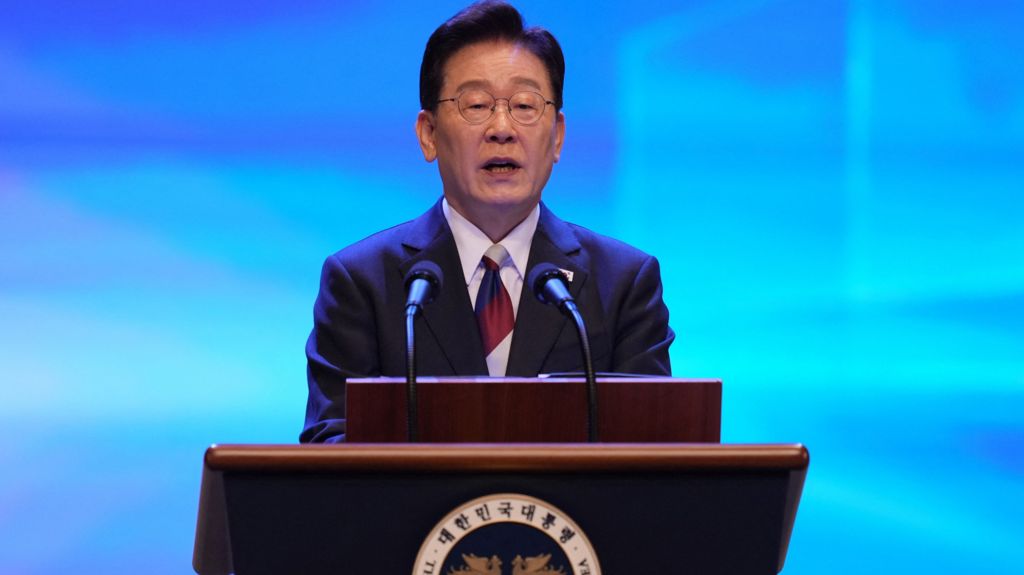
Seventy-one years after the Korean War was paused by an armistice that never transitioned into a formal peace treaty, South Korean President Lee Jae Myung has extended a bold new offer of direct dialogue to North Korea, calling for talks that could lock in peaceful coexistence and formally end the decades-long frozen conflict.
Speaking at a national ceremony marking the Korean Peninsula’s liberation from Japanese colonial rule, Lee laid out a clear, multi-pronged proposal: direct talks to negotiate a formal end to the war, a layered security framework to prevent dangerous flare-ups along the heavily fortified Demilitarized Zone (DMZ) that divides the two nations, and open discussion on concrete steps to roll back Pyongyang’s nuclear weapons program.
Tensions on the peninsula have remained a persistent flashpoint for global security in recent years, with North Korea ramping up ballistic missile tests – weapons designed to carry nuclear warheads – that have sparked alarm in both Seoul and Tokyo, which view the tests as deliberate shows of force and intimidation. The DMZ, the de facto border between the two Koreas, has seen repeated small-scale clashes and cross-border provocations for decades, with both sides trading accusations of hostile acts that range from propaganda broadcasts to the recent tactic of sending trash-laden balloons across the frontier.
Lee, who took office last year following the impeachment of his hardline predecessor Yoon Suk Yeol over an attempted martial law declaration, has made de-escalation with Pyongyang and improved ties with North Korea’s key ally China a core priority of his administration. Relations between the two Koreas had deteriorated sharply under Yoon’s confrontational approach, and Lee has moved quickly to shift course toward engagement.
“Let us put down our intentions to threaten each other and begin discussions to end the long-running war as the directly involved parties,” Lee told attendees at the Liberation Day ceremony. He added that he hoped the two nations would “sit face-to-face for peaceful coexistence and mutual growth,” framing the proposed talks as a space to negotiate “effective ways to halt the advancement of the North’s nuclear capabilities.”
North Korea first declared itself a nuclear-armed state in 2022 and has repeatedly stated it will never give up its atomic arsenal, which independent estimates suggest numbers around 40 to 50 warheads. Lee has previously acknowledged that Pyongyang continues to expand its stockpile, producing an estimated 15 to 20 new warheads each year. In an interview with the BBC last year, he signaled openness to supporting a new deal between U.S. President Donald Trump – who returned to the White House in 2025 – and North Korean leader Kim Jong Un that would freeze North Korea’s nuclear production, calling the agreement a realistic interim step even as Seoul maintains its long-term goal of full denuclearization of the peninsula.
Trump remains the only sitting U.S. president to have held direct face-to-face meetings with Kim, during his first term in office. Since his return to the presidency, Trump has focused most of his foreign policy attention on other global regions, but stated in August 2025 that he would be open to meeting Kim again when conditions are deemed appropriate.
As of this report, North Korea has not issued any official response to Lee’s latest peace offer. Pyongyang’s state media only reported that Kim Jong Un marked North Korea’s own Liberation Day commemorations with a traditional wreath-laying ceremony at a national war memorial and an inspection of an honor guard. The authoritarian regime has previously rejected Lee’s past attempts at engagement, criticizing a recent agreement for the U.S. to supply South Korea with a fleet of nuclear-powered submarines and regularly denouncing annual joint military drills between Seoul and Washington.
In a reminder of the continued tensions ahead of the upcoming scheduled U.S.-South Korean joint military exercise, North Korea test-fired another ballistic missile into the Sea of Japan on Tuesday. This launch marks the 11th suspected North Korean ballistic missile test conducted in 2026, continuing a pattern of provocative military activity that has raised concerns across the Indo-Pacific region.