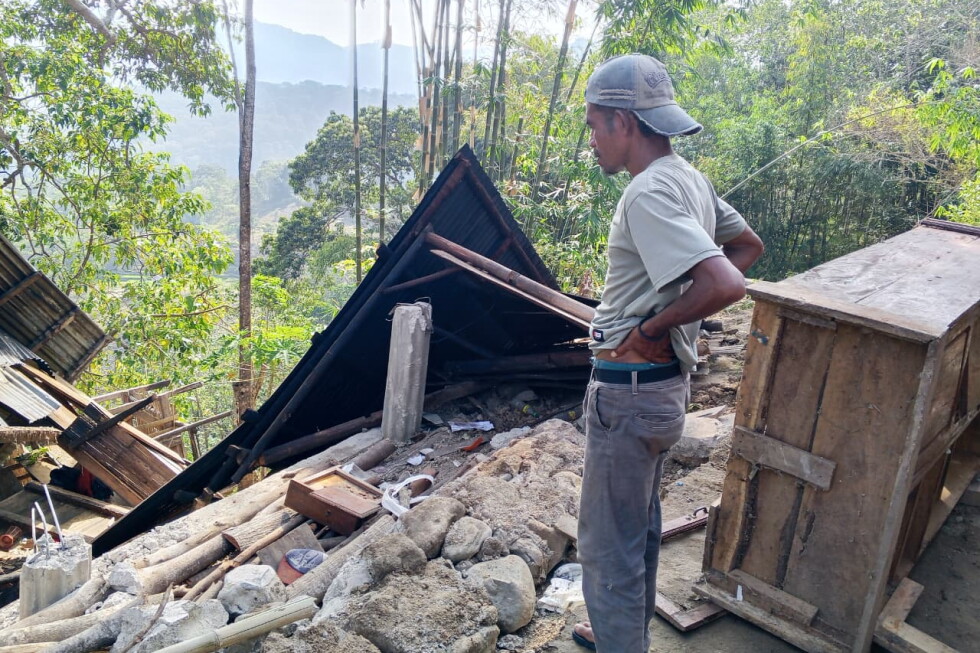
Early Saturday morning, a powerful 7.7-magnitude undersea earthquake shook coastal regions of Indonesia’s Flores island, leaving at least two people dead, two others injured, and a swath of collapsed infrastructure across the seismically active archipelago. As of the latest official updates, emergency response teams are still conducting preliminary damage assessments across the most hard-hit areas.
The U.S. Geological Survey recorded the quake striking at 5:58 a.m. local time, with a relatively shallow depth of just 10 kilometers. Its epicenter was placed roughly 68 kilometers (42 miles) north-northwest of Ende, a major city in Indonesia’s East Nusa Tenggara province. The initial seismic event was followed by multiple smaller aftershocks that complicated immediate response efforts.
Immediately after the quake was detected, Indonesian disaster authorities issued a broad tsunami warning covering coastal areas of four provinces: East Nusa Tenggara, West Nusa Tenggara, South Sulawesi, and Southeast Sulawesi. The warning urged all coastal residents to evacuate to higher ground and avoid low-lying areas including beaches and riverbanks. However, the Meteorology, Climatology and Geophysics Agency later canceled the alert after continuous monitoring confirmed no significant sea level shifts that would threaten coastal communities, easing widespread public panic.
Local eyewitness accounts paint a picture of chaotic panic as the quake hit. Yohanna Embu, a resident of Sikka regency in East Nusa Tenggara, told reporters that strong shaking damaged dozens of structures across the area, including a total collapse of the waiting room at Maumere’s port terminal. Panicked residents flooded roads heading for higher ground immediately after the shaking began.
At St. Peter Major Seminary, locally known as Ritapiret Seminary, dozens of students were gathered for morning Mass when the roof of the campus assembly hall caved in. Rev. Guidelbertus Tanga, the seminary’s rector, said students and on-site nuns fled the collapsing structure in immediate panic. At least one priest suffered a broken leg after jumping from the second floor of a damaged campus building to escape.
As a safety precaution, multiple hospitals across the affected region evacuated all patients from their main buildings. Local television footage showed medical staff moving critical equipment including patient beds, IV stands and oxygen cylinders outside, where they set up temporary triage and treatment areas to continue care amid the risk of aftershocks damaging weakened structures.
Indonesia’s position along the Pacific Basin’s “Ring of Fire” – a vast network of active volcanoes and tectonic fault lines – leaves the 17,000-island archipelago chronically prone to major seismic and volcanic events. This region of Flores is no exception: a devastating 1992 earthquake in the same area triggered a tsunami that killed an estimated 2,500 people, leaving a lasting memory of seismic risk among local communities.
Associated Press journalists Niniek Karmini and Edna Tarigan contributed reporting from Jakarta for this story.