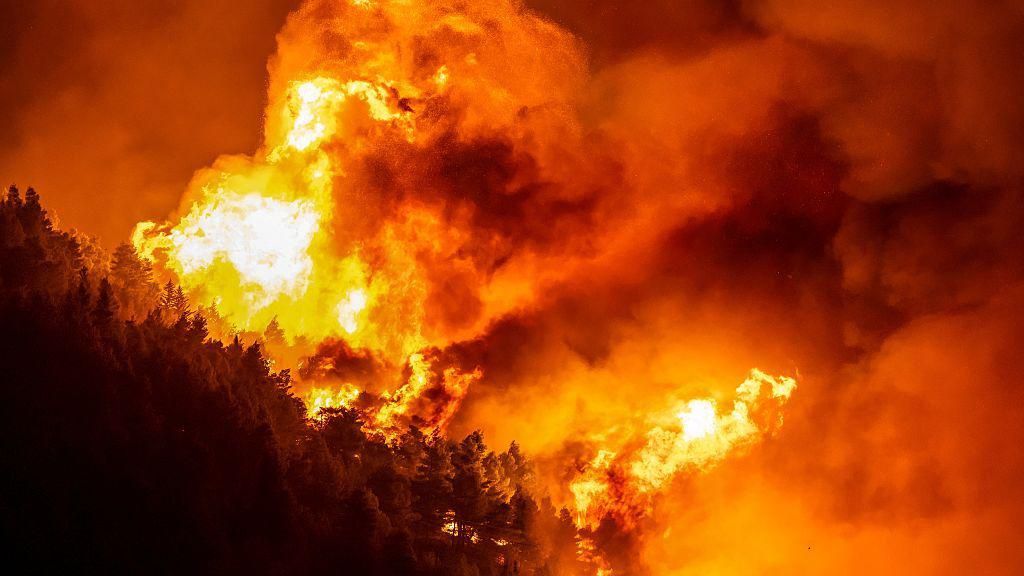
A catastrophic wildfire that ranks among the most destructive in Croatia’s modern history has carved a deadly path across the country’s Adriatic coastline, leaving at least one person dead and nearly 40 others injured, 10 of them in intensive care, after raging through coastal communities from Thursday night into Friday morning. The inferno ignited late Thursday near the small village of Lokva Rogoznica, and rapidly advanced toward the popular coastal tourist hub of Omis, located just six kilometers away. Fanned by gale-force winds that pushed flames across dry pine-covered hillsides, the blaze spread at an unprecedented rate, consuming 1,000 hectares of land in just four hours, destroying everything in its path, including dozens of homes and parked vehicles.
Approximately 1,200 people, both local residents and visiting tourists, were forced to flee the advancing fire, with emergency responders opening temporary shelters in multiple nearby coastal towns to house those displaced. Dramatic footage shared across social media captured apocalyptic scenes: thick black smoke choking the sky and turning it bright red, massive flames devouring vegetation, and panicked onlookers trapped as the fire cut off escape routes. Some desperate evacuees were forced to jump from their boats into the Adriatic Sea to escape the intense heat and advancing flames.
Over 300 firefighters were deployed to contain the blaze overnight, but rapid spread and extreme conditions forced crews to repeatedly retreat to avoid being trapped. Viseslav Pesic, commander of the Omis Volunteer Fire Department, told news outlet Reuters that the intensity of the fire led many fleeing residents to abandon their vehicles directly in active fire zones, blocking access routes and slowing emergency response efforts. On Friday morning, search teams conducting sweep operations of burned-out areas discovered the body of the fire’s first fatality, and search operations continued in affected zones as of Friday afternoon.
During an official visit to the impacted region on Friday, Croatian Prime Minister Andrej Plenkovic commended the relentless work of emergency crews, noting that the fire spread at “lightning speed” driven by powerful winds. “What the firefighters have managed to save here is truly a miracle,” Plenkovic told reporters on site. Croatia’s national fire chief Slavko Tucakovic echoed that assessment, labeling the event “one of the worst” wildfires in the nation’s recorded history.
This devastating blaze is far from an isolated event: much of Southern Europe is currently grappling with a wave of extreme wildfire activity, driven by a record-breaking summer of prolonged heatwaves and persistent dry conditions that have left vegetation tinder-dry across the continent. In Greece, more than 200 people were evacuated by sea from a beach resort in Agios Vasileios as wildfires spread across the country. In southwestern France’s Landes region, over 500 residents were displaced by a new blaze near an area already left devastated by earlier wildfires this summer. In western Germany, 2,000 residents of the village of Gey were ordered to evacuate when a forest fire advanced toward the settlement near the Belgian border. In the United Kingdom, authorities issued an emergency “very high risk” wildfire alert to millions of people across England and Wales on Friday, as firefighters battle multiple active blazes in the West Midlands.