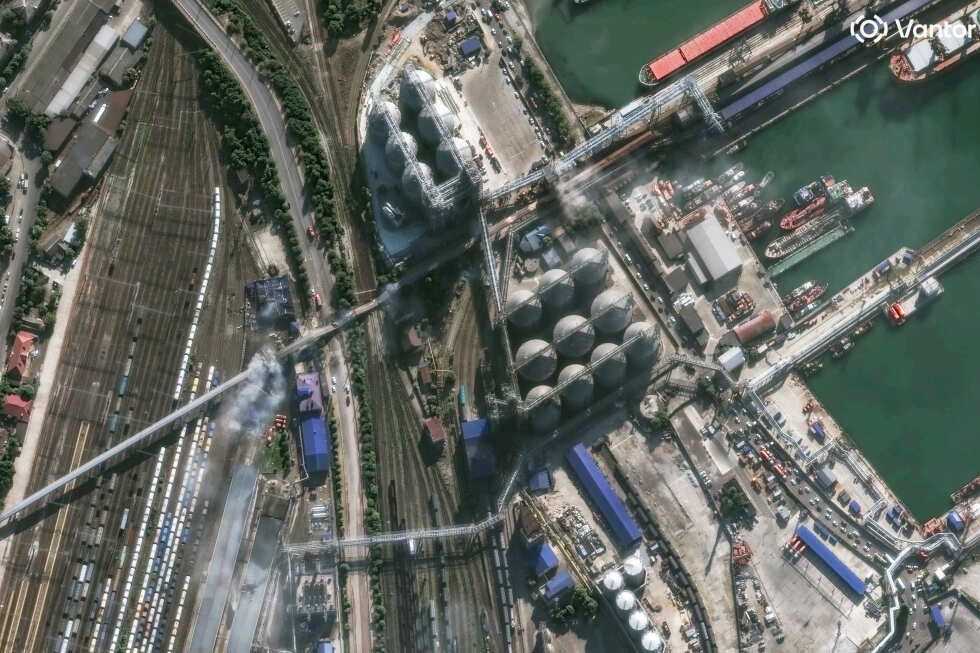
Four years into Russia’s full-scale invasion of Ukraine, Kyiv has ramped up a sustained campaign targeting Russia’s critical energy sector, carrying out the fourth deep-strike drone attack on Russian oil infrastructure in just three days, Ukrainian military officials confirmed Thursday.
As one of the world’s largest energy exporters, Russia’s oil industry forms the backbone of its national economy, funding the ongoing military campaign that has pushed slowly and at massive human and material cost deeper into Ukrainian territory. Kyiv’s strategy of disrupting Russia’s oil refining capacity aims to cut off a key revenue stream for Moscow’s war effort and force President Vladimir Putin into negotiating a peace deal, though there is currently no public evidence this objective is being achieved.
The latest target was the Gazprom Neftekhim Salavat oil refining and petrochemical complex, located in Russia’s Republic of Bashkortostan roughly 1,300 kilometers (800 miles) southeast of Moscow and 800 miles from the Ukrainian border. Ukraine’s General Staff announced via Telegram that overnight drone strikes sparked a large fire at the facility, one of Russia’s largest refining and petrochemical hubs, which processes up to 74 million barrels of crude oil annually to produce gasoline, diesel and a range of other petroleum products.
Radiy Khabirov, the governor of Bashkortostan, confirmed the attack, noting that two civilians were wounded and a fire broke out in Salavat’s industrial zone. Russia’s largest e-commerce retailer Wildberries also reported that a fire ignited at one of its unused facilities located within the same industrial zone following the strike, prompting a full evacuation of the site with no stored goods damaged.
Thursday’s attack on the Salavat refinery came just one day after Ukrainian anti-ship missiles and drones carried out a large-scale blitz on a key Russian naval stronghold along the Black Sea coast. In a separate incident Thursday in Sevastopol, the port city on Russia’s illegally annexed Crimean Peninsula, five people — four Russian Emergency Ministry explosive experts and one security guard — were killed when an unexploded Ukrainian weapon detonated as the team inspected the site of an earlier attack. To date, no independent third party has been able to verify the conflicting claims of the two warring sides.
The strike on Salavat follows a separate drone attack earlier this week on another key Russian refinery in Orsk, located in the Orenburg region near the Kazakhstan border. Orenburg Governor Yevgeny Solntsev confirmed Thursday that the Orsk facility has suspended all operations after critical infrastructure, including imported processing equipment, was damaged. In an unusual public acknowledgment of the disruption caused by Kyiv’s attacks, Solntsev noted that repairs could take up to six months due to ongoing international sanctions that limit access to replacement parts.
Russia has responded to Ukraine’s deep-strike drone campaign with intensified barrages across Ukraine, launching waves of ballistic missiles, jet-powered Shahed drones and glide bombs — weapons that are highly destructive and difficult for Ukrainian air defenses to intercept. According to United Nations estimates, these Russian strikes have killed more than 16,000 Ukrainian civilians since the full-scale invasion began.
Overnight between Wednesday and Thursday, Russian forces launched 133 long-range attack drones across Ukrainian territory, killing at least four people and wounding eight more. In the southern Odesa region, a Russian Shahed drone hit a passenger train, killing the lead engineer and his assistant, state railway operator Ukrzaliznytsia confirmed. A separate drone strike in the southern city of Kherson killed two civilians Wednesday evening, regional military administrator Oleksandr Prokudin reported.
On the diplomatic and military assistance front, Ukraine is facing growing shortages of critical air defense equipment, specifically U.S.-made Patriot interceptor missiles needed to counter Russian ballistic missile strikes. Ukrainian President Volodymyr Zelenskyy revealed in a CNN interview broadcast Wednesday that Kyiv currently has only two-fifths the number of Patriot interceptors it had in 2025, with stockpiles depleted in part by ongoing conflict tensions related to Iran. Zelenskyy noted he makes daily requests to secure additional interceptors, and has asked the U.S. to sell Ukraine 5% of its current stockpile to help Ukraine defend its power grid through the coming winter, when Russia typically intensifies strikes on energy infrastructure. To date, Ukraine has only secured 1% of the requested munitions, he said.
A new report published Thursday by Germany’s Kiel Institute, a leading organization tracking international military assistance to Ukraine, found that European countries have paid U.S. defense contractors at least 3 billion euros ($3.5 billion) for military equipment transferred to Kyiv in the first half of 2026. Overall, military aid commitments to Ukraine in the first six months of 2026 remained close to 2025 levels, but financial and humanitarian aid dropped by 41% year-over-year. The report also noted that the current U.S. administration led by former President Donald Trump has declined to provide new direct U.S. aid to Ukraine, but has permitted other allied nations to purchase U.S.-made weapons for transfer to Kyiv.