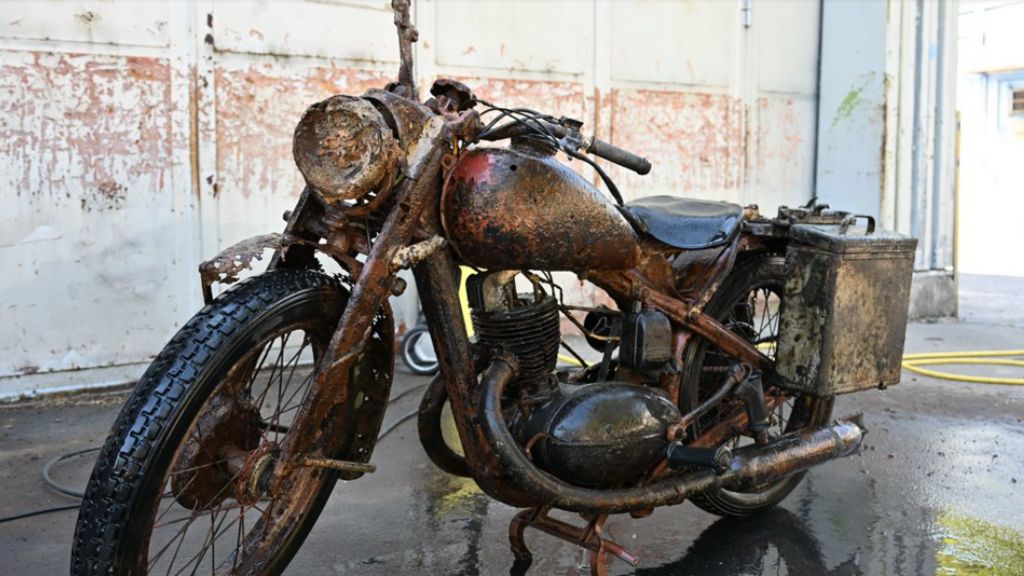
A severe, long-lasting drought across central Europe has dropped water levels in the Danube River to historic lows, uncovering a long-buried piece of World War II history in the heart of Budapest, Hungary. The German War Graves Commission (Volksbund Deutsche Kriegsgräberfürsorge), a non-profit mandated by the German government to locate, recover and properly inter German war dead across the globe, has confirmed the discovery of the remains of two German troops, alongside a remarkably preserved military motorcycle, identification tags, and other personal and military artifacts.
The first clue of the find emerged on August 2, when a pedestrian walking along Budapest’s central Danube riverbank spotted a portion of the motorcycle sticking out from exposed river rocks. Upon receiving the report, archaeological recovery teams from the German War Graves Commission moved in to excavate the site, uncovering the full remains of the two soldiers alongside a trove of well-preserved items. Along with the partial skeleton remains, crews recovered two intact military identification tags, a wedding ring, the Kuban Shield — a combat decoration awarded to German forces who fought in the Kuban campaign on the Eastern Front in 1943 — and the nearly complete Wehrmacht motorcycle. The recovery team also encountered inactive anti-tank mines at the site, forcing authorities to temporarily close the river stretch while a specialized bomb disposal unit secured the explosives.
Experts from the commission confirmed the motorcycle is a DKW NZ 350-1 model, a variant specifically mass-produced for German military use starting in 1944, near the end of the conflict. Of the two identification tags recovered, one is linked to a regular Wehrmacht soldier, while the other belongs to a member of the Waffen-SS — the military wing of the Nazi Party that was formally ruled a criminal organization for its role in systematic war crimes and atrocities during the Nuremberg Trials after the war.
A rare combination of harbor sludge and oil on the Danube riverbed created an anaerobic environment that kept many of the recovered artifacts in surprisingly good condition after nearly 80 years submerged, according to commission experts. This preservation has given researchers new hope that they can trace the identities of the two soldiers and connect with their surviving family members, many of whom have waited decades for answers about their missing relatives.
During World War II, German military protocol required identification tags to be split in half when a soldier died. One half stayed with the remains, while the other was sent to military command to register the casualty and notify next of kin. For these two troops, however, that notification never came. Their families “waited in vain” for official word of their fates, the commission said.
Arne Schrader, a representative of the German War Graves Commission, told German outlet Bild that the process of confirming identities is just beginning. “Now begins a puzzle, in which we will try to determine the identity of the two dead,” Schrader explained. While the names on the identification tags can be cross-referenced relatively quickly with the commission’s public missing persons database, researchers still need to confirm that the tags and decorations actually belong to the remains recovered at the site. Bone analysis will be a key step in verifying matches, and the commission has noted the final outcome of the investigation remains uncertain. Relatives of missing German troops from World War II are encouraged to search the commission’s online database to cross-reference names as the investigation progresses.
The discovery has resonated widely among communities of people researching the fates of their World War II ancestors, particularly on social media groups dedicated to wartime history. Many commenters have noted that while the extreme drought that exposed the site is a worrying climate event, the find offers a rare chance for closure for grieving families. “As bad as the low water level is, I am glad that bereaved families can once again be informed about the whereabouts of their relatives, and that the fallen soldiers can be given a dignified burial. Rest in peace,” one user wrote in a public Facebook group focused on tracking missing World War I and II service members.
Once the investigation is complete, the two soldiers will be interred with full dignity at the German war cemetery in Budaörs, located just outside the Hungarian capital. Budapest was the site of some of the bloodiest Eastern Front fighting in the final months of World War II, when Soviet forces pushed German troops out of Hungary in a brutal 1944-1945 siege.
This is not the only World War II relic uncovered by the Danube’s record-low water levels this year. Further downstream in Serbia near Prahovo, low water has already exposed the wrecked hull of a sunken World War II warship, a reminder of how shifting climate conditions are continuing to reveal long-hidden secrets from one of the deadliest conflicts in human history.