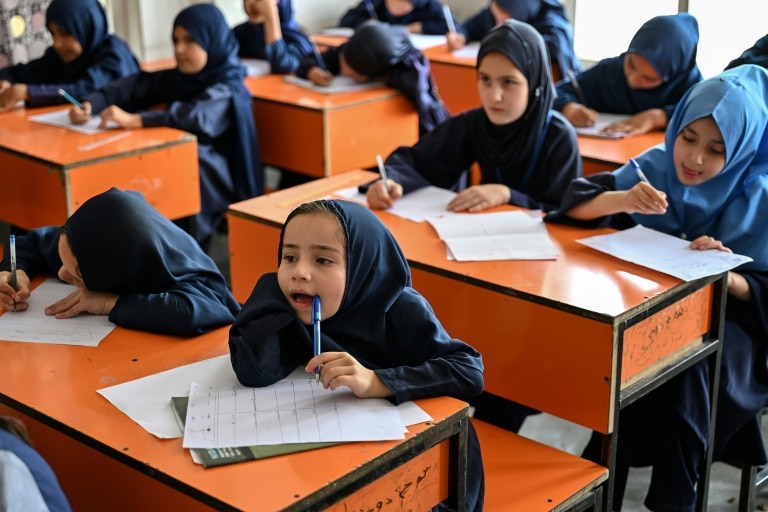
Nearly two and a half years after the Taliban retook control of Afghanistan, a devastating new tally from the United Nations Educational, Scientific and Cultural Organization (UNESCO) has laid bare the full scale of the crisis facing girls’ access to education in the country: around 2.4 million adolescent girls are now locked out of secondary schooling, a number that has climbed by 200,000 since 2023. If the current ban remains in place, that figure is projected to surge to nearly 4 million by 2030.
The policy barring girls from education beyond primary school was formally implemented in March 2022, just months after the Taliban completed its takeover of the country in August 2021. It is one of a sweeping set of restrictions the unrecognized Taliban administration has imposed on Afghan women and girls, including bans on university attendance, entry to public parks, gyms, and beauty salons. The United Nations has labeled this system of widespread gender-based exclusion as “gender apartheid”; currently, the Taliban government is only recognized diplomatically by Russia. Taliban leaders have defended the education ban by citing their own strict interpretation of Islamic law.
In a statement released Tuesday, UNESCO outlined how the restrictions have erased 20 years of gradual progress in expanding educational access for Afghan girls. When the Taliban was last in power in 2001, access to schooling for girls was almost nonexistent, but by 2021, nearly one million girls were enrolled in secondary education across the country. That progress has now been completely reversed.
“Afghanistan girls and women have the right to learn, that’s a basic human right,” said Hoda Jaberian, UNESCO’s programme coordinator for education in emergencies. “They have the right to work. They should have the freedom of movement.” The agency issued an urgent call for the immediate reversal of the ban and an end to systemic discrimination against women and girls across the country.
Beyond the immediate human cost, the education ban carries severe long-term economic consequences for Afghanistan, which is already grappling with one of the world’s worst humanitarian crises. UNESCO estimates that the cumulative loss to the Afghan economy from restrictions on women and girls’ participation will reach $9.6 billion by 2066.
The crisis extends far beyond secondary education for girls, the report adds. Afghanistan’s entire education sector is on the brink of collapse: more than half of all primary school-aged children are completely out of school, and over 90 percent of 10-year-olds in the country cannot read a simple text. Years of compounding crises have worsened these challenges, including repeated natural disasters, most notably destructive earthquakes that have damaged or destroyed hundreds of schools across the country. A lack of basic infrastructure, including drinking water, sanitation facilities, and heating in learning spaces, has also left many existing schools unfit for use. Since 2023, more than seven million Afghans have either voluntarily returned or been forcibly deported back to Afghanistan, placing additional unsustainable pressure on the already overstretched education system.