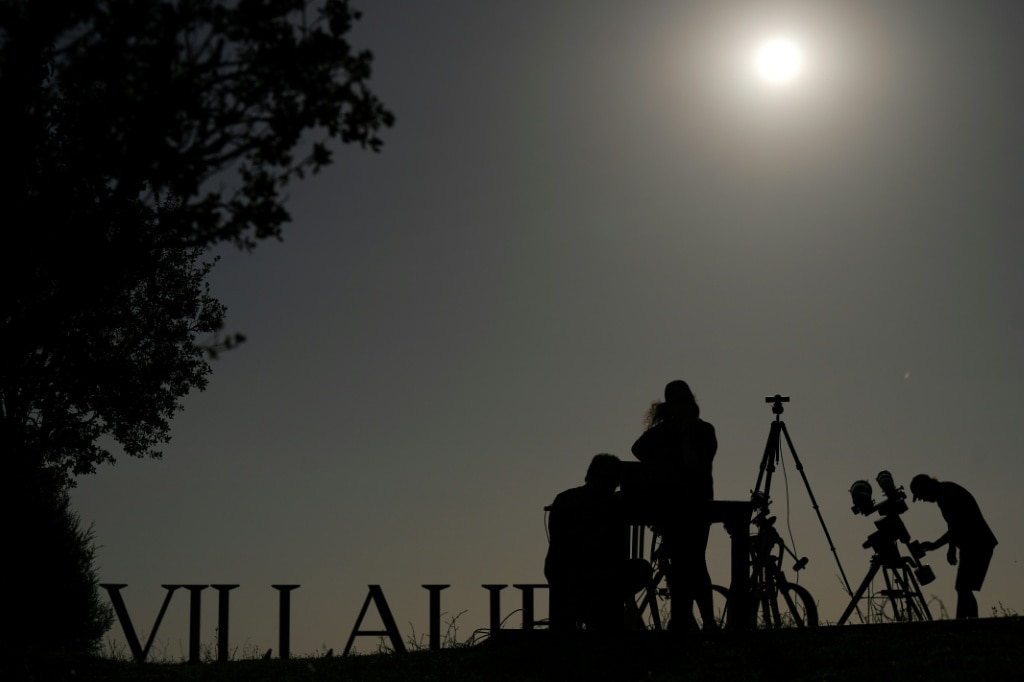
On Wednesday, a rare total solar eclipse will cut a path across parts of Europe, drawing millions of awestruck skygazers to the continent and transforming swathes of Spain into a sudden, eerie darkness in the middle of the day.
This astronomical event, the first total solar eclipse visible from mainland Europe since 2006, will begin its journey across the globe when the moon aligns perfectly between the Earth and sun around 17:00 GMT, casting its shadow over Russia’s remote northern Arctic region. From there, the shadow will arc northeast across Greenland and Iceland before reaching its most-anticipated viewing spot: mainland Spain, where the total eclipse will cross diagonally from the northern Atlantic coast to the Mediterranean Sea before fading from view around 18:30 GMT.
While only viewers along this narrow path will witness the full total eclipse, a partial eclipse will be visible to a far wider audience across most of Europe, large sections of Canada, the northern United States, and northwest Africa.
For as long as human civilization has existed, solar eclipses have provoked a vast range of emotions, from wonder to fear to reverence, as they seemingly disrupt the natural order of day and night. As the moon blots out the sun’s bright face, a dusky, unusual twilight descends, temperatures drop sharply, shadows warp into unfamiliar shapes, and many diurnal animals begin preparing for sleep as if night has fallen early. Unlike the long, drawn-out changes of a normal sunset, however, this astronomical spectacle is fleeting: for viewers in Spain, the period of total eclipse will end in less than two minutes, arriving just before sunset. Even in the longest viewing zones across Russia and Greenland, totality will last no more than two and a half minutes, while the full partial eclipse phase, from the moon’s first touch of the sun’s disk to its final exit, will extend to roughly one hour and 45 minutes.
Beyond the public excitement, the event offers planetary scientists a unique, valuable opportunity to study the sun’s faint outer atmosphere, known as the corona. Observations gathered during totality will help researchers advance their understanding of solar winds and the sun’s complex magnetic field, two key areas of study for understanding space weather that impacts Earth’s technology and climate.
Across the region, “eclipse fever” has taken hold, with dedicated eclipse chasers flocking to secure unobstructed vantage points along the path of totality, crossing their fingers for clear skies free of cloud cover, dust, or wildfire smoke that could block the view.
Weather forecasts paint a mixed picture across viewing areas. In northwestern Iceland’s Westfjords region, rain and cloud are expected to obscure the event, even as capital city Reykjavik prepares for its first total eclipse in more than 600 years, last having witnessed the phenomenon in 1433. Further south, Spain’s national weather agency AEMET predicts clear skies for most of the country, with only small pockets of cloud cover expected in northern and eastern regions.
Demand for certified solar viewing glasses, the only safe way to look directly at the partially eclipsed sun, has skyrocketed, leaving many retailers across Spain sold out of the essential protective gear. For the country, the eclipse represents a major opportunity to drive tourism revenue, particularly in depopulating rural northern regions that have struggled with declining populations and economic activity for decades.
Spain’s Economy Ministry projects the eclipse will add a net 347 million euros ($400 million) to the national economy, drawing more than 446,000 extra visitors to the key viewing zones. Quiet, little-known villages that rarely appear on standard tourist itineraries have suddenly found themselves inundated with eclipse chasers from across the globe. In the small northwestern town of Benavente, widely regarded as one of the best viewing spots in the country, all accommodation has been fully booked for weeks.
Benavente tourism office worker Laura del Teso told AFP that the town is receiving 50 inquiries a day from visitors asking about lodging, viewing spots, and parking. She added that the town has “never” hosted such a large influx of international tourists, with visitors traveling from as far as Belgium, Britain, Australia, New Zealand, the Netherlands and Germany to witness the event.
Despite the economic and excitement around the event, Spanish authorities have issued warnings about significant on-the-ground hazards tied to the expected influx of visitors. Forecasters predict temperatures will exceed 35 degrees Celsius across most of mainland Spain on Wednesday, with parts of the northeast climbing above 40C, creating major heat health risks for skywatchers who will spend hours outdoors waiting for the eclipse. AEMET also warned that most of the country faces a “very high” or “extreme” risk of wildfire, a danger amplified by thousands of visitors gathering in dry, parched rural areas and parking their vehicles along narrow country roads.
Officials estimate that as many as 1.5 million extra road trips will head toward the path of totality, straining rural transport infrastructure. Local municipalities have responded by designating dedicated public observation zones and increasing security, emergency response, and transport capacity to manage the expected crowds during the first total solar eclipse visible on mainland Spain in more than 100 years.
For eclipse enthusiasts who miss this event, the next astronomical spectacle is not far off: another total solar eclipse will cross southern Spain and northern Africa in August 2027, followed by an annular eclipse — often called a “ring of fire” eclipse, where the moon is too far from Earth to completely cover the sun’s face — that will cross the Iberian Peninsula in 2028.