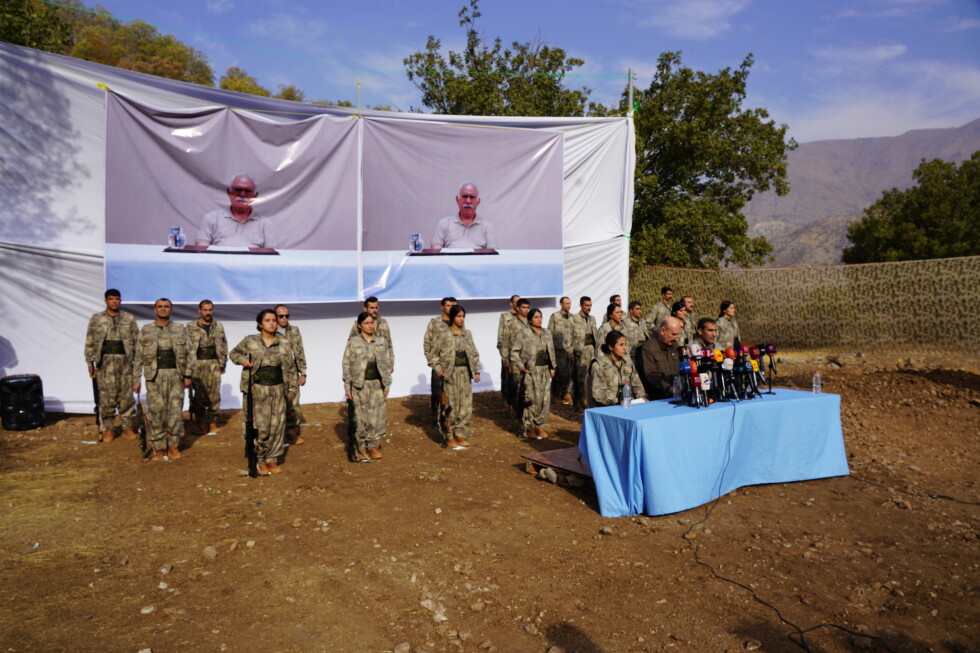
After four decades of violent insurgency that left thousands dead across southeastern Turkey, a landmark piece of legislation aimed at ending long-running conflict between the Turkish state and the Kurdistan Workers’ Party (PKK) has cleared parliament, triggering a complex mix of relief, optimism and unresolved concern among residents of the country’s majority-Kurdish southeastern region.
Lawmakers cast overwhelming votes in favor of the conditional pardon bill on Monday, a core step in advancing the ongoing peace process launched after the PKK announced last year it would lay down its arms. The legislation will not enter into force immediately: it only takes effect once Turkish authorities confirm the PKK has completed full disarmament, a key condition set by the state.
The bill outlines a clear framework for qualifying militants: it suspends prison sentences for convicted PKK members and pauses ongoing investigations and trials for other suspects for periods of five to 10 years, with the length determined by the severity of alleged offenses. If recipients do not commit any additional terror-linked crimes during the waiting period, all charges against them will be dismissed entirely. Turkish media estimates thousands of militants could benefit from the policy, including members based in exile across Europe, as well as those stationed in Iraq and Syria. Notable exceptions are militants convicted of intentional murder and those handed life sentences before 2005, a group that includes PKK leader Abdullah Ocalan and other senior figures of the organization.
The PKK first launched its insurgency in 1980s, originally seeking to establish an independent Kurdish state in southeastern Turkey. Over decades of conflict, the group shifted its goals to demanding greater autonomy and expanded rights for Turkey’s Kurdish population, which makes up an estimated 15 to 20 percent of the country’s total population. Last year, responding to a call from Ocalan—who has been imprisoned since 1999—the PKK announced it would dissolve the organization, held a symbolic disarmament ceremony at its base in northern Iraq, and withdrew its remaining fighters from Turkish territory to northern Iraq.
In Diyarbakir, the largest city in southeastern Turkey, local residents greeted the parliamentary vote with cautious optimism rooted in decades of unfulfilled hopes for peace. Many voiced expectation that the end of violence would unlock long-stalled economic growth for the region, which has long lagged behind the rest of Turkey in development and prosperity.
Seventy-year-old retired resident Ali Akdogan called the vote a moment of personal joy. “I was really very happy. I even applauded the result in my own home,” he said. “The economy will improve, good things will happen, people will start doing business. I believe it will bring peace. Since the peace process began, we haven’t had any conflict-related deaths, and this conflict killed thousands of civilians, soldiers and militants over more than 40 years.”
Hasan Gecti, a 56-year-old shop owner in Diyarbakir, agreed that an end to violence would bring tangible economic and social benefits to local communities, but warned that core political demands of Turkey’s Kurdish population remain unaddressed by the pardon bill. Kurds have long pushed for expanded rights including broader access to Kurdish-language education and public services, as well as greater political autonomy, including an end to the central government’s policy of removing locally elected Kurdish mayors and replacing them with state-appointed administrators.
“Has the Kurdish issue been directly solved? That’s a bit of a question mark,” Gecti said. “In my opinion, only the terrorism problem has been solved. Unfortunately, the Kurdish issue still remains where it is.”
Local business leaders echoed this nuanced perspective. Mehmet Kaya, head of the Diyarbakir Chamber of Trade and Industry, welcomed the broad parliamentary support for the bill as a positive signal for the region. “It signals that violence is ending and the doors of politics are opening,” he noted. But Kaya emphasized the legislation alone cannot resolve decades of political tension, adding that further targeted reforms are needed to build lasting peace.
“If the step taken now leads to sustainable democratization, and the social and economic policies the region expects are put in place, then the region will enter an important new phase,” Kaya said.
The PKK itself offered a similarly mixed assessment in a statement published Monday by the PKK-linked ANF news agency. The group framed the legislation as a “beginning” toward resolving outstanding disputes between the PKK and the Turkish state, but criticized the bill for “serious shortcomings and deficiencies.” The PKK repeated its core demands, including the immediate release of Ocalan from prison, the implementation of broad democratic reforms, and formal recognition of expanded Kurdish rights.