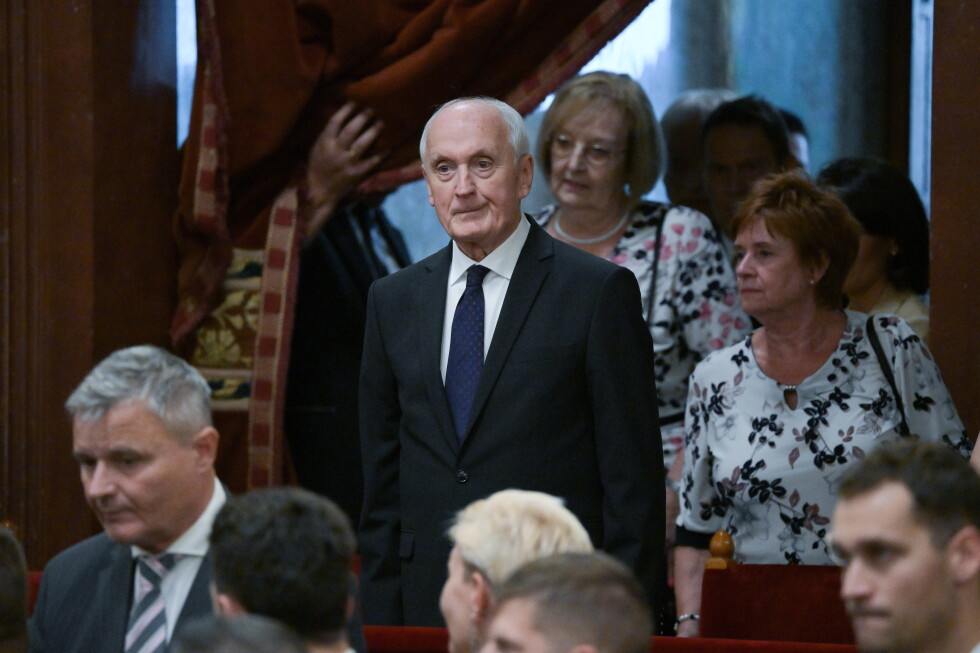
In a landmark step for Hungary’s new governing administration, the country’s national parliament voted Tuesday to confirm András Baka, a former chief justice of the Hungarian Supreme Court with a long history of pushing back against Viktor Orbán’s autocratic rule, as the nation’s new president. The vote caps weeks of political negotiation to remove an Orbán-era holdover from the presidency and advances the new government’s sweeping campaign to dismantle power structures built during Orbán’s 16 years in office.
Lawmakers from the ruling Tisza party, led by newly installed Prime Minister Peter Magyar, cast 140 votes in favor of Baka’s confirmation and just six against in a closed secret ballot, with no abstentions. Orbán’s far-right Fidesz party, which held power for more than a decade before Tisza’s landslide April election victory, boycotted the entire voting process. Baka is scheduled to be formally sworn into office on August 19.
While Hungary’s presidency is a largely ceremonial position, it carries meaningful legislative checks: the office holds the authority to send proposed legislation back to parliament for reconsideration or challenge bills before the Constitutional Court for judicial review. Baka’s ascension to the post follows a months-long power struggle to remove his predecessor, Tamás Sulyok, an Orbán nominee who retained his seat after refusing to step down at Magyar’s request. Tisza ultimately resolved the standoff by passing a constitutional amendment to end Sulyok’s term, which he reluctantly signed into law in July.
Magyar’s administration, which took office in May, has moved rapidly to dismantle what it labels Orbán’s “mafia state” by removing hundreds of political appointees and institutional leaders tied to the former prime minister’s government. Key changes so far include suspending the public television and radio news service — which Magyar has described as a state-run propaganda outlet for Fidesz — shutting down the Sovereignty Protection Office, a body widely criticized by Orbán’s opponents as a tool to intimidate government critics and silence independent media. The new government has also passed sweeping judicial reforms, established a special task force to investigate allegations of financial corruption and abuse during Orbán’s tenure, and imposed strict new term limits: 12 years for members of parliament and an eight-year cap for the office of prime minister.
Magyar’s government has framed these sweeping changes as a necessary step to restore democratic norms and institutional integrity that eroded significantly over 16 years of Fidesz rule. In response, Orbán and Fidesz have attacked the new administration’s policies as “tyrannical,” a claim that Magyar and Tisza have repeatedly rejected.
In remarks delivered to parliament shortly after his election was confirmed, Baka criticized the record of Orbán’s four consecutive governments, identifying deep social and political polarization as one of the most urgent challenges facing the country after the former leader’s long tenure. While the new president acknowledged that past cases of illegal activity and financial misuse must be properly investigated and prosecuted to repair democratic institutions, he emphasized that Hungary’s political transition cannot be rooted in retaliation.
“This country cannot build a common future while its citizens see each other as enemies,” Baka told lawmakers. “Political change should not mean that from now on people will have to be afraid, be silent, or feel like outsiders in their own country.”
Baka, 74, brings decades of legal and judicial experience to the presidency. He served as a judge on the European Court of Human Rights from 1991 to 2008, before taking on the role of chief justice of the Hungarian Supreme Court in 2009. His relationship with Orbán’s government turned bitter early, when he was removed from the Supreme Court post three years before his term was set to end. Baka challenged his dismissal at the European Court of Human Rights, which ruled in 2014 that Orbán’s government had violated Baka’s legal rights, finding his removal was directly tied to his public criticism of the administration’s controversial judicial reforms. Outside of his judicial work, Baka has also served as a visiting professor and lecturer at multiple prominent U.S. universities, including the University of Virginia, the University of California at Berkeley, and Columbia University.