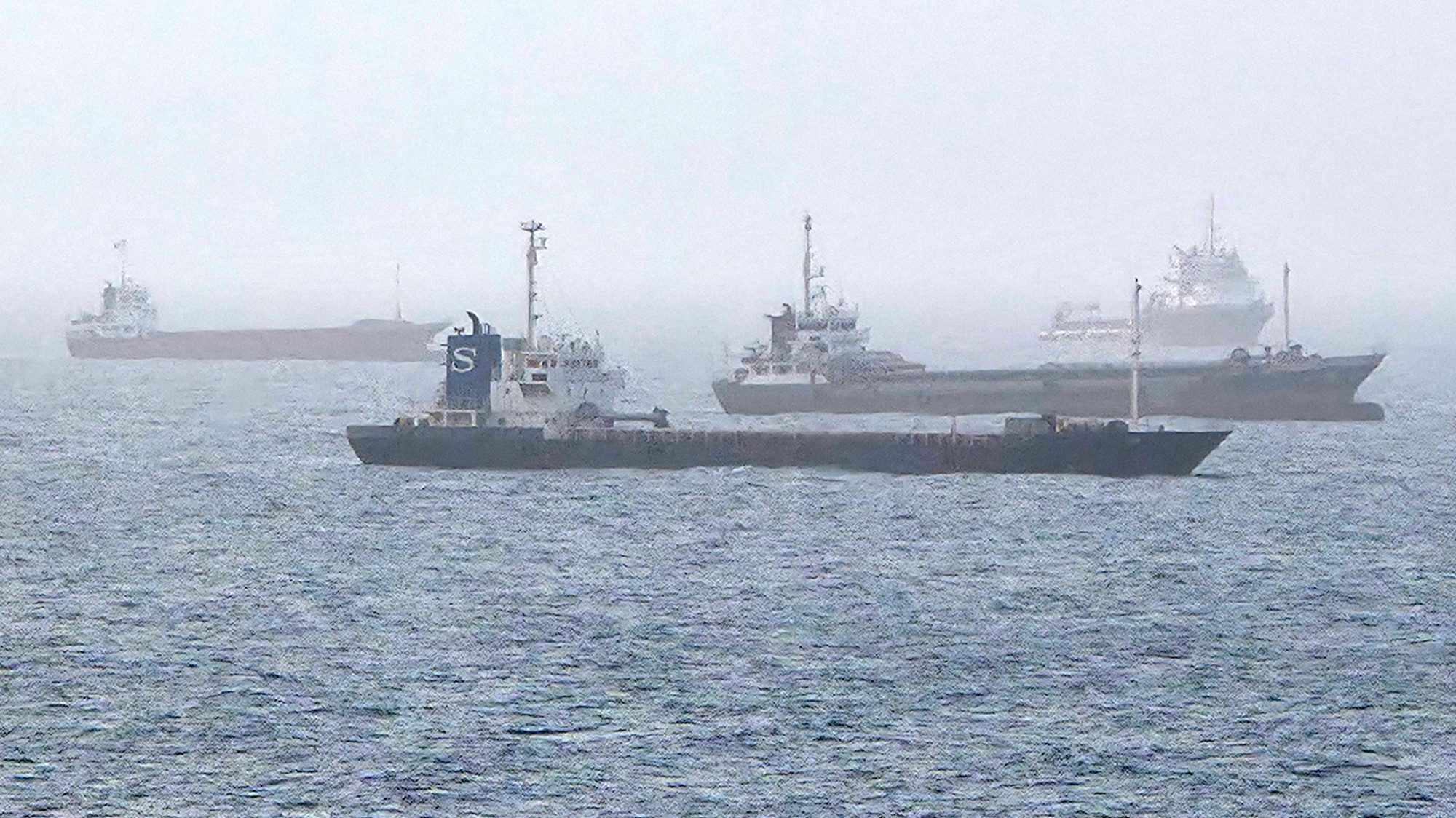
On July 25, a deadly strike on a commercial cargo ship sailing the Caspian Sea claimed the life of a young Iranian sailor and sparked fears of a dangerous widening of two intersecting global conflicts. The victim, 23-year-old Nima Moradi, was a first-generation mariner from the northern Iranian port city of Bandar Anzali, who had nurtured a childhood dream of a life at sea. He was killed when his ship, the Anna, carrying iron from Russia to Iran, was struck by a Ukrainian long-range drone. A second crew member was injured in the attack.
In a heartbreaking social media post following his son’s death, Moradi’s father Masoud captured the depth of the family’s grief, writing, “My son, I can’t believe the sadness your absence brings – you left me… we are in pain without wet tears.” In the aftermath of the strike, Iranian Foreign Minister Abbas Araghchi labeled the attack a blatant violation of the United Nations Charter, asserting it was carried out at the direction of Israel to draw European powers into the broader regional war. Israel has so far declined to issue any public comment on the accusation.
Iran initially threatened a harsh retaliation, with unconfirmed reports indicating the country planned to launch ballistic missile strikes against three targets in Ukrainian territory. Escalation was averted temporarily after Kyiv issued an official apology for the strike, though Iran continues to demand financial compensation for the fatal attack.
Analysts warn the incident is not an isolated accident, but a clear sign of Ukraine’s deliberate strategy to link its ongoing war with Russia to the U.S.-Israel conflict against Iran, raising the risk of a full merger of the two conflicts. Trita Parsi, vice president of the Quincy Institute for Responsible Statecraft, noted that Ukrainian officials have spent months building a narrative that frames Iran and Russia as fully aligned military partners, justifying treating the two conflicts as a single theater of war. Parsi added that Ukraine has long held resentment over the reallocation of Western military aid from Kyiv to Israel amid its war with Hamas, with visible examples including Patriot air defense batteries originally earmarked for Ukraine being redirected to the Middle East. “The Ukrainians knew from the outset that that war was going to come at their expense,” Parsi told Middle East Eye.
Parsi cautioned that Iran has not abandoned plans for retaliation, but has only paused its response to address other pressing priorities and avoid walking into a strategic trap that would legitimize expanded foreign involvement in the region. “I don’t believe that Iran has truly called it off. I think they’re putting a pause on it because they’re dealing with other issues,” he explained. From Kyiv’s perspective, Parsi argued, merging the two conflicts is a calculated gamble by Ukrainian President Volodymyr Zelenskyy to force direct U.S. involvement in its war with Russia – a long-held Ukrainian goal that successive U.S. administrations have rejected. The current U.S. political context, Parsi noted, has created a unique opening for Ukraine: with the Trump administration already embroiled in open conflict with Iran, Kyiv can position itself as a useful asset to Washington in exchange for increased military support.
By striking an Iranian commercial vessel in the Caspian Sea, Parsi explained, Ukraine is offering the U.S. a model of horizontal escalation similar to the tactics Iran has used against Western interests in the Persian Gulf for decades. This strategy would allow the U.S. to open a new front north of Iran, stretching Iranian military resources thin while proving Ukraine’s strategic value to Washington. The strategy also aligns closely with Israeli interests, Parsi added: a merged conflict would prolong U.S. hostilities with Iran – a core Israeli policy goal – draw European powers into direct confrontation with Iran, and allow Israel to reframe its war against Iran as a defense of Ukraine, helping repair Israel’s plummeting popularity in U.S. public opinion while reducing Israel’s own centrality in the conflict.
Israel has already conducted multiple strikes on Iranian military assets in the Caspian region in 2024, hitting Iranian naval infrastructure and assets in March and June. A Ukrainian role in strikes on Iranian targets in the region would represent a significant escalation, Parsi noted, as Ukraine’s long-range drone capabilities would add a new dimension to the conflict that carries unique weight in European capitals, where public and political sentiment is already sharply critical of Iran’s support for Russia’s war effort.
To understand the current alignment between Moscow and Tehran that underpins this conflict, experts point to a complex centuries-long history that has shifted from rivalry and hostility to pragmatic strategic partnership. Lana Ravandi-Fadai, head of the Eastern Cultural Centre at the Institute of Oriental Studies of the Russian Academy of Sciences, explained that for most of modern Iranian history, Russia was viewed not as an ally, but as an expansionist great power that seized a fifth of Iran’s 19th-century territory and repeatedly interfered in Iran’s internal affairs. During World War II, the Soviet Union joined Britain in invading neutral Iran to secure supply lines to the Soviet Union and block Nazi Germany from accessing the region’s oil reserves. Under the Western-aligned Shah of Iran in the mid-20th century, Iran began limited economic cooperation with the Soviet Union, including Soviet investment in Iranian infrastructure in exchange for Iranian natural gas exports, even as it remained a core U.S. ally.
After Iran’s 1979 Islamic Revolution, relations shifted back to open hostility: Iran’s new leadership labeled the Soviet Union the “Lesser Satan,” opposing both capitalist liberalism and Soviet atheistic communism, and condemned the Soviet invasion of Afghanistan in the 1980s. It was not until the 1990s, under the presidency of Akbar Hashemi Rafsanjani, that Iran moved toward a pragmatic, non-ideological partnership with post-Soviet Russia, signing wide-ranging agreements on economic, military and technical cooperation. That partnership deepened dramatically over the past decade, with the two states joining in a military coalition to support the Syrian government in 2015, and Iran aligning with Russia in the Ukraine war by providing Shahed drone technology. A 20-year Treaty on Comprehensive Strategic Partnership signed by the two countries in 2023 formalized their military, security and economic cooperation, a pact that reflects their shared status as states targeted by Western sanctions and their common goal of building a multipolar global order less dominated by Western powers.
Geopolitically, the Caspian Sea itself lies at the center of this new dynamic. The world’s largest inland body of water, it is bordered by Iran, Russia, Kazakhstan, Azerbaijan and Turkmenistan, and holds massive untapped offshore oil and gas reserves. The 2018 Convention on the Legal Status of the Caspian Sea bans outside powers from establishing military presence in the region, and the waterway has become a critical corridor for Russia and Iran to bypass Western sanctions and maintain trade and energy flows. “It’s a geopolitical bridge between Europe, the Middle East and Asia – whoever controls the major transport routes across the Caspian gains significant economic and political advantages,” Ravandi-Fadai noted. She warned that the spillover of the Ukraine war into the Caspian, even in isolated strikes, signals a dangerous expansion of global instability. “we are witnessing an expansion of the geography of instability,” she said.
Beyond its role as a sanctions bypass, the Caspian has become part of Iran’s broader strategy to reduce its reliance on the Strait of Hormuz, the strategic chokepoint through which a fifth of global oil supplies pass, which Iran has used to leverage pressure on Western powers. Parsi noted that the ongoing conflict has accelerated efforts by Iran and regional partners to build alternative trade routes that bypass the Strait of Hormuz, including new cross-Caspian pipelines, railways and overland trade routes connecting Iran to Central Asia, China and East Asia. Parsi projected that over the next 10 to 15 years, these alternative supply chains will reduce the strategic significance of the Strait of Hormuz, as Iran itself leads the push to diversify its trade routes and reduce its vulnerability to Western blockades.
Even with these strategic advantages, Parsi argued that Iran cannot sustain its current war effort long-term without sanctions relief, noting that limited trade with Russia, China and a small handful of other Asian states will not be enough to support Iran’s economic growth or maintain its defensive capabilities. In the weeks after the Caspian Sea ship strike, Iran demonstrated its willingness to escalate in response to the attack, launching a drone strike on the Egyptian port of Damietta. Parsi called that strike a deliberate show of force designed to deter further Western escalation in the Caspian, demonstrating that Iran possesses far greater asymmetric escalation capabilities than many Western planners had anticipated, a display that has likely given U.S. military planners pause.
The incident stands as a clear warning of the risk that separate regional conflicts can quickly become interconnected, drawing new powers into a widening cycle of violence that threatens stability across Europe, the Middle East and Central Asia.