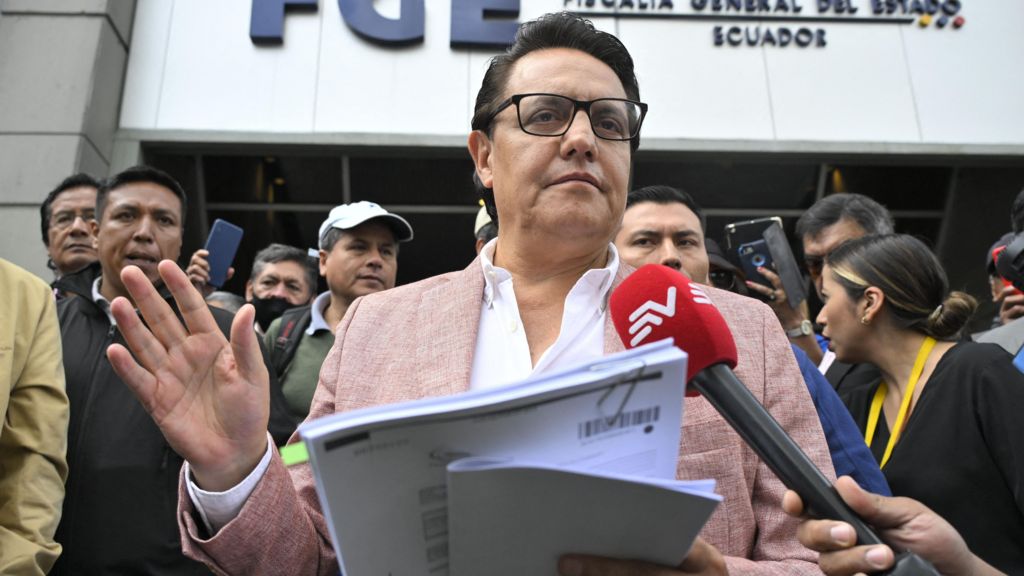
Almost three years after anti-corruption presidential candidate Fernando Villavicencio was gunned down at a campaign rally in Ecuador’s capital Quito, just days ahead of the 2023 general election, national prosecutors have unveiled new charges in the high-profile killing, implicating a former interior minister and six other co-conspirators with deep ties to organized crime.
Prosecutors formally named José Serrano, Ecuador’s former interior minister, and Wilmer “Pipo” Chavarria, the top leader of the notorious Los Lobos cartel, as key suspects in the coordinated assassination plot. The case has already seen five gang-linked defendants convicted of carrying out the killing in 2024, while Chavarria – who faked his own death to evade authorities – was captured in Spain late last year.
A former investigative journalist turned high-profile legislator, Villavicencio built his political platform on aggressive anti-graft campaigning, and stood out among 2023 election candidates for his public claims that organized crime syndicates had infiltrated senior levels of the Ecuadorian government. Despite receiving multiple death threats that prompted authorities to assign him a formal security detail, Villavicencio continued to attend open campaign events ahead of the vote, refusing to curtail his public engagement.
In the aftermath of the assassination, the 2023 election proceeded, and Daniel Noboa – a center-right business leader – claimed victory, subsequently assuming the presidency. Noboa has since taken an uncompromising, military-led hardline approach to crack down on the violent drug cartels that have destabilized the country in recent years.
In the original investigation into Villavicencio’s death, the alleged trigger puller was shot dead by security forces at the scene of the attack, and six other men initially detained in connection with the killing were later found murdered in a Ecuadorian prison while awaiting trial, a chilling sign of the cartel’s reach into state institutions. Five other co-conspirators were convicted of organizing the hit in 2024.
Announcing the new charges Saturday, Ecuador’s Attorney General’s Office confirmed that all seven newly accused are alleged to have played indirect, enabling roles in the assassination. The majority of the suspects hold confirmed ties to Los Lobos, also known as “The Wolves,” one of the most powerful and violent criminal gangs operating in Ecuador. Five of the seven charged remain at large as fugitives, authorities confirmed.
As of the latest update, Serrano and former official Xavier Jordán are believed to be residing in the United States, while ex-assemblyman Ronny Aleaga is located in Venezuela. Chavarria remains in Spanish custody, where Ecuador has submitted a formal extradition request that is still pending. The Attorney General’s Office has already requested Interpol red notices – the international law enforcement community’s highest-level alert for wanted fugitives – to secure the capture and extradition of all suspects at large.
One of the seven accused, Ángel Esteban Aguilar, a senior Los Lobos figure also known as “Lobo Menor” (“Little Wolf”), was arrested by law enforcement in Mexico City back in March after fleeing Ecuador. He was swiftly returned to Ecuador to face charges following the issuance of an Interpol red notice. Aguilar has a long criminal history: he was originally sentenced to 20 years in prison in 2013 for the murder of Serrano’s brother, but he fled the country after being granted parole. The final named accused is Luis Arboleda, another high-ranking member of the Los Lobos cartel.
Pre-trial hearings are currently underway in the case, and a judge will review the evidence presented by prosecutors to determine whether there is sufficient basis to move forward with a full public trial.
The assassination of Villavicencio unfolded against a backdrop of rising gang violence and drug trafficking instability across Ecuador. The country’s geographic position, wedged between Colombia and Peru – the world’s two largest producers of cocaine – has made it a critical transit hub for illicit drug shipments heading to North America and Europe. Transnational cartels including Los Lobos have relied on widespread corruption and brutal violence to seize control of key smuggling routes, and law enforcement investigations confirm the group maintains deep operational ties to the Jalisco New Generation Cartel, one of Mexico’s most powerful criminal organizations.