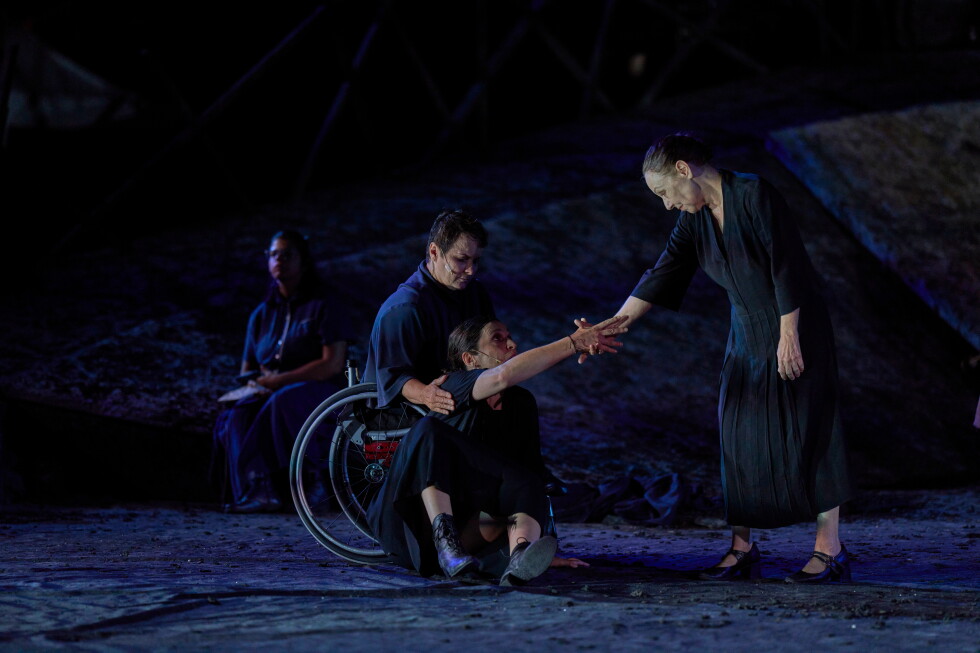
Against the backdrop of a global resurgence of interest in Homer’s ancient works sparked by Christopher Nolan’s recent adaptation of *The Odyssey*, a groundbreaking theatrical production in southern Greece is rewriting the rules of cultural accessibility, while centering a forgotten chapter of the Trojan War narrative.
On August 2, 22 disabled and non-disabled performers took the stage at the Ancient Theater of Epidaurus, the iconic 2,300-year-old open-air stone amphitheater famed for its unparalleled acoustics and historic place in Greek dramatic tradition. Their staging of Euripides’ *The Trojan Women* marked the first fully accessible performance in the theater’s long history, breaking down centuries of barriers that excluded disabled audiences and creators from engaging with one of the world’s most celebrated cultural sites.
Unlike Homer’s canonical epics, which follow victorious Greek warriors on their journeys home from the 10-year Trojan War, Euripides’ 5th-century BCE tragedy shifts focus away from heroic triumph to the devastating human cost of conflict. Written roughly three centuries after Homer’s works, the play centers on the widowed, exiled, and enslaved women of conquered Troy, giving voice to the suffering that war leaves in its wake.
To fulfill the production’s commitment to full inclusion, organizers rolled out a comprehensive suite of accessibility accommodations across the entire site. Blind and low-vision attendees received Braille event programs, tactile 3D models of the ancient theater, and live in-person audio description to follow the performance. Deaf and hard-of-hearing spectators could track dialogue via overhead projected titles, while widespread physical modifications to the venue’s walkways and seating areas improved access for visitors with mobility impairments.
For attendees and creators alike, the milestone event was far more than a theatrical performance—it was a public celebration of disability equality. Greg Polychronidis, a Paralympic gold medalist who participated in the event, noted that the production set a critical precedent for cultural institutions worldwide. “It’s the first time a performance at Ancient Epidaurus has been made accessible to everyone,” Polychronidis said. “Today was a celebration of equality and it should serve as an example for everyone, forever.”
The message of inclusion extended to the cast as well, where disabled performers held prominent roles that put overlooked communities center stage. For 58-year-old cast member Eirini Kourouvani, a wheelchair user who had never been able to enter the ancient theater before the production, standing on its historic stage was a transformative experience. “It is just grand,” Kourouvani said. “I feel my heart opening up as wide as this theater is.”
Ioanna-Maria Gertsou, a blind psychologist who attended the performance alongside her guide dog Babu, echoed that sentiment, emphasizing that accessibility is a fundamental right, not an extraordinary favor. “We too have the right to attend performances on an equal footing,” Gertsou said, noting her relief that her guide dog was able to remain with her throughout the show without disruption.
The landmark production was created by Greece’s National Theater, with accessibility design led by the nonprofit organization Liminal and financial backing from Alpha Bank, one of Greece’s largest financial institutions. Argyro Chioti, the National Theater’s artistic director, emphasized that full accessibility should not be a one-off special event, but the new standard for all major cultural venues.
Chioti acknowledged that building inclusive access required extensive advance work: “This was complex, not simple. It required months of planning. It cost money. And it required very specific organizational expertise. But that’s the standard and venues we need to reach — the major stages and the major theaters.”