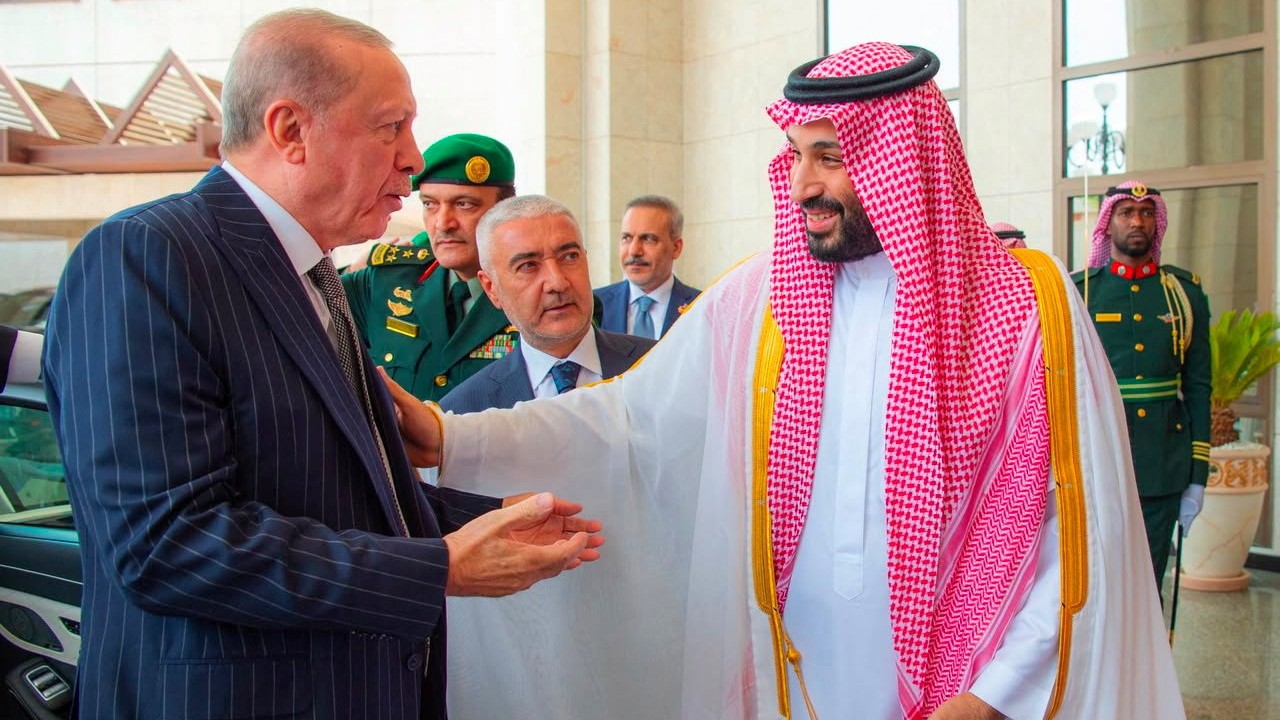
In a moment laden with religious and geopolitical symbolism, the leaders of three major Muslim nations gathered this week in Islam’s holiest city of Mecca to perform Friday prayers together, capping years of gradual reconciliation and marking a new chapter in regional security cooperation. Turkish President Recep Tayyip Erdoğan, Saudi Crown Prince Mohammed bin Salman Al Saud, and Pakistani Prime Minister Shehbaz Sharif joined the collective worship at the site, a public display of unity that follows years of strained ties between Ankara and Riyadh.
The symbolic prayer service comes on the heels of a landmark breakthrough: the signing of a historic trilateral joint defense agreement between the three countries, which for the first time places the three regional powers under a unified security framework. While Pakistan has long maintained warm, stable diplomatic and economic ties with both Saudi Arabia and Turkey, the relationship between Ankara and Riyadh has been defined by centuries of rivalry and decades of alternating détente and open rupture.
To understand the gravity of this week’s developments, it is necessary to trace the long, fraught history of relations between the two nations. Tensions over claims to leadership of the global Sunni Muslim community date back to the founding of both modern states in the early 20th century, with roots stretching even further to the 19th-century Ottoman-Saudi war, when Ottoman forces crushed an early Saudi expansion across the Arabian Peninsula. When the Ottoman Empire collapsed after World War I, the House of Saud defeated local rivals to seize control of Mecca and Medina in 1925, ending more than 350 years of continuous Ottoman rule over Islam’s two holiest sites. Formal diplomatic relations between the newly established Kingdom of Saudi Arabia and Republic of Turkey were not established until the 1930s, and the two sides maintained generally cordial ties for decades after: both backed Iraq during the 1980s Iran-Iraq War (with Saudi support far more public) and aligned with the United States during the 1991 Gulf War.
Even during this period of calm, however, low-level frictions persisted. Turkey repeatedly criticized Saudi Arabia for demolishing historic Ottoman-era sites across the kingdom, including fortresses, cemeteries, and 19th-century railway infrastructure. The most high-profile dispute came in 2002, when Turkey’s culture ministry condemned the demolition of the 220-year-old Al-Ajyad Fortress, which overlooked Mecca’s Grand Mosque. Turkey’s then-parliament speaker called the destruction “sinful behaviour in breach of the moral values of Islam”, but Saudi Arabia defended the move as a exercise of its sovereign right to redevelop the site to accommodate growing numbers of religious pilgrims. The site was later redeveloped to house the Mecca Clock Tower, one of the tallest structures in the world.
This era of cordiality, interrupted only by minor disputes, collapsed into deep strategic disagreement after the 2010 Arab Spring. While both Riyadh and Ankara backed efforts to oust longtime Syrian dictator Bashar al-Assad, their approaches to regional uprisings diverged sharply across the Middle East. In Egypt, Turkey openly supported the first democratically elected president Mohamed Morsi and fiercely condemned the 2013 military coup led by Abdel Fattah el-Sisi, a close ally of Saudi Arabia. For years after the coup, Ankara hosted Egyptian opposition media outlets and dissident groups, and Erdoğan refused to recognize Sisi’s government, calling for the release of tens of thousands of political prisoners.
Strategic rifts widened across the region in subsequent years. During the 2017 Saudi-led blockade of Qatar, which accused Doha of supporting terrorism and meddling in regional affairs, Ankara sided openly with Qatar and deployed military forces to the Gulf state. In post-revolution Libya, where power fractured into rival factions after 2011, Turkey backed the internationally recognized government in Tripoli, while Riyadh threw its support behind eastern-based warlord Khalifa Haftar. Tensions boiled over into open hostility in early 2018, when Mohammed bin Salman labeled Turkey part of a “triangle of evil” alongside Iran and extremist religious groups.
Relations hit their modern lowest point later that year, following the killing of veteran Saudi journalist Jamal Khashoggi, a former contributor to Middle East Eye, who was murdered by Saudi operatives inside the Saudi consulate in Istanbul in October 2018. Turkish prosecutors indicted 20 Saudi citizens over the killing, building a case based on phone records, entry and exit logs, witness testimony, and analysis of Khashoggi’s personal devices. Erdoğan publicly stated the killing had been ordered at the “highest levels” of the Saudi government. In the years that followed, Riyadh imposed an unofficial boycott on Turkish goods that saw Turkish exports to Saudi Arabia plummet 92% year-on-year in 2021, after systematically pressuring local businesses to drop Turkish products from store shelves. Both sides also blocked each other’s state media outlets.
After more than four years of open rupture, Ankara and Riyadh formally ended their dispute in 2022, as part of a broader wave of regional rapprochement led by Saudi Arabia. That June, Mohammed bin Salman traveled to Ankara for his first visit since Khashoggi’s killing, meeting Erdoğan at the presidential palace and agreeing to deepen cooperation across trade, defense, energy, and tourism. A key concession from Turkey that cleared the way for reconciliation was the transfer of the Khashoggi murder trial to Saudi courts, meeting a core Saudi demand for restoring ties.
The reconciliation between Ankara and Riyadh fits into a broader regional shift: Saudi Arabia has moved to end disputes across the Middle East in recent years, including ending its three-and-a-half-year rift with Qatar, launching peace talks with the Houthi movement in Yemen, and restoring full diplomatic relations with Iran in a 2023 deal brokered by China. For Turkey, mending ties with oil-rich Gulf states was also an economic priority, as Ankara grappled with a collapsing national currency and widespread economic instability. Since the 2022 reconciliation, the two sides have signed a series of major deals on technology, defense, and renewable energy, highlighted by a 2023 Saudi agreement to purchase Turkish drones in what remains the largest defense contract in Turkey’s history.
In recent months, growing strategic alignment on regional issues has pushed the two countries even closer. In Syria, both now back the new government led by Ahmed al-Sharaa and have joined forces to lobby the United States to lift crippling sanctions on Damascus. In Libya, once a point of sharp division, both now back the internationally recognized unity government. In war-torn Sudan, both Riyadh and Ankara support the Sudanese Armed Forces led by Abdel Fattah al-Burhan, while the UAE backs the rival Rapid Support Forces. In Somalia, too, Ankara and Riyadh stand together in supporting the internationally recognized central government, while the UAE backs Somaliland’s bid for independence. Notably, a growing public rift has emerged between Saudi Arabia and its one-time closest Gulf ally the UAE, with Turkey increasingly aligned with Riyadh on these issues, even as Ankara avoids taking an open public stance to protect its own substantial financial ties with Abu Dhabi.
This week’s joint prayer service and historic defense pact cement the completion of a years-long reconciliation process, reshaping the geopolitical landscape of the Middle East and creating a new trilateral security bloc connecting South Asia, the Anatolian Peninsula, and the Arabian Gulf.