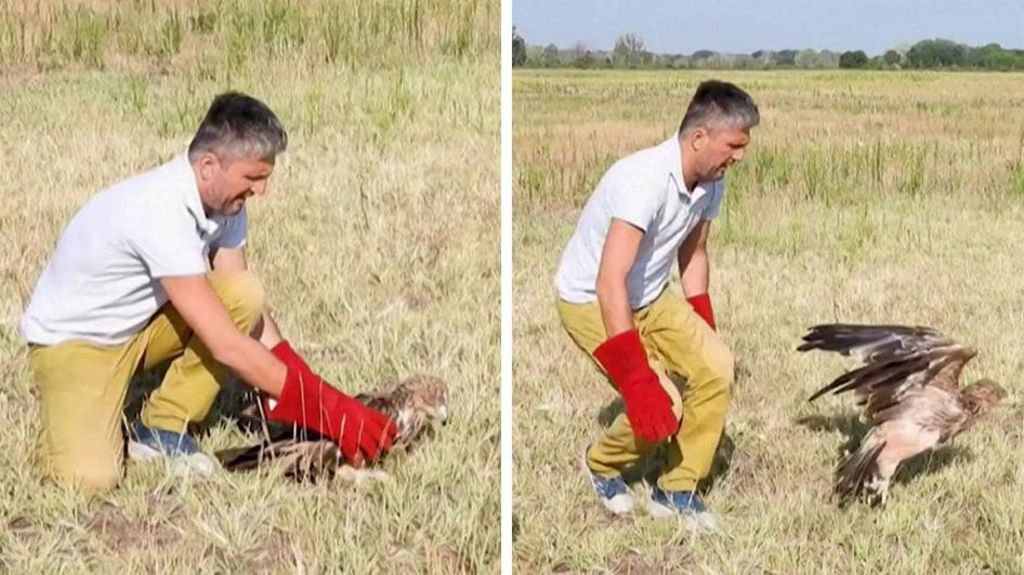
A remarkable journey of conservation and cross-border cooperation has ended with the successful release of a rare, critically endangered eastern imperial eagle back into its natural habitat in Serbia, months after the bird was snatched by poachers in the Middle East.
Named Feliks by conservationists, the young raptor fledged from its nest in Serbia in July 2025. As part of ongoing species recovery efforts, experts from the Bird Protection and Study Society of Serbia (BPSSS) fitted the bird with a tracking device to monitor its migratory movements. When the young eagle began flying toward the Middle East, conservation teams immediately grew concerned about the risks it faced in the region, where illegal wildlife trafficking is pervasive.
By October 2025, Feliks’ tracking signal cut out entirely. At first, teams assumed the issue was a faulty tracking device, but they soon made the grim discovery that the bird had been captured by poachers in Syria, who later attempted to sell the protected animal. Following weeks of silence, a partner wildlife organization in Lebanon reached out to BPSSS to confirm that Feliks’ captors were demanding a ransom for his safe return. Rejecting the demand outright to avoid fueling the illegal wildlife smuggling network, BPSSS entered into months of protracted negotiations to secure the eagle’s release without paying.
According to reports from the Associated Press, the delicate handover saw refugees smuggle Feliks across the Nahr al-Kabir river, which forms the northern border between Syria and Lebanon, hidden inside a potato sack. Once in Lebanon, the bird was transferred to a specialized wildlife rehabilitation center in Beirut, where he received veterinary care and spent more than six months recovering from his captivity.
In June 2026, Serbian peacekeepers deployed on a peacekeeping mission in Lebanon arranged to repatriate Feliks back to Serbia aboard a military transport plane returning from the region. The bird arrived exhausted at Palic Zoo’s wildlife shelter in Serbia, where zookeepers and conservationists monitored his health daily for more than a month as he regained his strength ahead of release.
The successful rescue of Feliks comes alongside major progress in the recovery of the eastern imperial eagle, a protected species classified as critically endangered. BPSSS data shows that targeted conservation efforts launched in 2017 have grown Serbia’s wild population from just a single breeding pair to 29 breeding pairs as of 2026, marking one of the most successful species recovery initiatives for the raptor in Europe.
After completing his recovery, Feliks was officially released back into the wild on Thursday. Conservation leaders expressed hope that the young eagle will thrive, establish his own breeding territory, and contribute to the ongoing growth of Serbia’s recovering eastern imperial eagle population. In the coming weeks, experts will continue to closely monitor Feliks’ movements and behavior via his tracking device to ensure he readjusts successfully to life in the wild.