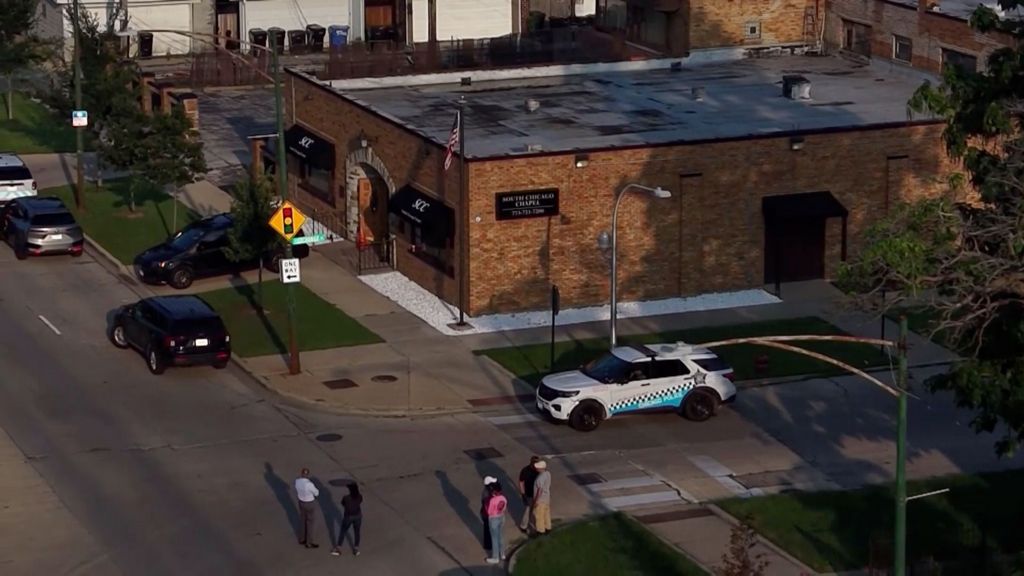
A shocking discovery at a Chicago funeral home has left dozens of families in agonizing uncertainty, as investigators launched a painstaking process to identify improperly stored remains found in deplorable, unrefrigerated conditions. The Cook County Medical Examiner’s Office, leading the multi-agency investigation, confirmed Thursday that nearly 60 bodies were located at South Chicago Chapel, left in various stages of decomposition amid documented rodent and maggot infestations. Investigators worked through the overnight hours to transport all remains to secure facilities to begin the identification process, which officials warn could take multiple days to complete.
According to regulatory records obtained by CBS News, the BBC’s media partner, the funeral home’s director Johanna Morgan intentionally allowed multiple decedents to be stored in an unrefrigerated space with unsanitary conditions that accelerated decomposition and attracted pests. In response to the findings, the Illinois Department of Financial and Professional Regulation (IDFPR) has suspended Morgan’s funeral director license. The facility has not responded to multiple requests for comment from the BBC.
The case has already raised questions about regulatory gaps, as the operation of South Chicago Chapel has ties to a prior mishandling incident involving the Morgans. Public records show that Clark Morgan, Johanna Morgan’s husband and the listed president of South Chicago Chapel, had his own funeral director license revoked in 2024. Clark Morgan previously owned and operated Heights Crematory, another Chicago-based facility that was shut down in 2025 after investigators also uncovered mishandling of human remains there. Michael Sharkey, general counsel at the Illinois Funeral Directors Association, told the BBC he was the one who initially reported the Heights Crematory incident last year, and he questioned why regulatory officials did not increase scrutiny of the Morgans ahead of the latest discovery.
“It is extremely disturbing that the same individuals who appear to be involved with the events at South Side Chapel are the same persons,” Sharkey said in a formal statement. He added that while he believes the IDFPR has performed well overall, the repeated failures by the same operators point to gaps in proactive oversight.
For local families already grieving, the discovery has turned mourning into fear and uncertainty. Patrice Halliburton told CBS News Chicago that she arranged for her late sister Melody to be cremated at South Chicago Chapel, but now has no way to confirm whether the ashes she received actually belong to her loved one. “We don’t know if Melody is in there or not,” Halliburton said. “So right now, we’re more fearful… than we are angry. I’d rather save that anger for later when we know for sure what’s going on.”
The Chicago incident is the latest in a string of high-profile mishandling cases across the United States that have reignited calls for stricter, more consistent regulation of funeral homes. Currently, oversight of the funeral industry is split between federal and state authorities: Federal Trade Commission rules mostly govern pricing transparency and consumer contract requirements, while day-to-day operational standards for handling remains are set entirely by individual states.
Sharkey explained that Illinois already has relatively strict rules for handling decedents, including requirements that each body be stored separately rather than stacked, and that a written chain of custody log must be maintained to track every movement of a remain after it enters a funeral home’s care. State regulators are authorized to audit these logs and conduct routine inspections of facilities, though Sharkey acknowledged that consistent enforcement remains a challenge.
Regulatory frameworks vary widely across the country, with some states requiring no licensing for funeral home operators at all. In 2023, nearly 200 bodies were discovered at the Return to Nature funeral home in Colorado, a state that did not require operators to hold a license at the time of the incident. In response to that case, Colorado will implement new mandatory licensing requirements for funeral operators starting in January 2027. Similar high-profile cases have been reported internationally: in the United Kingdom, a funeral director was sentenced to 20 years in prison after authorities discovered dozens of improperly stored bodies and half a tonne of unprocessed ashes at his facility, a case that inflicted years of trauma on affected families and sparked widespread calls for regulatory reform.
Dan Ford, president of the U.S. National Funeral Directors Association, expressed deep sorrow over the Chicago incident in a statement to the BBC. “I am absolutely heartbroken over what has happened here,” Ford said. “I feel for everybody that’s affected, all the families and loved ones who are now facing this additional pain after losing someone they care about.”