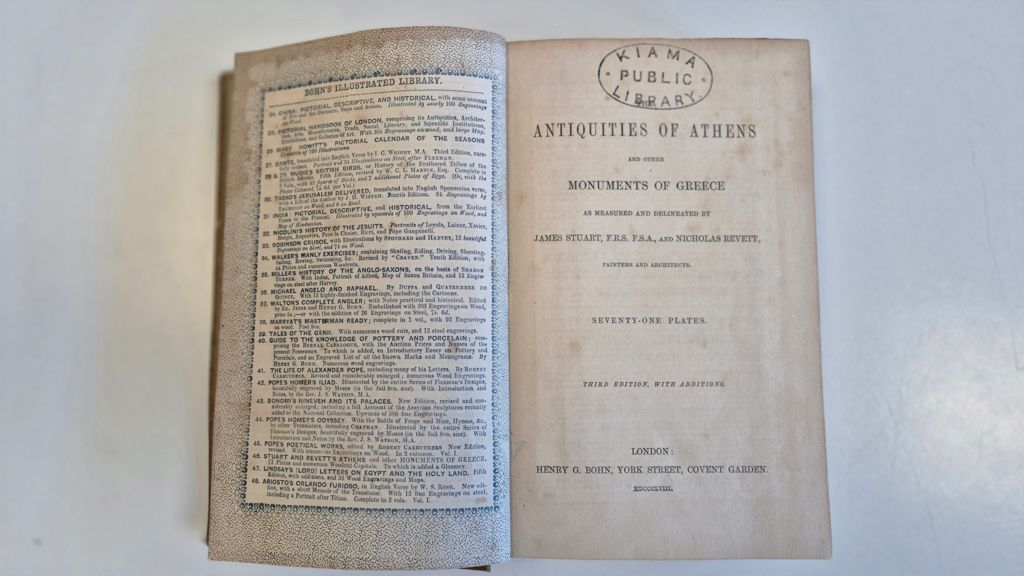
More than a century and a half after it was first checked out, a rare 19th-century architecture book has found its way back to the small coastal Australian library it was borrowed from — and its unlikely journey traces back to a stonemason who helped build one of London’s most iconic landmarks.
The volume, *Antiquities of Athens*, a detailed illustrated reference on classical Greek architecture, was borrowed from Kiama Library in the 1870s. Kiama, a quiet seaside town located roughly 120 kilometers south of Sydney, had only opened its public library eight years prior, built with a £200 government grant that launched the institution’s original collection of fewer than 1,000 books. This particular volume, cataloged as item number 506, would disappear from the library’s records for generations.
The story of its rediscovery begins with 77-year-old Ross Simmons, a dedicated amateur family historian who has spent years unpacking the legacy of his great-grandfather, John Simmons. Born in the United Kingdom, John Simmons trained as a stonemason in Westminster between 1839 and 1844, and worked as an apprentice on the construction of the UK Houses of Parliament before emigrating to Australia in 1857 at the age of 27. After settling first in Sydney’s Newtown suburb, he moved permanently to Kiama after leading the construction of a local sandstone church, establishing himself as a respected architect in the region.
Ross Simmons explains that his great-grandfather, who had a deep professional and personal passion for architecture, likely borrowed the reference volume to support his work. For decades after John Simmons’ death, the book sat undisturbed in a wooden tea chest stored alongside other family documents, tucked into a boarded-up fireplace in the old family home. The sealed hiding place kept the volume safe for generations, until a home renovation 30 years ago unearthed the chest, and the collection of books inside was passed to Ross Simmons for safekeeping.
It was only two weeks ago that Simmons finally sorted through the full collection, and made a surprising discovery: inside the front cover of the 1858-published *Antiquities of Athens*, a clear Kiama Library stamp was visible, alongside the library’s original 19th-century borrowing rules. Those rules offer a fascinating window into 1870s public library practices: patrons could normally only check out one book at a time, unless they could prove six members of the same household were literate, which allowed a limit of three books; intoxicated patrons were banned from borrowing, and late returns incurred a fine of three pence per week overdue.
When library staff calculated the total fine accumulated over 150 years, adjusted for inflation, the total came out to roughly AU$28,000 (equivalent to around £15,000 or $20,000 USD). In an act of good faith, the library has completely waived the unexpected fine, recognizing the historic significance of the returned volume.
While the library’s original borrowing records from the 1870s have been lost to time, so there is no definitive proof that John Simmons was the one who checked the book out, the circumstantial evidence strongly points to him. Today, the book remains in surprisingly good condition: it has minor water damage from its decades in the fireplace, but its detailed fold-out illustrations of Greek monuments, complete with the original precise measurement notes, are still intact.
Kiama Council libraries manager Michelle Hudson says the extraordinary story of the book’s return has drawn widespread public interest, with visitors traveling from more than 40 minutes away just to see and even handle the historic volume. The library has now added *Antiquities of Athens* to its special collections archive, meaning it will no longer be available for checkout to prevent another century-long disappearance. “We don’t want to wait another 150 years for it to come back,” Hudson joked.
For Ross Simmons, the book’s homecoming feels like the perfect end to a long, unlikely journey. “I think he’d be happy to see the book returned and he’d probably have a bit of a laugh about it,” he said of his great-grandfather.