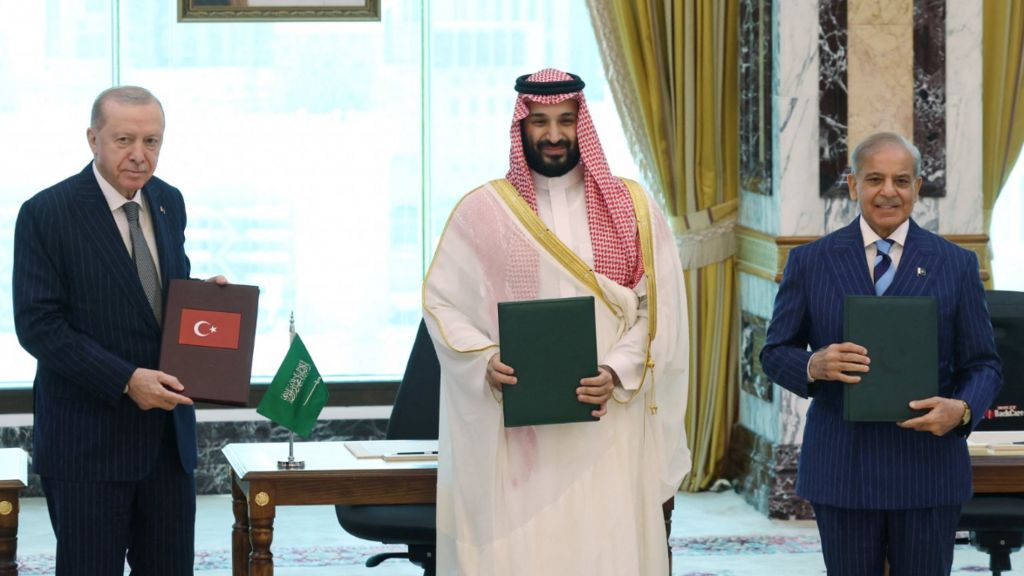
Against a backdrop of simmering regional conflict that has disrupted critical global energy shipping lanes and dragged neighboring states into rising violence, three major Sunni Muslim nations have formalized a new collective security agreement. In a ceremonial signing held in the holy Saudi city of Mecca, Saudi Crown Prince Mohammed bin Salman, Turkish President Recep Tayyip Erdogan, and Pakistani Prime Minister Shehbaz Sharif put their signatures to the historic Mecca Joint Defence Agreement.
The core commitment of the new pact is clear: any armed aggression against one of the three signatories will be treated as an attack against all three nations. Beyond this mutual defense guarantee, the agreement also lays out a framework to deepen collaboration across all areas of defense cooperation, with the explicit goal of strengthening collective deterrence against external threats. However, the document stops short of outlining specific, binding obligations for each member state, leaving details of how the pact will operate in practice still undisclosed. A senior Turkish official speaking to Reuters emphasized that the agreement is strictly defensive in its purpose and scope.
This new trilateral agreement builds on a bilateral defense pact that Saudi Arabia and Pakistan agreed to one year ago, expanding the existing security partnership to include Turkey. The three nations bring complementary strengths to the alliance: Saudi Arabia contributes substantial financial resources and stands as one of the world’s largest importers of advanced military hardware; Turkey, NATO’s second-largest standing military force, boasts a robust and advanced domestic defense manufacturing sector; and Pakistan brings nuclear deterrence capability to the coalition.
The pact comes amid rapidly escalating instability in the Middle East, rooted in ongoing conflict between the United States and Iran that has spilled over to disrupt critical maritime trade routes. The Strait of Hormuz, through which roughly a fifth of global oil supplies pass, and the Red Sea have both seen major disruptions to shipping since hostilities flared. Following joint US-Israeli strikes on Iran in late February, Iran and its allied militias launched retaliatory attacks on targets across Saudi Arabia and other Gulf states, and blocked commercial shipping transiting the region. Pakistan stepped in as a neutral intermediary, hosting ceasefire talks between the two sides that produced a temporary pause in fighting, but hostilities have since reignited.
Though Saudi Arabia has long sought to avoid direct entanglement in the broader US-Iran conflict, repeated attacks from Iranian-aligned groups forced the kingdom to respond. After coming under attack from multiple directions, Riyadh joined the US in joint airstrikes last month against Iranian proxy militias in Iraq that it accuses of launching repeated drone strikes against Saudi targets. In neighboring Yemen, the Iran-backed Houthi movement, which controls large swathes of northwestern Yemen, has stepped up attacks: the group announced a formal maritime embargo against Saudi Arabia last month, and has launched strikes targeting Saudi airports, critical oil infrastructure, and commercial tankers operating in the Red Sea. In response, Saudi Arabia has launched counter-strikes against Houthi military positions and joined a new international naval coalition tasked with protecting commercial shipping in the Red Sea and Gulf of Aden.
For the three signatory nations, the new defense pact represents a coordinated effort to bolster collective security at a moment when regional tensions show no sign of de-escalation, and the United States faces growing challenges managing the spillover effects of the Iran conflict across the Middle East.