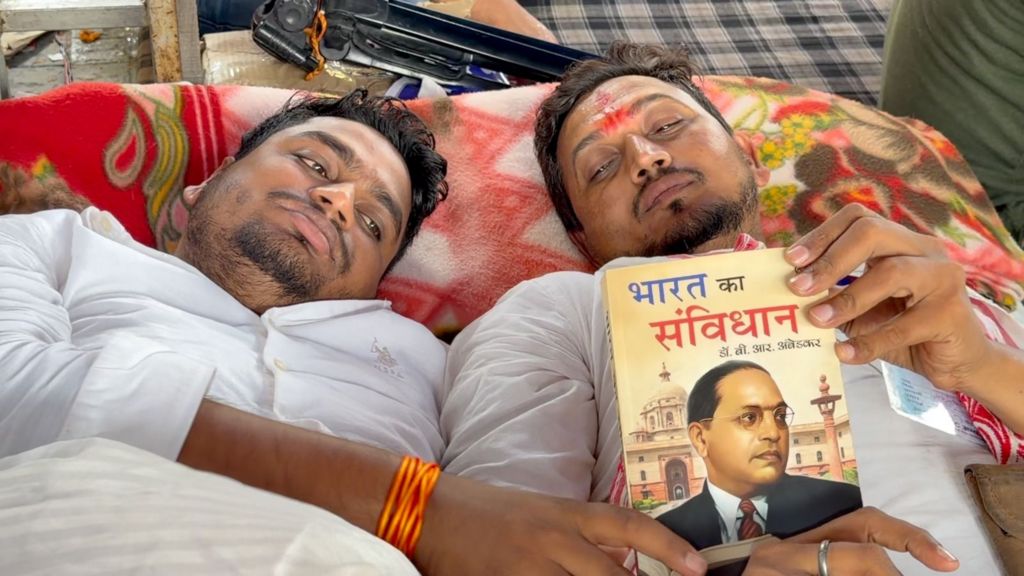
Weeks after mass youth protests over examination paper leaks swept the national capital New Delhi, a new wave of grassroots anger over flawed government recruitment processes has erupted in India’s eastern state of Jharkhand, where dozens of student and job seekers have launched an ongoing hunger strike in the state capital Ranchi.
Since July 25, hundreds of frustrated aspirants have set up a permanent encampment at a Ranchi stadium, demanding sweeping reforms to Jharkhand’s public service examination system. Many demonstrators have slept in the open amid monsoon rains, with a core group opting for hunger strike to escalate their demands.
Umme Habiba, a 27-year-old aspirant from a farming family in Bokaro, has dedicated years to preparing for the Jharkhand civil service exam, a path she hoped would deliver the stability and social prestige of a government role. Having already taken the test three times, she entered this year’s sitting confident in her prospects. “We want justice. We will not leave until we get it, even if it costs us our lives,” she stated, encapsulating the resolve of the protesting cohort.
The immediate trigger for the unrest is the April 2026 preliminary civil service examination, whose results were released in July. Candidates quickly raised red flags after leaked answer sheets circulated on social media revealed that several high-ranking successful applicants had answered far fewer questions correctly than low-ranking or unsuccessful candidates. The inconsistencies fueled widespread suspicions of results manipulation, leading protesters to demand the exam be canceled and re-administered, alongside a probe by India’s top federal investigative agency, the Central Bureau of Investigation (CBI).
To date, the state’s Criminal Investigation Department (CID) has launched an official inquiry, and the Jharkhand Public Service Commission has postponed the next stage of the exam process. Commission chairman L Khiangte resigned on July 22 and has already been questioned by investigators. Authorities are also scrutinizing the selection process and role of a private contractor that handled portions of the exam administration, a point of major concern raised by candidates.
Jharkhand government minister Deepika Pandey Singh told reporters that state authorities launched an investigation into the allegations before the current protest began. She urged demonstrators to allow the state CID to complete its work rather than transferring the case to the CBI, noting “We want a fair investigation,” and confirming that any person found responsible — “whether a bureaucrat, employee, middleman or a big politician” — would face full legal consequences. Singh added that the state government is open to direct negotiations with protesters over their demand to scrap the April exam.
But for demonstrators, the movement extends far beyond a single contested exam. They are calling for a broad, independent investigation into years of alleged systemic recruitment irregularities, urgent action to clear long-standing backlogs in government hiring, and guarantees of transparent, regularly scheduled exams that end the indefinite waiting that has derailed the career plans of thousands of young people.
In India, government positions hold uniquely high stakes: they offer a fixed, livable salary, formal social status, and a well-trodden path to entering the middle class. Competition for these roles is cutthroat, with many aspirants spending years of their lives preparing for exams that only accept a tiny fraction of applicants. In Jharkhand, repeated delays and persistent fraud allegations have stretched that uncertainty into years for many candidates, leaving them financially dependent on their families even as their peers move forward with careers and personal lives.
For 28-year-old Savita Kumari, the wait for a viable government job began back in 2000. She had stayed up until midnight to see this year’s preliminary results, confident she had cleared the round, only to find her name missing from the pass list. “We cried the whole night,” she recalled. Kumari joins other candidates in alleging the exam was deliberately manipulated, claiming some low-performing candidates intentionally left answers blank to allow organizers to fill them in later for favored applicants. Investigators have since seized answer sheets from successful candidates and executed search warrants at the Jharkhand Public Service Commission headquarters and other related locations.
This erosion of trust in public recruitment processes is not unique to Jharkhand. Last month’s mass “cockroach protest” in Delhi, organized by independent youth movement the Cockroach Janta Party (CJP), represented one of the largest outpourings of youth anger over employment and examination issues in recent Indian history. The CJP has since publicly pledged its support for the Ranchi protests, and CJP networks have helped coordinate delivery of food, water and other supplies to the stadium encampment.
After nearly two weeks, the protest camp has established a steady daily routine. Hunger strikers rest on mattresses under tarpaulins during the day, with portraits of constitutional architect BR Ambedkar and Indian independence movement leaders displayed behind them. Even heavy monsoon downpours have not dissuaded demonstrators from occupying the space. By evening, crowds grow larger, impassioned speeches begin, and protest slogans echo across the stadium grounds, reigniting energy for the movement.
Unlike the Delhi protests, which were strictly independent of established political parties, the Ranchi agitation has garnered widespread cross-party backing. The Bharatiya Janata Party (BJP), the main opposition party in Jharkhand, has openly supported the protesters, staged parallel demonstrations, raised the issue in the state legislative assembly, and repeated the demand for a federal CBI probe. The Indian National Congress, which is a junior partner in the current Jharkhand state government and the BJP’s national political rival, has also publicly expressed support for the aspirants’ demands.
Devendra Nath Mahto, a former state election candidate and long-time recruitment reform campaigner, has emerged as the most visible public face of the Ranchi movement, and he is among those participating in the hunger strike. Mahto began campaigning for fair recruitment as a student, and joined previous protests over a 2023 Jharkhand exam irregularity despite not even taking that test himself. “Even if I didn’t take the exam today, I will have to take it tomorrow,” he explained, noting systemic flaws affect all future aspirants regardless of their current candidacy.
Despite the cross-party support, many rank-and-file protesters insist the movement will remain student-led and independent of political party agendas. “Students will lead this movement. They will be on the stage and in front,” said Vikram Kumar, an assistant engineering recruitment aspirant who has waited for a hiring process to open since 2019. Kumar noted that politicians are welcome to support the cause, but must “leave their party’s flag and agenda at home.” He added that since Jharkhand was established as a separate state in 2000, assistant engineer recruitment exams have only been advertised three times, leaving hundreds of official posts vacant and thousands of qualified aspirants in limbo. “All we get is assurances,” he said.
State authorities have offered to hold formal talks with demonstrators, who have selected an 11-member delegation to negotiate on their behalf. As of August 7, no formal meeting between the two sides had been held. Habiba, the Bokaro-born aspirant, remains skeptical of empty government promises. She says demonstrators have heard commitments to reform before; what they demand now is an investigation they can trust and a future of fair, transparent examinations. For now, the protesters remain camped in the Ranchi stadium, still waiting for meaningful action.