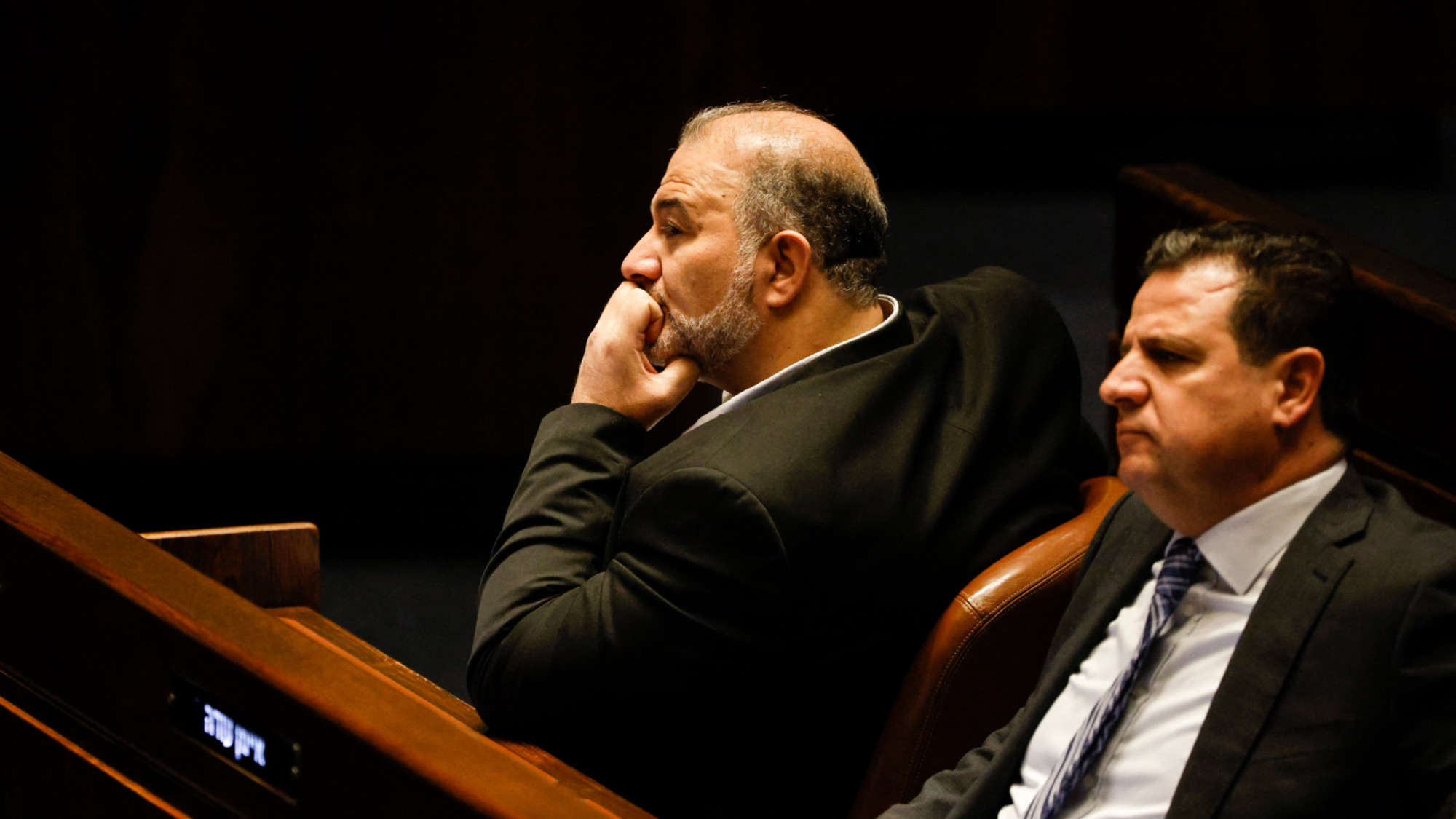
As Israel prepares for its pivotal national election on October 27, a striking political shift is reshaping the country’s opposition landscape, with almost all anti-Netanyahu leaders moving to rule out power-sharing coalitions with Palestinian Arab parties – a reversal of the historic 2021 power-sharing arrangement that ended Benjamin Netanyahu’s 12-year tenure in office.
Gadi Eisenkot, a retired Israeli general and leader of the Yashar party who has emerged as a key contender for prime minister, was the latest opposition figure to formalize this stance during a recent security conference hosted by Israeli outlet Yedioth Ahronoth and the Institute for National Security Studies. He announced his goal of forming a self-described “Zionist majority” government holding 63 to 64 parliamentary seats. If he cannot secure this threshold, he said he would pressure ultra-Orthodox parties to join his bloc, and would call for fresh elections rather than turn to Palestinian Arab parties for support.
Eisenkot’s position reflects a broader trend across the anti-Netanyahu camp. Former prime minister Yair Lapid and former alternate prime minister Naftali Bennett, who jointly partnered with the United Arab List (Ra’am) – a Palestinian Arab party – to oust Netanyahu in 2021 and defended that partnership as a necessary political experiment at the time, now echo Eisenkot’s refusal to collaborate with Palestinian Arab factions. This shift comes despite repeated public statements from Ra’am leader Mansour Abbas affirming his willingness to negotiate with any Jewish-majority bloc seeking to replace Netanyahu.
Political analysts trace this sharp reversal directly to the post-7 October 2023 security and political context that has transformed Israeli public opinion. Following the Hamas-led attacks, cooperation with Palestinian Arab parties has been framed by right-wing factions as a compromise on both national security and the Jewish identity of the Israeli state. This framing has made any outreach politically toxic for opposition parties, even centrist blocs that previously supported inclusion. Data from the December 2025 Israel Democracy Institute Democracy Index underscores this shift: 71.5% of Jewish Israelis now oppose including Palestinian Arab parties in any governing coalition, and a separate 2025 Institute for National Security Studies survey found 57% of all Israelis reject the creation of a Palestinian state under any circumstances, reflecting a broad hardening of public sentiment.
Palestinian political analyst Ehab Jabareen argues that Netanyahu and his right-wing bloc spent years weaponizing the question of collaboration with Palestinian Arab parties, successfully framing any cooperation as politically illegitimate. “Today, the political cost of being seen as close to Palestinian Arab parties has become very high,” Jabareen explained to Middle East Eye. While he notes that some opposition blocs may still quietly leave open the option of partnering with Palestinian Arab parties if parliamentary math leaves no other path to power, few are willing to state this publicly during the campaign: “They keep the back door open, but the front door is locked.”
This new political landscape has forced Palestinian Arab parties – which represent the roughly 2 million Palestinian citizens of Israel, who make up 21% of the country’s total population – to rethink their electoral strategies. The community are descendants of Palestinians who remained on their land after the 1948 Nakba, when Zionist militias displaced an estimated 750,000 Palestinians to establish the state of Israel. After decades of systemic discrimination, Palestinian citizens formed political parties to advocate for civil equality, an end to the Israeli occupation of Palestinian territories, and recognition of Palestinian national rights. For decades, these parties remained on the margins of Israeli politics, as collaboration with governing coalitions was viewed as toxic by both most Jewish voters and many Palestinian citizens. That taboo was only broken in 2021, when Ra’am’s four seats provided the critical margin for Bennett and Lapid to form their narrow majority.
Now that the taboo has reasserted itself, Ra’am’s Abbas has adopted a bold new approach to expand the party’s influence: Israeli media has confirmed that the party has reached a preliminary agreement to add former Yesh Atid lawmaker Yoav Segalovich, a Jewish politician, to its electoral list. A recent Channel 13 poll projects this move could boost Ra’am’s seat count from the currently projected five to an unprecedented seven seats.
Jabareen argues that Abbas’ strategy is targeted at three distinct audiences. For Palestinian Arab voters, he positions himself as the only leader pursuing pragmatic, achievable political progress. For the fragmented anti-Netanyahu camp, he leaves open a pathway to secure his party’s support if they cannot form a majority without it. And for the Israeli political establishment, he signals that Ra’am remains a reliable, institutional negotiating partner. But the strategy carries clear risks: “He is signalling a willingness to negotiate with a side that publicly says it has no interest in negotiating with him,” Jabareen notes. “That creates an image of weakness because the balance of power is not in his favour.”
Other Palestinian party leaders reject the framing that Palestinian Arab factions should prioritize joining governing coalitions. Aida Touma-Sliman, a Knesset member from the Palestinian-led party Hadash, argues that the refusal of Jewish opposition parties to collaborate with Palestinian factions is not just about electoral calculations – it reflects deep-rooted ideological bias. “The leaders of these parties know the Israeli public does not want any partnership with Palestinian Arab parties after years of incitement,” she said. “They lack the courage to present a genuine alternative to the current government’s policies. In reality, they also hold Zionist and discriminatory positions.”
Touma-Sliman emphasized that Palestinian Arab representation in the Knesset has never been solely focused on joining ruling coalitions. Instead, it serves as a platform for political struggle: to represent Palestinian citizens, expose discriminatory government policies, and defend the community’s collective rights. Even as parliament becomes an increasingly hostile space, she argues that abandoning it would only erase Palestinian political influence at a critical moment: “our political weight is needed to confront fascism, even if that only means preventing the formation of another far-right government.”
For Jabareen, the core challenge facing Palestinian Arab parties extends far beyond the current election cycle or coalition negotiations. After years of centering campaigns around the question of which bloc they might support to form a government, he argues it is time for a fundamental reset, amid a dramatically shifted Israeli political landscape. “The important question is no longer who will invite us into a coalition,” he said. “The real question is how we rebuild Palestinian political power inside Israel over the next decade in a way that makes ignoring us politically costly.”
Current polling puts the Eisenkot-led anti-Netanyahu bloc and Netanyahu’s right-wing bloc in a dead heat. Some surveys suggest Eisenkot could secure a majority without support from Palestinian Arab parties, while others indicate neither bloc will be able to reach the required threshold without backing from Palestinian factions, leaving the final outcome of the October 27 election still deeply uncertain.