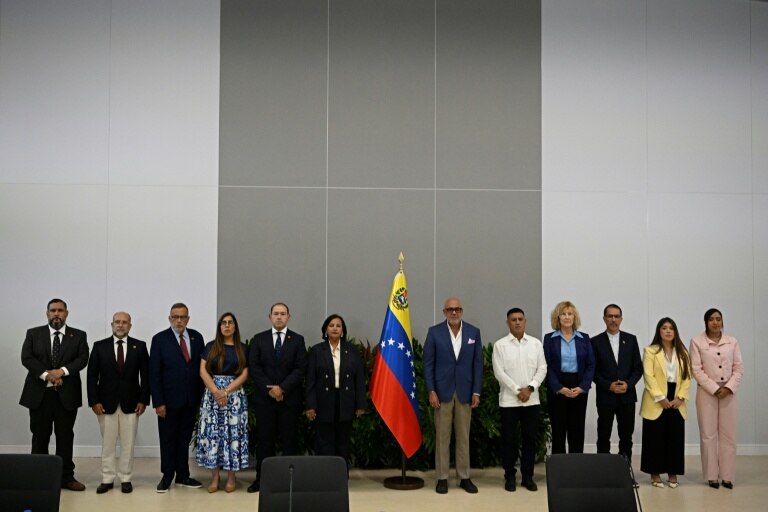
The first in-person round of US-backed political transition negotiations between Venezuela’s interim government and opposition delegates officially launched Thursday in the capital Caracas, a confirmed on-the-ground report from an Agence France-Presse photographer confirmed.
This diplomatic process comes seven months after United States military forces detained former Venezuelan president Nicolas Maduro, leaving interim head Delcy Rodriguez to lead the country under Washington’s oversight. Across the crisis-stricken South American nation, ordinary Venezuelans are holding onto cautious optimism that these talks will clear a path to long-awaited, free democratic elections that can pull the country out of years of political and economic turmoil.
A notable absence from the negotiating table is Maria Corina Machado, the Nobel Peace Prize-winning opposition figure who remains in exile after being barred from joining the discussions. Stepping into the opposition’s role is Dinorah Figuera, a veteran opposition leader who touched down in Venezuela Wednesday after years living abroad. Figuera leads the political coalition that secured a supermajority in the 2015 National Assembly election, the last legislative contest widely recognized as free and fair by the global international community.
Representing the interim government on the negotiating team is Jorge Rodriguez, president of the current National Assembly and brother of interim leader Delcy Rodriguez. Speaking to local broadcaster Televen shortly after arriving at Caracas’s international airport, Figuera outlined the core goal of the opposition’s participation: “We are focused on the official opening this week of this dialogue process, which seeks the restoration of democratic institutions.”
Figuera has already made clear that top opposition priorities include sweeping reforms to Venezuela’s Supreme Court of Justice and National Electoral Council, two bodies that drew widespread international condemnation for formally certifying Maduro’s widely disputed 2024 re-election victory. Opposition parties rejected the 2024 result outright, claiming they won the popular vote and accusing Maduro’s government of orchestrating widespread systemic electoral fraud.
The US State Department issued a formal statement welcoming Figuera’s delegation to the opening of the in-person negotiations, calling the direct talks “a unique opportunity” for progress. The statement urged all stakeholders to back the process to deliver “tangible results for Venezuelans” and emphasized that Washington’s end goal is “stabilization, economic recovery and political reconciliation, and a peaceful transition” to a permanent democratic government.
The talks are being held at the La Carlota military base in central Caracas, with only press photographers granted on-site access to the opening session. According to the joint official agenda published by both negotiating teams, discussions will cover three core areas: emergency response and recovery for the twin earthquakes that struck the country on June 24, which claimed more than 6,000 lives, strengthening of democratic frameworks, and the expansion of political civil rights across the country.
Despite being excluded from the talks, Machado has publicly stated she will not obstruct the transition process. In a post on X, the former presidential candidate wrote, “A democratic transition in Venezuela will restore our freedom and our prosperity,” adding that a new democratic government would become “a vital and reliable ally for the national security of the United States and regional stability.” Closing her message, Machado wrote, “The Venezuelan people are eager and ready!”
Recent reports have claimed that former US president Donald Trump, who received Machado’s Nobel Peace Prize as a symbolic gift, personally vetoed Machado’s request to return to Venezuela, a claim Washington officials have repeatedly denied. Trump has publicly and privately expressed repeated satisfaction with the leadership of Delcy Rodriguez, whose interim administration has opened Venezuela’s lucrative mining, electricity, and oil sectors to foreign investment and domestic private competition, a policy shift aligned with US economic priorities for the region.