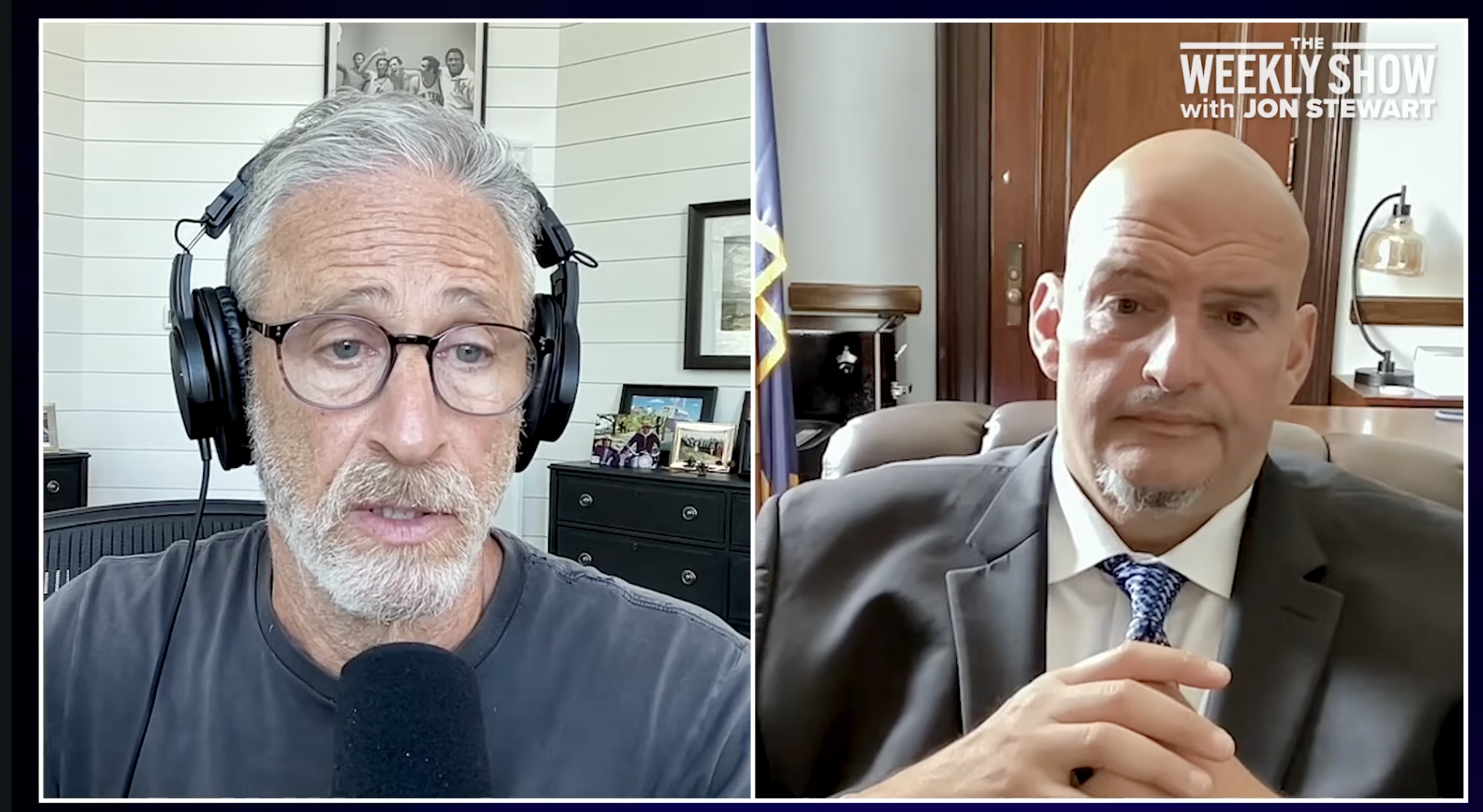
A high-profile interview between staunchly pro-Israel Democratic Senator John Fetterman and comedian-podcaster Jon Stewart has reignited debate over the growing ideological divide within the U.S. Democratic Party regarding U.S. policy toward Israel, as progressive voices calling for accountability for Israeli actions in Gaza gain electoral traction across the nation.
In the recorded Tuesday conversation, Fetterman, who represents the critical swing state of Pennsylvania in the Senate, made clear that he is willing to sacrifice intra-party support rather than soften his unwavering backing for Israel, a stance that has put him sharply at odds with a rising wave of progressive Democrats who advocate for Palestinian rights. The Pennsylvania senator acknowledged that his unapologetic support for Israel following the October 7, 2023, Hamas-led attacks on southern Israel has made him increasingly unpopular among members of his own party, but emphasized that this was a deliberate choice he stands by.
Fetterman’s hardline position emerges at a moment of notable shift within the Democratic coalition. Just one day after the interview, on Wednesday, progressive candidate Abdul El-Sayed defeated a pro-Israel opponent funded by the powerful pro-Israel lobbying group American Israel Public Affairs Committee (AIPAC) in Michigan’s Democratic primary, bringing him one step closer to becoming the first Muslim U.S. senator in American history. Even former Obama advisor Rahm Emanuel, whose father was a member of the 1948 Irgun militia linked to violence against Palestinian civilians, has publicly acknowledged that the Democratic Party must move away from its longstanding posture of unconditional support for Israel.
Though Fetterman aligns with most Democratic policy priorities, he has been an ideological outlier on all matters related to Israel since taking office in January 2023. The 56-year-old senator has publicly condemned the widespread 2024 college campus protests calling for an end to Israel’s military campaign in Gaza, a campaign that multiple holocaust experts and the United Nations have labeled a genocide. He has also backed former President Donald Trump’s hardline policy toward Iran and remains fully committed to sending unlimited U.S. foreign aid to Israel, which he describes as an irreplaceable “special ally.”
When Stewart pressed Fetterman on whether there was any action by Israel he would criticize, Fetterman replied simply: “No.” He pushed back on claims that Israel’s actions in Gaza constitute genocide, arguing that only the Jewish people have experienced a “true genocide” and claiming that if Israel sought to eliminate all Palestinians, it would have done so already. When Stewart noted that more than 22,000 Palestinian children have been killed in the campaign and asked if actions such as displacing 2 million Gazans into a fraction of their original territory and imposing a crippling siege can be justified as self-defense, Fetterman focused solely on the violence of the October 7 attacks, repeating unsubstantiated claims that Hamas fighters raped Israeli civilians — a claim that no international organization has ever documented with direct first-person or eyewitness evidence.
The conversation also saw Stewart push back against Fetterman’s conflation of antisemitism in the U.S. and criticism of the Israeli state. Stewart, who is Jewish, pointed out to Fetterman that “The Jewish community and Israel are not the same thing.” Fetterman also complained that the term “Zionist” is now used as a slur by some within the Democratic Party and questioned why student protesters do not target Iran for its domestic crackdowns on dissent — a point Stewart countered by noting that the U.S. does not send billions of dollars in annual military aid to Iran, instead imposing harsh sanctions on the regime.
Fetterman repeated the common claim that Hamas steals all humanitarian aid bound for Gaza, a claim that contradicts public statements from the former Republican head of the World Food Programme, who confirmed last year there is no evidence of Hamas systematically stealing or attacking aid convoys entering the enclave.
Observers noted multiple unusual moments during the 75-minute interview, where Fetterman struggled to recall talking points and often veered off-topic, appearing unable to fully structure responses to Stewart’s questions. These difficulties align with well-documented health challenges Fetterman has faced: three months before his 2022 Senate election victory against celebrity candidate Mehmet Oz, Fetterman suffered a major stroke. During the campaign, he struggled with verbal articulation in public appearances and his high-profile debate with Oz. Despite these challenges, he won the seat with 51% of the vote. A month after his 2023 swearing-in, Fetterman revealed he was suffering from clinical depression and spent two months in inpatient care, a decision widely praised by both parties as a courageous step in destigmatizing men’s mental health struggles.
The interview also covered broader tensions within the Democratic Party, with roughly half of the conversation focused on the growing unpopularity of the Democratic establishment, the rise of progressive democratic socialists who have energized young and working-class voters, and the economic status quo that has alienated many swing voters from centrist candidates. Fetterman argued that candidates embracing democratic socialist platforms cannot win general elections in key swing states, a framing Stewart pushed back on by pointing to El-Sayed’s policy platform — which includes banning corporate money from politics, raising taxes on billionaires to fund housing, education and universal healthcare — calling Fetterman’s labeling of progressive candidates as communist or socialist sympathizers a “caricature.”
Fetterman denied labeling all progressives communists, but singled out popular left-wing political commentator Hassan Piker, who has endorsed El-Sayed and appeared at campaign rallies with him, arguing that Piker’s support for Palestinian rights amounts to being “pro-Hamas.” Fetterman concluded by arguing that the party has a responsibility to “police its own ranks” to avoid nominating candidates who will cost Democrats winnable swing state seats in upcoming national elections.