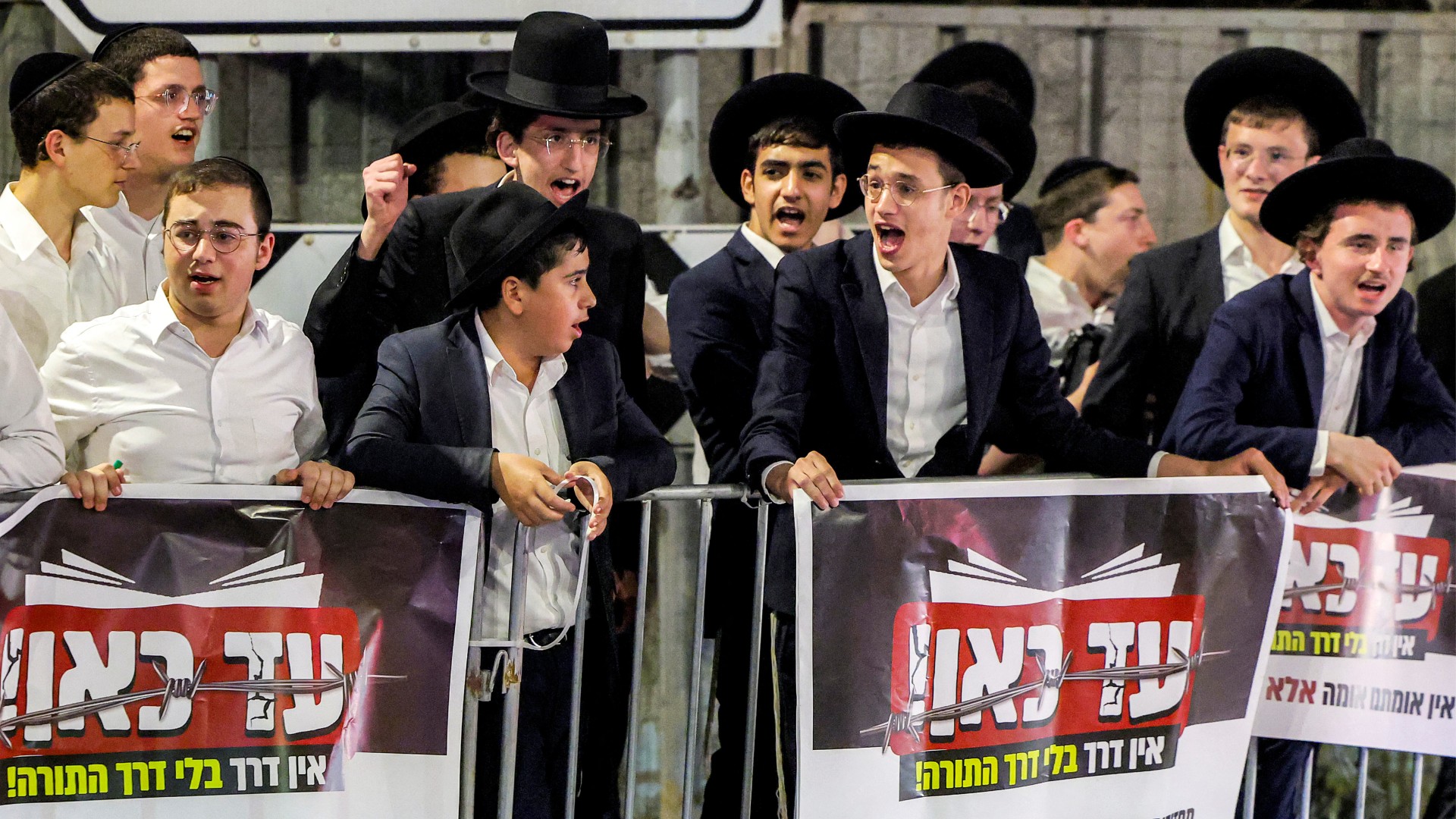
For almost 30 years, Israeli Prime Minister Benjamin Netanyahu has anchored his political power on a foundational alliance with ultra-Orthodox Jewish political parties, a partnership that has kept him in office through multiple terms. But as he prepares for one of the most competitive elections of his decades-long career, that long-standing governing coalition faces unprecedented strain, with the decades-long dispute over mandatory military conscription for ultra-Orthodox men pushing the partnership to a breaking point. The escalating conflict has laid bare deep fissures within Netanyahu’s right-wing bloc, leaving political observers questioning whether his two most reliable allies—United Torah Judaism (UTJ) and Shas, partners since his first term as prime minister in 1996—could abandon his bloc to align with a rival government. “There is deep disappointment and anger across the ultra-Orthodox public about their current standing,” Pnina Pfeuffer, director general of the Ultra-Orthodox Public Organisation, a civil society group focused on the community, told Middle East Eye. Pfeuffer notes that the future political alignment of ultra-Orthodox parties is now so uncertain that a break from Netanyahu is no longer a far-fetched scenario—including a potential shift to a government led by Gadi Eisenkot, Netanyahu’s most formidable challenger in years. “Eisenkot is not viewed as anti-ultra-Orthodox by the community,” she explained, referencing the former Israel Defense Forces chief’s reputation among religious voters. Avi-ram Tzoreff, an Israeli historian and human rights activist specializing in Jewish cultural, political and religious history, says the growing rift between Netanyahu and his ultra-Orthodox allies has opened unexpected new pathways for Israel’s opposition. “There is clearly a rupture between the ultra-Orthodox community and the right-wing bloc,” Tzoreff told MEE. Echoing a common slogan chanted at anti-conscription protests, Tzoreff added: “The ultra-Orthodox as a political force have made their position clear: they would rather die than be drafted. The alliance between ultra-Orthodox parties and the right is no longer a foregone conclusion.” Tzoreff argues that an Eisenkot-led opposition bloc could leverage these internal divisions to break apart what he calls the Israeli right’s “unnatural political alliance” with the ultra-Orthodox. For opposition parties aiming to oust Netanyahu, he says, a full rethink of traditional coalition-building strategies is necessary. “Once political alliances are structured around the question of ultra-Orthodox military conscription, it becomes far harder to build broad, inclusive coalitions,” he explained. “If the centre-left wants to take power, it needs to redefine how it draws the boundaries of its political camp.” The long-running exemption of ultra-Orthodox men from compulsory military service has existed for decades, allowing the group to focus on full-time religious study at yeshivas. But the issue exploded into Israel’s most divisive political flashpoint after the launch of Israel’s war on Gaza, which has seen hundreds of thousands of reservists mobilized for active duty. The unprecedented demand for military manpower has massively intensified public pressure to end the long-standing exemption. Netanyahu’s governing coalition has repeatedly failed to pass new legislation to regulate ultra-Orthodox conscription, triggering mass protests organized and backed by UTJ and Shas, and leading to the detention of dozens of ultra-Orthodox men charged with draft evasion. Last year, lawmakers from both ultra-Orthodox parties resigned from their cabinet posts to protest the coalition’s failure to advance a draft law that met their demands, though they continued to cooperate with the government on core legislative priorities. The dispute has also split Netanyahu’s own Likud party, where multiple sitting lawmakers have characterized attempts to pass a new conscription law that preserves most exemptions for ultra-Orthodox communities as an unacceptable concession to the alliance partners. Dan Illouz, a Knesset member who left Likud last month over the issue, told Israeli outlet Ynet that the right-wing bloc “has become idolatry” that “undermines our ability to advance right-wing economic and security policy,” including guaranteeing the Israeli military has sufficient personnel to meet its operational needs. For their part, ultra-Orthodox leaders have openly questioned their decades-long partnership with Netanyahu in recent months. In May, Rabbi Dov Lando, the influential spiritual leader of Degel HaTorah—one of the two factions that make up UTJ—publicly declared that “we no longer have trust in Netanyahu,” adding that the party was no longer politically “committed to him.” Last month, a senior Degel HaTorah official told Israeli newspaper Ma’ariv that “there is no such thing as a right-wing bloc anymore,” noting the party would open coalition negotiations with any political bloc that agrees to meet its core demands on conscription. Beyond the immediate tensions within Netanyahu’s coalition, the conscription dispute has laid bare deep ideological rifts among Israel’s ultra-Orthodox leadership over the country’s military campaigns and the role of the secular state. While most opposition parties across the political spectrum agree that ultra-Orthodox men should be required to serve, analysts say the debate also reflects starkly diverging views on Israel’s war in Gaza and broader regional military engagement. Those differences were thrown into sharp relief last month, when 96-year-old Rabbi Lando delivered an unusually harsh rebuke of the Religious Zionist movement, whose supporters have played a high-profile role in both the Gaza war and the expansion of Israeli settlements in the occupied West Bank. “They wage wars not for the sake of rescue, only for the sake of the state’s honour,” Lando said, accusing Religious Zionists of being “evil” and murderers. His comments drew widespread condemnation from across Israel’s political landscape, including from Netanyahu, who called the remarks “awful” and rejected them outright. But Lando’s statements are consistent with his long-held ideological positions. Last year, he claimed Religious Zionists had “brought physical disasters, not only spiritual ones, upon the Jewish people,” arguing that Zionist actions had left Arabs hating Jews “like never before.” Pfeuffer argues that Lando’s remarks should not be read as a direct political challenge to Netanyahu’s coalition. “Rabbi Lando is expressing an ethics-based position on the situation, not a political one, and as evidence, he never demanded leaving the government over the war,” she told MEE. Instead, she says the comments reflect a long-standing ultra-Orthodox worldview that distances the community from the Israeli state’s core military ethos. “The ultra-Orthodox don’t perceive the war as their own,” Pfeuffer said, noting that over the course of the nearly 10-month conflict, “life continued fairly normally” in ultra-Orthodox communities across Israel and the occupied West Bank. Even without immediate political fallout, Pfeuffer says Lando’s intervention is significant because it offers a clear alternative to the dominant Israeli narrative surrounding the war. “It represents moderation and restraint, which stems from a perception that our place in this land is not guaranteed and that we need to live alongside our enemies,” she explained. Tzoreff echoes that analysis, noting that Lando’s comments stem from a deeply held theological position rather than a tactical political move. “If you send someone to kill in the name of the honour of the state, you’re actually elevating the theological status of the state at the expense of Torah study,” he said. “This isn’t just a random statement. It was released to the media, and even if it doesn’t currently have broad public traction, its purpose was to build support for this position over time.” Even so, Lando’s anti-war, anti-conscription position sits uneasily with a broader shift toward the right among parts of Israel’s ultra-Orthodox electorate. According to Pfeuffer, far-right National Security Minister Itamar Ben Gvir has made significant inroads among traditional Shas and UTJ voters, complicating the political calculations of ultra-Orthodox party leaders. “Part of Shas’s constituency aren’t classic Shas voters—they could vote for Ben Gvir or Likud, because they don’t live strictly ultra-Orthodox lives. Therefore, Shas needs to show that it is part of the right-wing bloc and aligned with Netanyahu,” she explained. While Pfeuffer notes that Shas remains far more committed to Netanyahu’s coalition than UTJ, Tzoreff says the party has steadily drifted toward the far right since the 2013 death of its founding spiritual leader, Rabbi Ovadia Yosef. Shas, he says, has “undergone a process of Ben Gvirization,” as hardline religious figures such as the late Rabbi Meir Mazuz have gained increasing influence over the party’s policy and ideological direction. “Rabbi Ovadia was a bulwark against moving rightward,” Tzoreff explained. “Since the revered spiritual leader’s death, Shas has been struggling to set clear red lines. The party’s leadership, similar to other parties, doesn’t act to lead public opinion, but acts to please it.” Tzoreff says this rightward shift extends beyond Shas, pointing to increasingly close ties between ultra-Orthodox communities and Israel’s settler movement, as well as the growing adoption of nationalist rhetoric within many ultra-Orthodox communities. He also notes the strengthening of links between settlers and ultra-Orthodox communities in the occupied West Bank, alongside the growing acceptance of the idea that Torah study itself contributes to Israel’s national security. “But on the other hand, there’s a strong movement against military conscription,” he added. For Israel’s opposition parties, Tzoreff argues, this internal contradiction within the ultra-Orthodox community creates a unique political opening. “The role of the centre-left is to divide and conquer within the right-wing bloc,” he said. Rather than automatically ruling out cooperation with ultra-Orthodox parties, he says Netanyahu’s opponents should pursue pragmatic engagement with the group. “They need to consider partnership with the UTJ and Shas not out of idealization of the ultra-Orthodox, but because there is a political opening that can be exploited,” he added.
Netanyahu’s ultra-Orthodox alliance shows signs of fracture before crucial election