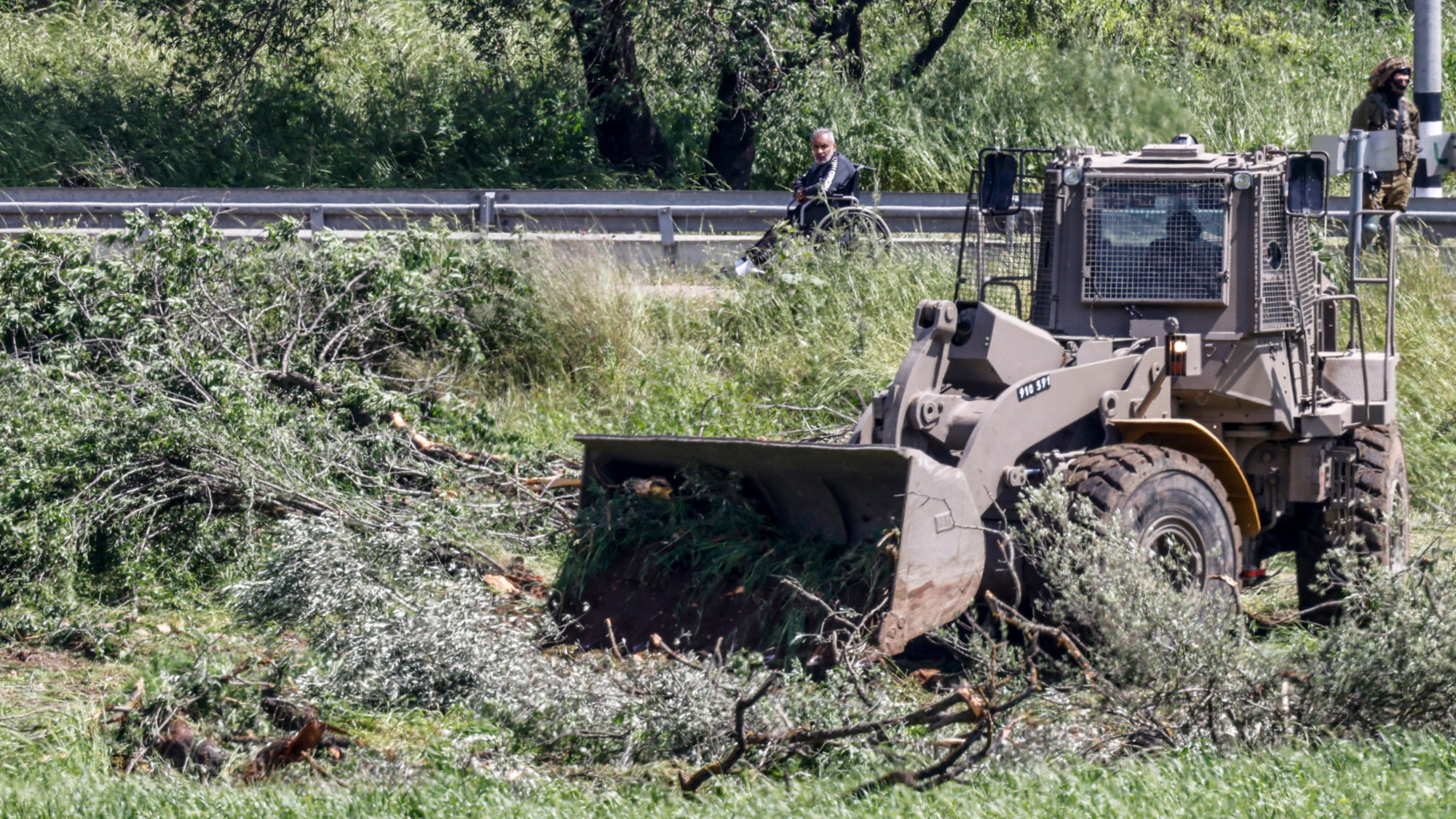
On a Wednesday just weeks before Palestinian farmers were set to begin their annual olive harvest, Israeli bulldozers moved into two Palestinian villages near Jenin in the occupied West Bank, felling dozens of olive trees in a continuation of a widespread campaign to uproot cultivated groves across the territory.
This latest round of destruction targeted agricultural plots in Ajjah and Zububa, two villages located in close proximity to Israel’s controversial separation barrier. For local families who have tended these lands for multiple generations, the destruction has delivered a devastating blow to both their livelihoods and cultural heritage.
Zaki Jaradat, who leads Zubaba’s Village Council, confirmed that the incident on Wednesday is far from an isolated action. He reported that since the beginning of 2024, Israeli forces have already uprooted more than 2,950 olive trees across more than 300 dunams (nearly 75 acres) of prime Palestinian agricultural land in the area.
Fuad Yahya Maqalda is one of the dozens of local farmers whose generational landholdings were destroyed in the latest operation. From the rooftop of his home, which overlooks his family’s olive groves, he was forced to watch helplessly as bulldozers cleared the land, unable to reach the site to stop the work.
“We are unable to do anything,” Maqalda told reporters from Middle East Eye. “We cannot understand the intentions behind this uprooting. The occupation uprooted olive trees that have stood on our land since the time of our grandparents.”
The timing of the destruction has compounded the grief for affected families, with the annual olive harvest – the most economically important event of the year for thousands of West Bank Palestinian households – mere weeks away. Maqalda detailed the full scope of his own loss: three generational family plots were targeted, with 111 trees destroyed on one plot and an additional 215 cleared from a second. “Every single one of those trees has been removed,” he said.
Tareq Ighbariya, a spokesperson for the Palestinian Commission Against the Wall and Settlements in Jenin, explained that the actual damage on the ground frequently exceeds the limits set out in formal Israeli military orders authorizing land clearing.
“Military orders may specify a certain area for tree uprooting or land clearing, but when they are carried out, the affected area is often much larger,” Ighbariya told Middle East Eye. “In some cases, bulldozers enter agricultural land and begin clearing it without any prior military order.”
The mass clearing in Zububa is part of a broader pattern of encroachment on Palestinian agricultural land across the Jenin governorate. Ighbariya noted that the commission has documented similar destruction across roughly 300 dunams of farmland in recent months, adding that ongoing assessments mean the final count of damaged and cleared land may be even higher than current records show.
For Palestinian communities in the occupied West Bank, the annual olive harvest holds meaning far beyond economic survival. While the crop provides a critical, steady source of income for thousands of families, it is also deeply woven into Palestinian cultural and social identity, with groves passed from parent to child over centuries.
In recent years, the lead-up to and during harvest season has brought growing levels of disruption and risk for Palestinian farmers across the territory. Reports have surged of increased restrictions on access to farmland, particularly near Israeli settlements and designated military zones, alongside widespread incidents of settler violence, deliberate vandalism, crop theft, and targeted uprooting of olive groves. For many farming communities, what should be a vital annual harvest has now become a period of significant uncertainty, with families bracing for potential loss of land or attacks as they attempt to tend and collect their crops.