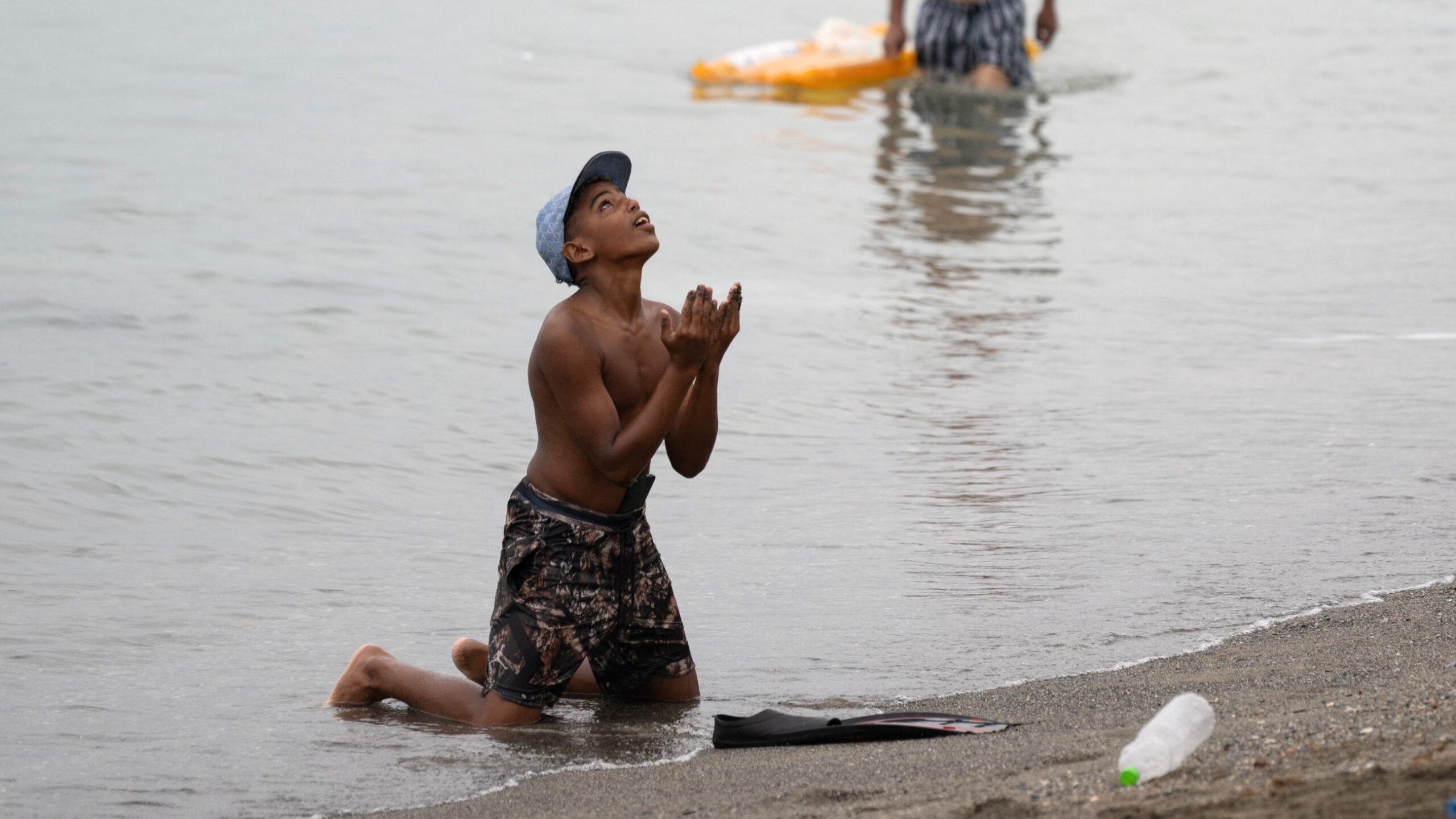
The Spanish North African enclave of Ceuta is currently reeling from one of the largest unregulated migration events in recent history, after an estimated 72,000 people crossed irregularly from Morocco into the territory starting July 31, a date that coincides with Morocco’s annual King Mohammed VI Throne Day. As of the latest official updates, roughly 70,000 of these arrivals have already been forcibly returned to Morocco, leaving a growing trail of human tragedy and diplomatic fallout between the two neighboring nations.
No definitive explanation has yet emerged for what triggered the unprecedented crossing, but multiple theories have circulated among policymakers, analysts and migrants themselves. Some observers link the surge to a deliberate political signal from Rabat, coming just 10 days after Spanish Prime Minister Pedro Sanchez’s high-profile visit to Algeria, Morocco’s long-standing rival in the region over the Western Sahara conflict. Other unconfirmed speculation has suggested external involvement from third parties, tied to Spain’s public stance opposing the ongoing conflict in Gaza and escalations against Iran. What remains undisputed is the deeply rooted human desperation driving the crossing: most migrants are young, educated Moroccans who see no viable future in their home country, and at least 141 people have already died during the dangerous journey, with the death toll projected to climb as recovery efforts continue.
Morocco’s leading independent human rights group, the Association for Human Rights (AMDH), has placed full blame for the crisis squarely on the Moroccan state. In an official statement, the organization described the harrowing border scenes as a direct reflection of systemic despair among Moroccan youth, fueled by mass unemployment, lack of economic opportunity, endemic corruption, growing authoritarianism and the absence of meaningful social justice. The AMDH drew parallels between the situation and humanitarian crises typically seen only in active war and conflict zones. In response, Morocco’s Ministry of Interior has pushed back against these claims, arguing the surge stemmed from misinformation spread virally on social media, combined with human trafficking networks exploiting a recent Spanish Supreme Court ruling that banned immediate forced returns of migrants arriving by sea.
However, expert analysis and firsthand accounts from migrants directly contradict Rabat’s official narrative. Multiple migrants who completed the crossing told reporters that Moroccan border security actively facilitated their journey, standing aside and even encouraging groups to enter Ceuta. “The Moroccan border security stood back and watched us cross; they would tell us, ‘Go on, hurry up, get into the water,’” explained 19-year-old Hamza, a migrant from Kenitra who traveled more than 40 kilometers to reach the border. Hamza added that police only used violence against migrants who hesitated to cross, beating those who refused to move forward with sticks and ordering them to return home if they would not proceed.
Carla Hobbs, head of the Madrid Office and policy fellow at the European Council on Foreign Relations (ECFR), confirms that the weight of evidence points to deliberate Moroccan complicity in the surge. “It would have been very hard for this to happen without Moroccan complicity,” Hobbs noted in an interview, pointing to multiple patterns that align with past uses of migration as a political tool by Rabat. She explained that reduced border controls, firsthand accounts of official encouragement, and the timing of the surge immediately after Sanchez’s Algeria visit all point to a deliberate strategic move. This pattern mirrors a 2021 crisis, when a similar mass crossing into Ceuta occurred amid a diplomatic breakdown between Madrid and Rabat over the Western Sahara dispute. Hobbs also highlighted a key shift in this latest crisis: unlike past crossing attempts that were dominated by sub-Saharan African migrants transiting through Morocco, this wave is made up almost entirely of young Moroccans, with reports that Moroccan police blocked sub-Saharan migrants from joining the crossing.
For the young people who made the journey, the decision to leave grew out of economic hopelessness that even advanced education cannot solve. Nineteen-year-old Hamza, who holds professional diplomas, explained that qualified young people can only earn a handful of dirhams for full-time work even in major Moroccan cities, leaving no path to stable, dignified living. “Even if they try to force me, I will never go back. Morocco has not given me anything,” he said. Twenty-three-year-old Asmae from Casablanca echoed this sentiment, saying she decided to make the crossing after seeing viral posts about the opening on Instagram. She confirmed that Moroccan police remained passive and did not interfere with migrants who chose to leave of their own free will. For 23-year-old Younes, a multilingual college graduate, the journey was driven by a simple hope: “I felt like in Ceuta I would finally get an opportunity in life.” That hope quickly turned to horror, as Younes witnessed three teenage migrants drown during the final swim to shore, and was beaten by Spanish authorities shortly after arriving. He described how Ceuta’s basic services collapsed under the sudden surge, with closed shops, no access to clean water, and widespread violence against new arrivals. “My dream was to get in, and now I swear to god I advise every parent to not send their kids here,” he warned.
The human cost of the crisis extends far beyond the crossing itself, as hundreds of families remain stranded on the Moroccan side of the border, waiting for any word of their missing loved ones. Najaat, a mother of six, told reporters that three of her children – two daughters aged 12 and 13, and a 14-year-old son – joined the crossing. Before leaving, the girls wrote down their mother’s phone number on their birth certificates, but she has received no word from them since. Overwhelmed with grief and fear, she said she only wants to know if her children are alive or dead, and expressed constant terror that her young daughters face the risk of sexual violence. “I work to take care of my children; I don’t want them to emigrate like this. I deprive myself of things to give to my children,” she said.
On the ground in Ceuta, humanitarian organizations are scrambling to respond to the crisis, while documenting what they describe as widespread abuses against migrants during deportation processes. No Name Kitchen (NNK), a humanitarian NGO that responds to migration crises, has expanded its small local team from 4 to 18 staff to meet the sudden demand for aid. NNK coordinator Ric Fernandez told reporters that Spanish authorities have used what he calls irregular, violent tactics to force migrants back across the border. “We’ve seen the army use ‘trawling’ tactics, forming human chains of people to force them toward the border with shoves, kicks, shouting and insults, threatening to beat them further if they didn’t move,” Fernandez said. Beatings of migrants who refuse to board deportation trucks are often carried out at night, out of public view, he added. “No one, including the police, the Guardia Civil or the military, asks people how they are, what they need, or why they came to Spain… Even though we sense they’re fleeing hell, the priority is to send them straight back into it,” Fernandez said. The organization is working to connect vulnerable migrants with shelter and resources, while carrying out a large-scale legal documentation effort to protect those eligible for international protection. Their biggest fear, however, is that many vulnerable people will be deported before their claims can be processed.
Diplomatically, the crisis is expected to cause lasting damage to the slowly rebuilding relationship between Spain and Morocco, which collapsed entirely in 2021 after Spain allowed Polisario Front leader Brahim Ghali to receive medical treatment in Madrid, a move that infuriated Rabat over the Western Sahara dispute. While relations have been on the mend in recent years, Hobbs says the latest surge will leave ties “smooth on the surface but worsened underneath.” Spain has avoided public criticism of Morocco, Hobbs explained, because Madrid relies on Rabat for long-term migration and security cooperation. But the crisis comes ahead of upcoming Spanish elections, and the dramatic images of the surge are already being leveraged by Spain’s far-right anti-immigration party Vox, creating domestic political pressure on the Sanchez government that will not be forgotten. From Morocco’s perspective, the weak, divided response from the European Union has signaled that using migration pressure as a political lever carries very little cost, making it likely Rabat will use the same tactic again in the future, Hobbs added.