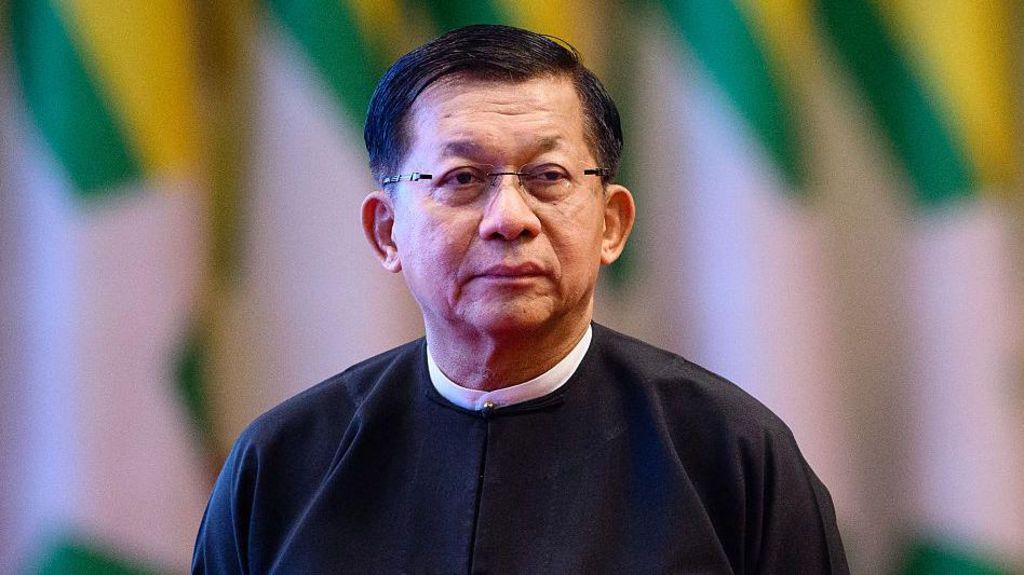
Four years after seizing power in a 2021 coup that ousted Myanmar’s democratically elected government led by Aung San Suu Kyi, the country’s top military leader Min Aung Hlaing has stepped onto the international stage for his first official foreign trip, landing in neighboring Thailand for a multi-day state visit. The 2021 takeover triggered a widespread civil conflict that has claimed the lives of thousands of civilians and reduced Myanmar’s once-stable economy to ruin, deepening a humanitarian crisis that has rippled across Southeast Asia.
Long isolated by the global community, Min Aung Hlaing has carried international sanctions and condemnation for years, stemming first from his role in the 2017 mass expulsion of the Rohingya Muslim minority, a campaign that international courts have labeled crimes against humanity. Banned from entering nearly all Western nations, he has existed as a pariah in most global diplomatic circles for years. His international standing has not improved since he was sworn in as Myanmar’s president in April, following a widely discredited election that was boycotted by major opposition parties, excluded voting in large swathes of opposition-held territory, and was universally rejected as neither free nor fair by the international community. The rigged vote left Myanmar’s military-aligned party with full control of the country’s new parliament.
For three years, the Association of Southeast Asian Nations (ASEAN) has barred Min Aung Hlaing from its official summits, a punitive measure imposed after he refused to uphold a 2021 five-point peace consensus agreed to by all ASEAN member states. The deal required Myanmar’s military to end hostilities and open inclusive negotiations with opposition groups, a commitment the junta has never honored. Many key ASEAN members, including Indonesia, Malaysia, the Philippines, and Singapore, have maintained that full diplomatic engagement with the junta should only resume after it makes tangible concessions to ease the humanitarian crisis and end the civil war.
Thailand, however, has broken ranks with the regional bloc’s cautious approach, adopting a policy it calls “calibrated re-engagement” with Min Aung Hlaing’s regime. Citing its 2,400-kilometer shared border with Myanmar, Thai officials argue that high-level dialogue is essential to addressing cross-border challenges ranging from human trafficking to insurgent spillover. This week, that approach has translated into full ceremonial welcome: Min Aung Hlaing has received a red-carpet reception from Thai Prime Minister Anutin Charnvirakul, is scheduled to attend an official state dinner, meet with leaders of Thailand’s upper and lower parliamentary houses, and co-lead a bilateral Thai-Myanmar business forum designed to expand economic ties between the two nations.
Thailand’s move follows a similar path taken by Myanmar’s two largest neighbors, China and India. Both countries formally recognized Min Aung Hlaing’s new government immediately after his swearing-in and extended invitations for official visits shortly after he took office. China’s ongoing support has been particularly critical for the embattled junta, with military and economic assistance helping the regime reverse earlier battlefield losses and retake significant territory from anti-junta armed groups.
Unlike China and India, however, Thailand is a founding ASEAN member and a self-identified democracy, making its high-profile reception of Min Aung Hlaing a source of sharp international criticism. Campaigning group Justice for Myanmar has condemned the visit, arguing that Thailand’s ongoing diplomatic outreach grants unwarranted legitimacy to the unelected junta. The organization added that the policy of calibrated re-engagement is a failed strategy that will only extend the suffering of the millions of Myanmar people affected by the ongoing civil conflict.