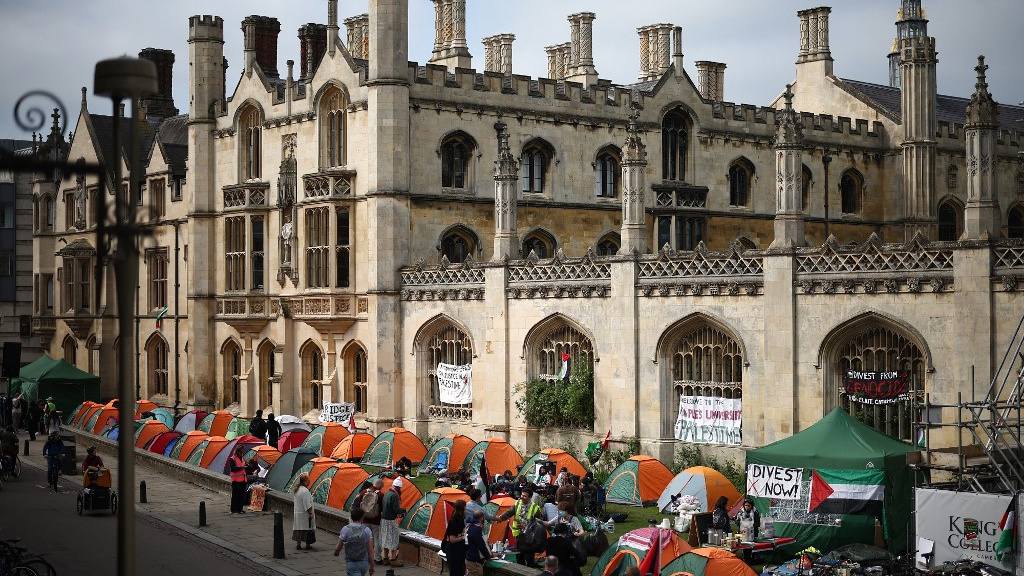
Exclusive reporting from Middle East Eye has uncovered that the University of Cambridge has reversed a planned policy that would have paved the way for full divestment from weapons manufacturers, a step that came in direct response to widespread student and faculty campaigning over the institution’s investments linked to Israeli human rights violations.
Internal documents reviewed by MEE show that on April 16, Cambridge’s top governing body, the University Council, signed off on a new monitoring framework for endowment investments in conventional weapons producers. The framework was developed by the Cambridge University Endowment Trustee Body (CUETB), the body tasked with overseeing the university’s £4.2 billion ($5.74 billion) endowment fund, which is managed day-to-day by University of Cambridge Investment Management Limited (UCIM).
Under the original policy, the framework was designed to track the endowment’s total exposure to firms that primarily manufacture conventional weapons. If that exposure crossed a pre-set threshold as a share of total fund assets, mandatory discussions would be launched with UCIM to outline a timeline for reducing those holdings. In July 2026, CUETB went a step further, setting the threshold for arms investments at zero percent — a historic decision that would have required divestment talks for any level of investment in weapons companies, effectively committing the institution to full divestment.
This policy was developed by a 2024 university working group convened after student activists with Cambridge for Palestine set up on-campus encampments to demand the university cut financial ties with firms enabling Israeli occupation and human rights abuses in Gaza and the West Bank. The policy reaffirmed commitments the university made to academic staff just one month ago, when the Council publicly stated it would move to reduce arms investments that crossed the established threshold.
However, multiple anonymous sources with direct knowledge of the internal decision-making process told MEE that CUETB has quietly scrapped the original plan, replacing it with a new policy that removes any requirement to reduce holdings even if the zero percent threshold is breached. While the zero percent threshold remains on paper, the revised policy no longer mandates action to cut exposure to weapons manufacturers.
Critically, the non-public policy change was made by CUETB without bringing the decision to a vote before the full University Council, and multiple sitting Council members confirmed to MEE they were never notified of the revision. It remains unclear when the reversal was approved, and the University of Cambridge has not responded to multiple repeated requests for comment from MEE on the policy shift.
This is not the first time Cambridge has faced scrutiny over its endowment investments. In February 2025, MEE revealed that UCIM had allocated more than £140 million ($189 million) to an S&P 500 fund that holds stakes in multiple companies linked to Israeli human rights violations, including Palantir Technologies, Caterpillar, and GE Aerospace. The university has repeatedly refused to disclose the full list of firms in its endowment portfolio, citing legal confidentiality requirements. Earlier this year, dozens of senior Cambridge academics accused the institution of “maximal obfuscation” over its investments, arguing that the lack of transparency prevents faculty from conducting proper oversight of the endowment’s ties to arms manufacturers.
A spokesperson for Cambridge for Palestine told MEE that the activist group was “shocked, but not surprised” by the university’s reversal of its public commitments. “The notice in April issued by the University Council made clear that if arms investments were to exceed a yet-to-be-decided threshold of overall investments, then exposure to such investments would be reduced as part of a new monitoring scheme,” the spokesperson said. “Now that this threshold has been set at zero percent, we are hearing that the university has chosen to ignore and sideline its own statements and commitments by removing any process of investment exposure reduction.”
The spokesperson added that the decision is particularly problematic because it was made unilaterally by the trustee body, rather than going through the university’s formal governance processes. The original divestment motion that launched the working group process has still not been put to a vote before Regent House, Cambridge’s democratic governing body made up of faculty and staff. “The University can backtrack all it likes, and obfuscate language to avoid scrutiny and accountability,” the spokesperson said. “But Cambridge for Palestine re-emphasises that students, staff and local activists will never stop campaigning until the University’s money is used for education as it should be, not for funding war and occupation.”