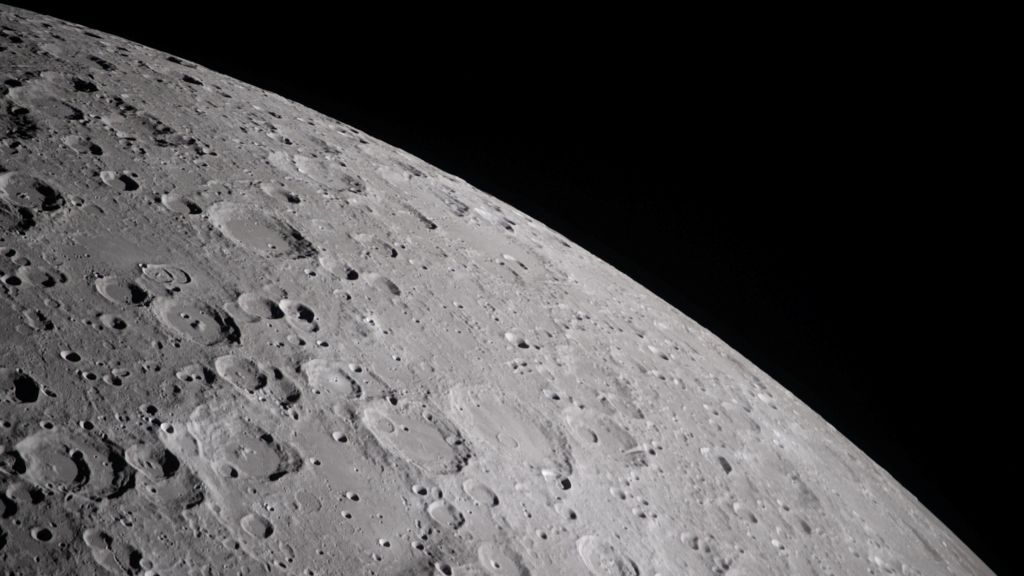
In an unplanned cosmic collision that has turned into a rare scientific windfall, a discarded upper stage of a SpaceX Falcon 9 rocket has impacted the Moon’s surface near the iconic Einstein crater, opening new doors for lunar research that will benefit future human and robotic missions to Earth’s only natural satellite.
The crash occurred at approximately 06:35 GMT on Wednesday, with the empty 4,000-kilogram rocket stage – roughly the size of a five-story building – striking the lunar surface at a blistering speed of nearly 8,700 kilometers per hour. The brief, intense flash generated by the impact was all but invisible to even the most well-equipped amateur astronomers, lasting just a fraction of a second and appearing far too faint for ground-based telescopes to capture clearly. While amateur observers were unlikely to spot the flash, some may have detected a plume of ejected lunar dust stretching as far as 100 kilometers that lingered for several minutes after the collision.
No orbiting spacecraft were positioned to capture the impact in real time. South Korea’s Danuri lunar orbiter passed the crash site shortly before the collision, and the mission team has confirmed that any collected data and imagery will not be released to the public until initial scientific analysis is complete. In the coming days, NASA’s long-operating Lunar Reconnaissance Orbiter will maneuver into position to photograph the impact site, allowing scientists to compare high-resolution pre- and post-impact imagery to map the newly formed crater in detail.
The path to this accidental collision began more than 18 months ago, when the Falcon 9 rocket launched from Cape Canaveral, Florida, in January of the previous year. Its core mission was to deliver two robotic lunar landers onto a trans-lunar trajectory out of Earth’s orbit, a goal the rocket completed successfully. After deploying its payload, the spent upper stage was left drifting in a large, looping orbit that alternated between swinging close to the Moon and returning near Earth. Over the following year and a half, tiny, cumulative gravitational tugs from the Earth, Moon, and Sun, combined with the faint pressure of solar radiation, gradually shifted the rocket stage’s orbit until astronomers tracking the debris confirmed it was on an irreversible collision course with the Moon, gaining speed with each passing orbit.
Initial observations and early data analysis are being led by large ground-based observatories across the Americas, where the sky was still dark at the time of impact. Even for these advanced facilities, detecting and processing clear data of a 14-meter object striking the Moon 385,000 kilometers from Earth is a significant challenge, and scientists warn it could take days or even weeks to produce a full, clear picture of the impact site and the initial findings from the event.
For planetary geologists and lunar scientists, this unplanned collision is far more than an interesting space oddity – it is a unique, well-characterized natural experiment. Unlike most random impact events, researchers already have precise data on the rocket stage’s mass, size, speed, and exact impact location, allowing them to test long-standing models of crater formation, debris dispersion, and seismic activity within the Moon’s interior. These data will have direct practical applications for future lunar exploration: understanding how far impact debris travels and how much seismic shaking is generated by high-speed collisions will help engineers design safer lunar landers and durable long-term Moon bases for crewed missions.
Additionally, the material ejected from beneath the Moon’s surface during the impact will provide new, unaltered samples of lunar geology that can be studied remotely, helping scientists refine existing theories about the formation of the Earth-Moon system 4.5 billion years ago.
This event marks far from the first time a human-made object has collided with the Moon. Since the Soviet Union’s Luna 2 probe became the first human-made object to impact the lunar surface in 1959, dozens of spacecraft and rocket stages have crashed there, both intentionally for scientific research and by accident. Notable past impacts include NASA’s Ranger probes in the 1960s, discarded rocket stages from the Apollo program, and the 2009 LCROSS mission, which was deliberately crashed into a polar crater to confirm the presence of water ice. The last confirmed accidental rocket impact occurred in 2022, when a discarded booster from a 2014 Chinese lunar mission struck the lunar surface, highlighting the growing issue of orbital space debris that has been accumulating around Earth and the Moon for more than 60 years.