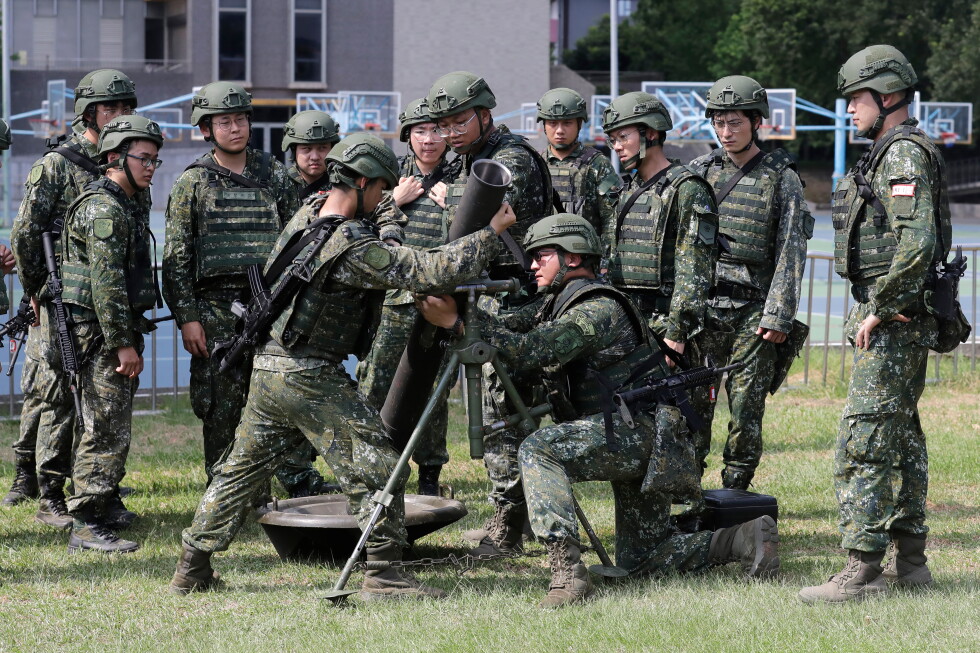
TAIPEI, Taiwan — Against a backdrop of steadily mounting cross-Strait tensions, Taiwan launched its annual 10-day Han Kuang military exercises on Wednesday, a large-scale training series designed to prepare the self-governing island for a potential military incursion from China, which has long claimed Taiwan as part of its sovereign territory.
Unlike routine training maneuvers, this year’s drills are tailored to address the full spectrum of modern security threats Taiwan faces, from large-scale invasion scenarios to the incremental, below-war-threshold “gray-zone” pressure that China has regularly employed in recent years. A core operational objective of the exercises is to verify whether Taiwan’s standing military can maintain uninterrupted 24-hour defensive operations across multiple fronts, while building more flexible, autonomous response capabilities for frontline troops.
This iteration of the exercises introduces several key updates that reflect evolving defense priorities. Drawing on doctrinal guidance from the United States, Taiwan’s military is testing new communication protocols, including the backbrief system, through which lower-echelon commanders explicitly outline their mission execution plans to senior leaders. Defense analysts note this framework is intended to empower frontline fighters to make independent, effective decisions amid the chaos of combat, rather than relying solely on top-down orders.
Another notable expansion comes in reserve mobilization: this year’s drills will activate a record force of more than 5,000 reservists organized into two full brigades, marking a significant increase from 2023’s exercise, which mobilized just one 3,000-strong reserve brigade. The drill will assess how quickly reserve personnel can transition from peacetime standby status to fully operational active duty, a critical capability for reinforcing frontline defenses in the opening days of a conflict.
In line with Taiwan’s longstanding focus on integrating civilian defense into national security planning, urban resilience drills will be conducted across three major population centers: the capital Taipei, central Taiwan’s Taichung, and southern Taiwan’s Kaohsiung. To simulate the signal jamming and telecommunications disruption that would likely accompany a large-scale attack, organizers will intentionally slow mobile internet speeds for a 30-minute period during the drills, testing civilian response protocols and public adaptability to critical infrastructure outages.
The exercises also mark the first formal field testing of Taiwan’s newly delivered American-made M1A2T Abrams main battle tanks. Taipei signed a contract to purchase 108 of the advanced tanks from the U.S. in 2019, with the final shipment of the platform arriving on the island in April this year.
Taiwan relies on the U.S. for the vast majority of its advanced military hardware, and Washington remains Taipei’s most important informal security partner amid persistent Chinese territorial claims. Beijing views the democratically governed island as a separatist province that must be reunified with mainland China, by force if necessary, and has ramped up near-daily military coercion campaigns over the past five years, including regular incursions of military aircraft and naval vessels into Taiwan’s adjacent air and sea defense identification zones.
Just weeks before the launch of the Han Kuang exercises, Taiwan’s legislative body approved a $24.8 billion supplementary defense budget earmarked for U.S. arms purchases, a figure that fell short of the $40 billion proposal put forward by President Lai Ching-te. Currently, the Taiwanese government is awaiting approval for a long-delayed $14 billion arms sales package from Washington. While former U.S. President Donald Trump and Congress previously signed off on a separate record-breaking $11 billion arms package for Taiwan, Trump indicated after a May visit to China that arms sales to Taipei could serve as a “good negotiating chip” in talks with Beijing, and has so far declined to greenlight the new, pending $14 billion sales package.