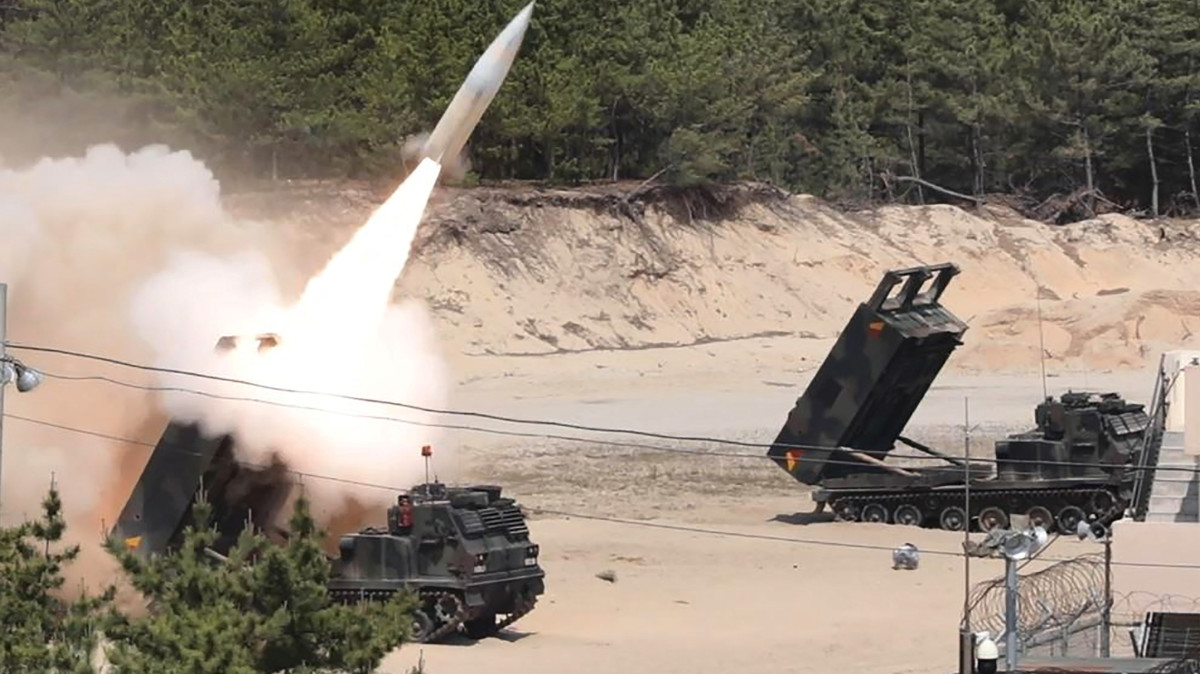
Months of sustained military operations against Iran have left the United States nearly drained of its most advanced long-range precision surface-to-surface missiles, new reporting reveals, creating critical supply constraints that have undermined the Trump administration’s repeated threats of massive, unprecedented escalation against the Islamic Republic.
Citing two anonymous defense sources, Reuters reported Tuesday that the U.S. military has exhausted “virtually all” of its stockpiles of Army Tactical Missile Systems (ATACMS) and the newer Precision Strike Missiles (PrSM), two cornerstone weapons in America’s conventional arsenal. These munitions are prized for their ability to strike enemy targets with high accuracy from hundreds of kilometers away, eliminating the need to deploy crewed warplanes that face risk from enemy air defense networks.
The depletion has forced U.S. Central Command (CENTCOM), the military command responsible for all operations across the Middle East, to reallocate missile stockpiles from other active combat theaters around the world to replenish its supplies, according to the report.
Hostilities between the U.S., Israel and Iran first erupted on February 28, when joint U.S.-Israeli strikes opened the current round of conflict. A ceasefire was negotiated in June via the Islamabad Memorandum of Understanding, but skirmishes and low-intensity fighting have continued to escalate through the summer months.
To support operations against Iran, the Trump administration repositioned key air defense batteries and active duty troops from East Asia at the start of the conflict. The ATACMS missiles now expended in the Middle East were also a critical capability that the U.S. had supplied to Ukraine for use against Russian invading forces, creating cross-theater resource strains.
For months, the Trump administration claimed its strikes had completely destroyed Iran’s integrated air defense network. But independent reporting from Middle East Eye and other international outlets has confirmed that Iran has received new advanced air defense systems from both China and Russia to reinforce its capabilities. In April, an American F-15E Strike Eagle fighter jet was shot down over Iranian territory, triggering a large-scale rescue operation for the downed crew that nearly escalated tensions even further – had Iran captured the pilot, the captive would have represented a major diplomatic bargaining chip during subsequent ceasefire negotiations.
The current munitions shortage extends far beyond offensive long-range missiles. Even before the full-scale outbreak of conflict, the U.S. was already facing low stockpiles of missile and drone interceptors, a gap created by months of supporting Israeli air defense operations during the 2025 June conflict that culminated in U.S. strikes on Iran’s nuclear infrastructure. For weeks, senior U.S. military leaders have warned the Trump administration that stockpiles of key defensive interceptor systems, including Patriot surface-to-air missiles, are also declining rapidly, the Reuters report added.
The revelation of deep military resource depletion has validated longstanding criticism from both anti-intervention conservative and progressive analysts who argue the conflict is eroding American military power and draining critical strategic resources at the global level.
“CENTCOM used everything they had before the war and have drawn down from rest of the world to critical levels,” Saagar Enjeti, a conservative commentator and co-host of the popular Breaking Points political program who has opposed U.S. intervention in Iran, wrote on social media platform X.
Amir Handjani, board member of the Washington-based Quincy Institute for Responsible Statecraft, a think tank that opposes aggressive U.S. foreign intervention, offered a sarcastic rebuke to pro-war lobbying groups in a post on X. “Thank you FDD and UANI for the wonderful policies you have been advocating for. They have made America stronger!” Handjani wrote, referencing the Foundation for Defense of Democracies and United Against Nuclear Iran – two organizations that critics say led lobbying efforts to push the U.S. into war with Iran.
The Reuters report comes just days after former President Trump reversed his own public pledge to launch massive new strikes against Iran. Just over a week ago, Trump threatened to carry out “the biggest attack since World War II” against the Islamic Republic. But he walked back that threat on Monday, claiming that Gulf Arab states had requested he avoid further escalation and that negotiations for a renewed ceasefire are underway. “I want to give them every last chance before decapitation,” Trump stated Monday. Iranian officials have repeatedly denied that any direct bilateral talks with the U.S. are currently ongoing.
This coverage draws on original reporting from Middle East Eye, an independent outlet focused on unrivaled, unbiased coverage of the Middle East, North Africa and global affairs.