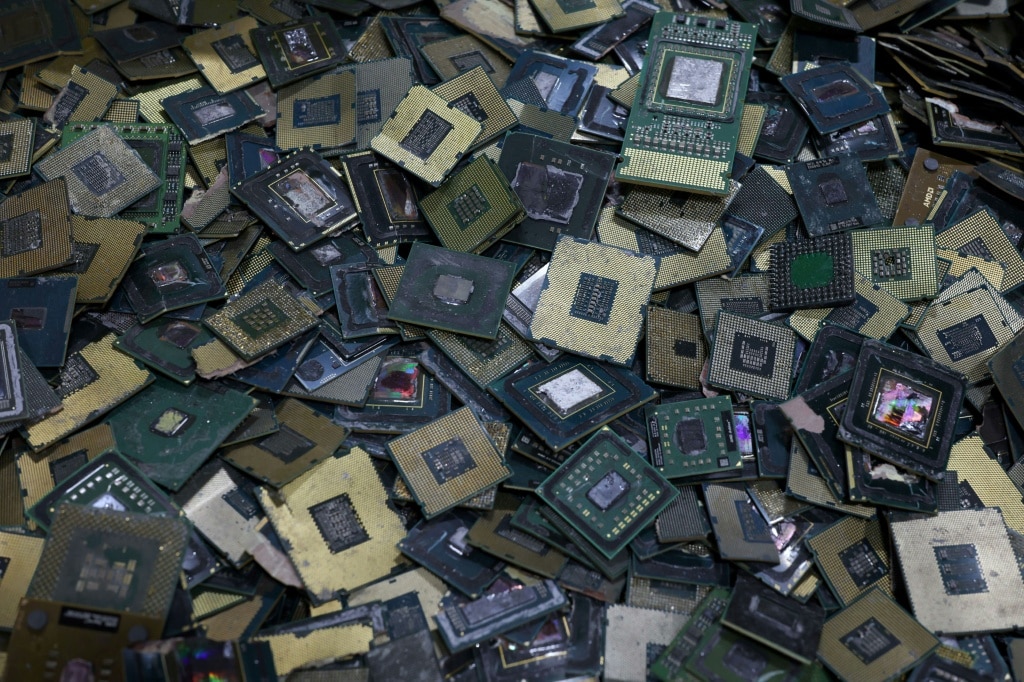
Nestled behind barbed-wire perimeters and encrypted security gates just outside Cardiff, Wales, Britain’s historic state-owned Royal Mint—best known for producing the UK’s circulating coins and official commemorative medals—is breaking new ground in circular economy innovation. What was once a facility solely dedicated to minting currency is now home to a pioneering project that turns discarded electronic devices into a new source of precious gold for luxury jewellery.
The operation focuses on recovering hidden gold reserves trapped in the circuit boards of discarded electronics, starting with decommissioned Bank of England office telephones. Each device is manually disassembled before components are processed, a departure from the bulk melting techniques common to many e-waste recycling operations. After disassembly, copper, tantalum, and circuit board plastics are sorted separately and sold to industry-specific recycling partners, while gold is extracted through a proprietary, low-impact process developed by Canadian firm Excir.
Traditional gold recovery from e-waste relies on either high-temperature smelting or corrosive acid baths that generate toxic hazardous waste, creating new environmental risks even as they recover the valuable metal. In contrast, the Royal Mint’s process dissolves gold at room temperature, requiring no external energy input to trigger the reaction. The chemical solution used in the process can be reused repeatedly across hundreds of processing batches, drastically cutting waste and energy consumption compared to conventional methods. Each decommissioned Bank of England telephone holds roughly 30 milligrams of gold, equal to around £3 ($4) at current market rates, while a single modern smartphone holds roughly the same value of the metal.
Launched two years ago, the 4,000-tonne annual capacity processing facility extracts approximately 400 kilograms of refined gold each year. After purification, the recycled gold is used exclusively for the Royal Mint’s “886” luxury jewellery line—named for the year the institution was first founded. The Mint also incorporates recycled silver sourced from discarded medical radio equipment supplied by British hospitals into its pieces. Veteran craftsman John Powell, who previously worked in the Mint’s high-volume coin-pressing halls, now polishes recycled gold rings in the quiet jewellery workshop, noting that once refined, there is no detectable difference between recycled and newly mined gold.
This initiative arrives amid a growing global crisis of e-waste mismanagement. A 2022 United Nations report found that only 22.3% of all electronic waste generated worldwide is properly collected and recycled. Unregulated disposal and improper processing often leach lead, mercury, and microplastics into soil and water systems, contributing to ecosystem damage and accelerating climate change. At the same time, recent volatility in global gold prices, which hit an all-time high of nearly $5,600 per ounce in late January 2025 amid widespread economic uncertainty, has made e-waste gold extraction commercially viable even for small, specialized operations.
Jason Hallett, professor of sustainable chemical technology at Imperial College London, explains that elevated gold prices eliminate one of the biggest barriers to adopting more sustainable extraction methods. “When the price of gold is really high, the cost of processing the waste to recover the gold is irrelevant, making alternative solutions commercially viable,” he noted. Hallett added that if the process avoids spiking energy use or greenhouse gas emissions, the model represents a clear win-win: it diverts toxic e-waste from landfills and unregulated processing facilities while reducing demand for newly mined gold, which carries its own heavy environmental footprint.
For the centuries-old Royal Mint, the project represents a new chapter in institutional adaptation, turning one of the world’s fastest-growing waste streams into a valuable, sustainable resource for its consumer product lines.