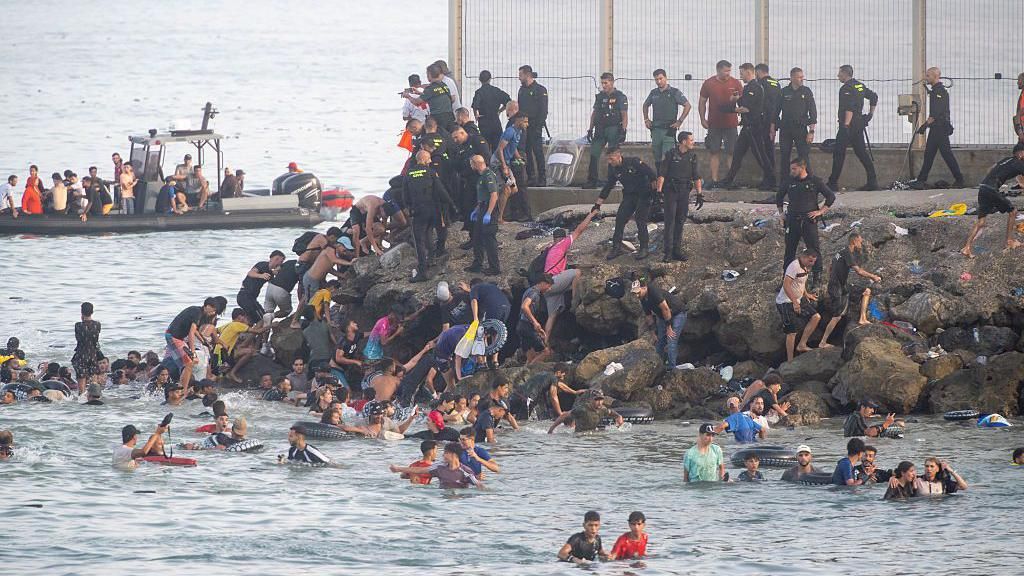
A sudden, chaotic mass crossing of thousands of migrants from Morocco into Spain’s North African exclave of Ceuta at the end of July has sent ripples of division across the European Union, prompting top EU leaders to demand coordinated collective action to strengthen the bloc’s external border security.
In the wake of the unprecedented influx, latest official updates show that more than 69,500 of the migrants who entered Ceuta have already traveled back to Morocco — a figure that outpaces the initial projection of 50,000 returnees. The human cost of the crisis has been steep: 72 people have been confirmed dead on the Spanish side of the border, while an additional 11 fatalities have been recorded on Moroccan territory.
European Commission President Ursula von der Leyen has called for unified EU action to address gaps in border management, following the crisis. In a formal letter addressed to Spanish Prime Minister Pedro Sánchez, von der Leyen commended the Spanish government for its rapid response to the emergency, but stressed that the incident exposed critical weaknesses that demand collective remediation.
“From this incident, it is clear that we must do more to further strengthen our borders at critical points,” von der Leyen wrote. She emphasized that protecting the EU’s shared external borders is a collective responsibility for all member states, calling for enhanced vigilance, targeted monitoring and the deployment of physical infrastructure to secure high-risk crossing points where necessary.
To address the fallout and map out a coordinated path forward, EU interior ministers will hold an emergency video conference on Tuesday. During the talks, the bloc will work to identify key lessons from the Ceuta crisis, with von der Leyen noting that irregular migration is a shared challenge that can only be resolved through a unified, collective European response rooted in solidarity.
She laid out five core priorities for the bloc to ramp up its action: partnering with non-EU source and transit countries to prevent irregular departures in the first place; bolstering security and capacity at the EU’s external borders; rolling out continent-wide early warning systems for migration surges; dismantling transnational human smuggling networks; and streamlining processes for the safe return of migrants who do not qualify for asylum or residency.
The crisis has already exposed deep rifts within the EU’s 27 member states over migration and border policy. In response to the Ceuta crossings, Italy unilaterally announced a temporary suspension of its Schengen Area border-free arrangements with Spain. The Schengen Agreement, one of the EU’s landmark integration projects, eliminates internal border checks across 29 European countries, serving a population of more than 450 million people.
Italy’s move drew public backing from Finland and Denmark, while Czech Prime Minister Andrej Babiš went a step further, calling for Spain to be temporarily suspended from full Schengen membership entirely.
Sánchez has pushed back sharply against these actions, noting that Ceuta has never been part of the Schengen Area, and that the crossing rules for the exclave do not fall under Schengen’s jurisdiction. The Spanish prime minister said he holds “serious concerns” about the positions taken by some fellow EU governments, acknowledging that most member states have offered Madrid support and solidarity, but accusing others of launching unfair political attacks driven by prejudice, misinformation, ignorance or domestic political gain.
Spain has blamed criminal human traffickers for engineering the mass crossing, saying the smuggling networks exploited a recent ruling by the Spanish Supreme Court that restricted the government’s authority to carry out immediate deportations of irregular migrants who arrive by sea. As of Saturday, Spanish Interior Minister Fernando Grande-Marlaska confirmed that the situation in Ceuta has nearly returned to full normalcy. The government is currently developing a new inflatable floating barrier to block future unauthorized water crossings in the region.