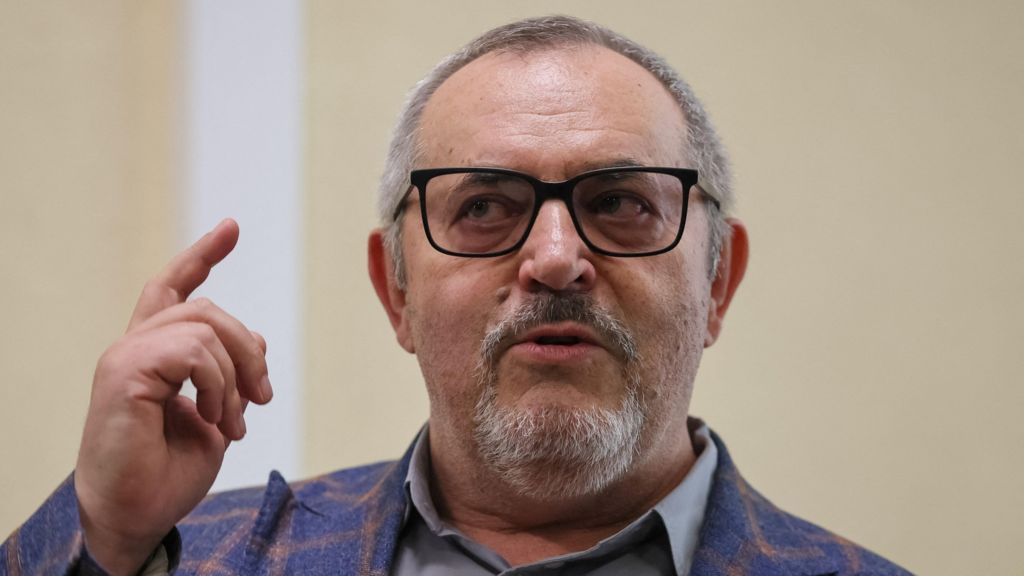
A prominent Russian opposition figure who built his political profile on an anti-war platform has left Russia for exile in France, becoming the latest critic of Vladimir Putin’s government to be forced out of the country amid a sweeping crackdown on dissent.
Boris Nadezhdin, 63, announced his new location in a video message posted to Telegram on Monday, filmed in front of Paris’ iconic Eiffel Tower. “Hi everyone. I have some good news. I’m alive and free. Unfortunately, I’m not in Russia at the moment,” he told viewers in the clip, adding that he would outline his future plans after taking time to assess his situation. “Right now, I need to get my bearings and figure out what to do next. I’ll write about my plans later.”
Nadezhdin first rose to international attention two years ago when he launched a bid for the Russian presidency, centering his entire 2024 campaign on a call to end the ongoing conflict in Ukraine. His platform also pushed for a reset of diplomatic relations between Russia and Western nations, and he argued that millions of Russian voters already opposed the Kremlin’s current trajectory of authoritarianism and militarism.
Though his criticism of Putin was relatively measured, leading some political analysts to speculate he might be permitted to run to lend a veneer of legitimacy to the election, the Russian Central Electoral Commission ultimately blocked his candidacy just weeks before voting began. Officials claimed more than 15% of the voter signatures submitted with his application were invalid, a ruling Nadezhdin contested unsuccessfully. He was not the only opposition voice sidelined: all credible alternative candidates were barred from the 2024 race, which Putin won in a landslide to secure a fifth term in office. A 2020 constitutional amendment reset the Russian president’s term limits, clearing the way for Putin to stay in power until 2036, with the next presidential election scheduled for 2030 when he will be 78.
Earlier this year, Nadezhdin announced he would launch another campaign, this time running for a seat in Russia’s lower parliamentary chamber, the Duma, in the upcoming September elections. That move triggered a fresh wave of legal and regulatory action from the Russian government. Last month, the country’s Ministry of Justice designated Nadezhdin a “foreign agent” — a designation that would have automatically barred him from running for office, and comes with widespread social and economic restrictions for anyone labeled under the law.
The accusations against Nadezhdin included claims he spread misinformation about the Russian government and encouraged public participation in unapproved anti-government protests. He also faced a separate charge of “displaying extremist symbols” linked to an image of late opposition leader Alexei Navalny that appeared for 10 seconds on a reposted video on his social media accounts in November 2023. Nadezhdin has dismissed the charge as absurd.
Weeks before his departure, Nadezhdin spoke to BBC Russian from an undisclosed location, describing his political prospects as “vague” after he was forced to abandon his parliamentary campaign. He argued at the time that for any active politician, participating in elections is the core of political engagement: “If you’re a politician, you should participate in politics while you have the opportunity. How do you participate in politics? By participating in elections.”
Nadezhdin also previously told the BBC that as the Russian economy has fallen into deeper crisis and the Kremlin has expanded internet restrictions for millions of domestic users, ordinary Russians are increasingly connecting their daily hardships — from rising food prices to failing healthcare to restricted digital access — directly to Putin’s policy choices.
Today, the Kremlin maintains almost complete control over Russia’s political landscape, with virtually no space allowed for legitimate opposition to challenge the country’s current leadership. Nearly all major opposition figures who could offer voters an alternative to Putin’s rule have been imprisoned, forced into exile, or killed.