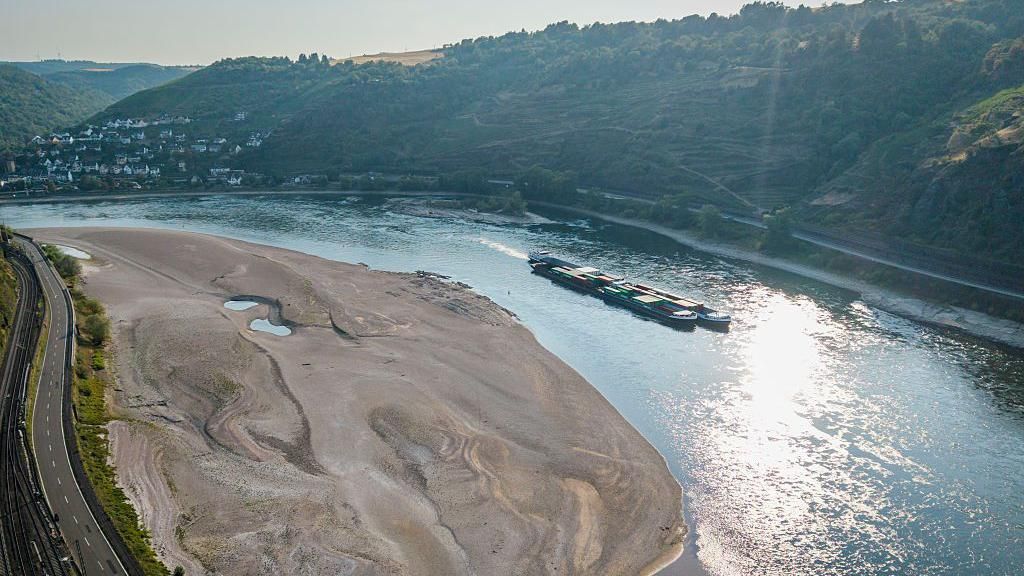
As unrelenting heatwaves blanket much of Western and Central Europe, one of the continent’s most critical waterways has hit historic lows that are already rippling through regional economies and energy systems. The Rhine River, which stretches from the Swiss Alps to the North Sea, has dropped to all-time record low water levels at multiple measuring points in Germany and the Netherlands, according to official monitoring data from both countries. Last week, gauges in Cologne, Germany, and Lobith—where the Rhine crosses the German-Dutch border—recorded depths lower than any seen since systematic record-keeping began.
This extreme water scarcity is not isolated to the Rhine. Other major European river systems that underpin cross-continental transport, power generation and agriculture have also plummeted to near-unprecedented lows. The Danube, which travels through 10 European countries, has dropped to its lowest levels in 30 years across Balkan and Central European sections, while Italy’s longest river, the Po, hit a historic low near Cremona in late July.
Data from the European Union’s Drought Observatories shows that as of mid-July, drought conditions remained stable but critically severe across most of the continent, with dry conditions worsening further in central-western regions. Forecasters project that the renewed heatwave will persist for at least another seven days, pushing temperatures above 40 degrees Celsius across broad swathes of central and southern Europe.
Germany’s National Low Water Information System (NIWIS) reported that by the end of July, 44% of all Rhine monitoring stations and 78% of Danube stations had registered extremely low water levels. As one of Europe’s busiest inland waterways, the Rhine’s falling depths have sparked urgent concerns about widespread economic disruption from restricted shipping. On Friday, water depth at the critical Kaub chokepoint near Koblenz matched the 2018 record low of 25 centimeters, before ticking up slightly over the weekend. The Kaub gauge is a key benchmark for Rhine navigability, as its measurement directly determines how much cargo vessels can safely carry. Extremely low levels here sharply restrict the capacity of inland shipping.
Martin Wolters, a representative of the Rhine Waterways and Shipping Authority, told German public broadcaster WDR that a full suspension of shipping along the river is unlikely, but mandatory precautions will still drive up costs and create supply chain bottlenecks. Vessels must spread cargo across more ships to reduce draft, a change that cuts total transport capacity and increases operational costs. “There comes a time when loads are too small to be worthwhile or vessel owners are worried about damaging their ships,” one commodity trader told Reuters.
The drought has already triggered cascading disruptions to Europe’s energy sector along the Danube. Hungary was forced to shut down its only nuclear power plant last week due to insufficient water for cooling systems, and Prime Minister Peter Magyar confirmed Monday that the timeline for restarting operations remains uncertain. “We don’t know when we will be able to restart [the plant]. We hope that it will happen as soon as possible and we hope that the cooling, liberating rain that the forecasters do not yet see coming will arrive,” Magyar said.
Neighboring countries have also faced energy disruptions: Serbia has reduced output at its coal-fired power plants because of cooling system failures linked to low water levels, while Romania carried out a controlled explosion to clear a large rock from the Danube’s banks to increase water flow to the Cernavoda nuclear power plant.
In Italy, the historic low levels of the Po have forced authorities to raise drought alerts to “high” across the entire Po Valley, with experts warning of potential disruptions to drinking water supplies. Reduced flow at the river’s mouth has also allowed Adriatic saltwater to intrude upstream into the riverbed, disrupting freshwater ecosystems and leaving farmers without usable irrigation water for crops.
While a recent analysis from the World Weather Attribution scientific group found no clear long-term downward trend in rainfall across most of Europe, researchers confirmed that anthropogenic climate change is amplifying drought risk by raising temperatures and increasing evaporation of soil and surface water moisture. Higher temperatures also drive increased demand for freshwater for household, agricultural and industrial use, exacerbating already tight supply. Prolonged drought also lowers lake levels, reducing overall stored freshwater reserves across the continent.
The 2022 European drought, one of the worst on record, contributed to a surge in wildfire activity that pushed carbon emissions well above the 21st century average, according to data from the EU’s Copernicus Climate Change Service.