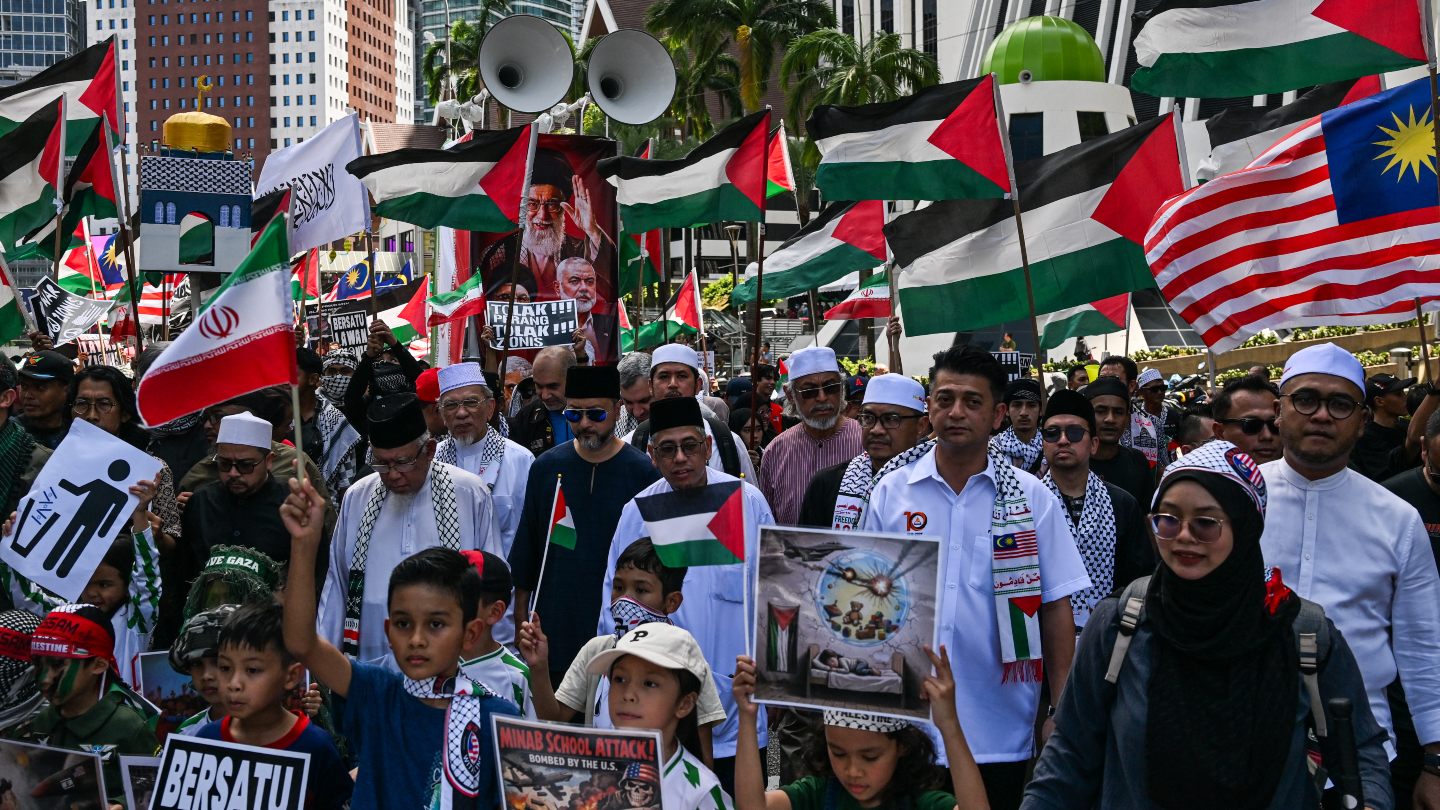
In mid-July 2025, a controversy sparked by unsubstantiated allegations of Israeli nationals working at a controversial tech-backed project in southern Malaysia has thrown a harsh spotlight on the deep contradictions between Kuala Lumpur’s longstanding pro-Palestine foreign policy and its aggressive push to attract global foreign investment.
On July 15, Malaysian Prime Minister Anwar Ibrahim made a forceful public declaration: any Israeli national found on Malaysian soil would be immediately deported, and the country would not compromise on its immigration stance, a position rooted in Malaysia’s official non-recognition of the state of Israel. The prime minister’s comments followed the emergence of online claims that Israelis were embedded in the Network School, a little-known initiative tied to the so-called ‘Network State’ concept launched by former Silicon Valley venture capitalist and Stanford professor Balaji Srinivasan, located in Johor state’s Forest City development.
Within hours of the allegations surfacing, Johor Chief Minister Dato Onn Hafiz Ghazi ordered state agencies including the Iskandar Puteri City Council to launch a full review of the Network School’s business compliance, and called for federal agencies including the Home Ministry, Immigration Department, police and customs to lead a formal probe into the claims of Israeli presence. Malaysia’s federal Home Ministry quickly greenlit the investigation.
After two rounds of inspections covering 379 foreign nationals registered at the site, Malaysia’s Immigration Department confirmed no regulatory violations were found among the vast majority of those checked, but noted that 19 individuals could not be traced. Director-General Dato Zakaria Shaaban told reporters the untraced people may have entered or exited the country through irregular channels, and authorities have launched a nationwide lookout for the group. On July 17, Ghazi’s administration issued formal notices to the Network School after uncovering that one of its linked properties was operating without a valid business license.
The crisis escalated on July 23, when the United States government summoned Malaysia’s ambassador to Washington, Tan Sri Muhammad Shahrul Ikram Yaakob, to demand clarification of Anwar’s deportation announcement. In a firm response, the Malaysian government reaffirmed it would not revise its longstanding immigration policy toward Israel. Srinivasan, for his part, took to social media platform X to request an audience with Anwar, seeking to reassure international investors and restore confidence in Malaysia as a viable destination for tech investment.
To understand the roots of this controversy, it is necessary to examine the unconventional nature of Srinivasan’s Network State project. First conceptualized publicly in 2022, the initiative frames itself as a “startup society” focused on peace, with the ultimate goal of crowdfunding physical territory to build a new sovereign state that would eventually earn diplomatic recognition from existing global governments. The project’s website describes it as a community built around an “ethnic diaspora” connected digitally, with physical outposts that act as “cloud embassies” where recruits can test the project before committing to stay. The Network State counts heavyweight backers including Silicon Valley titans Peter Thiel, Marc Andreessen, Joe Lonsdale and Patri Friedman, as well as major crypto firms such as Coinbase and Praxis.
Critics have long flagged the project’s troubling parallels to historical settler colonial ventures, noting that it centers on a digitally organized movement seeking to purchase and control physical territory in foreign nations. Many academic observers have also pointed out that Srinivasan frequently cites Israel as a model for successful nation-building, and draws direct ideological inspiration from Israel’s state-building experience. Compounding these red flags for Malaysia, multiple backers of the Network State have well-documented ties to Israel’s military and surveillance apparatus: Thiel’s data firm Palantir has invested heavily in Israeli military startups accused of providing surveillance technology that enables Israel’s military campaign in Gaza.
Srinivasan launched the Network School in 2024, choosing Forest City in Johor for its close proximity to Singapore, a global tech hub. But the location itself is mired in decades of controversy. Forest City is a multi-billion dollar joint venture between China’s Country Garden Group and Malaysian firm Iskandar Esplanade Danga 88 Sdn Bhd, whose shareholders include Johor’s ruling Sultan Ibrahim and business interests linked to the United Malays National Organisation, Malaysia’s largest Malay nationalist political party. Built largely on reclaimed coastal land, the development has long faced condemnation from environmental activists and local communities: an investigative report by Mongabay confirmed that construction began without a required environmental impact assessment, leading to the destruction of critical seagrass habitats and massive sand dumping that erased hundreds of hectares of traditional fishing grounds relied on by local communities. Rights groups have also previously criticized the project for relying heavily on low-wage migrant workers from South Asia, particularly Bangladesh, with limited labor protections.
The Network School scandal is not an isolated incident, but the most visible exposure of longstanding tensions at the heart of Malaysia’s foreign and economic policy. Malaysia has positioned itself as a vocal supporter of the Palestinian cause and a critic of Israeli military actions in Gaza, but it has also actively courted billions in foreign investment from Western and U.S.-linked firms, many of which have documented ties to Israel.
Earlier this year, for example, a BlackRock subsidiary was allowed to join a consortium taking a ownership stake in Malaysia Airports Holdings Berhad, a move that drew widespread criticism from Malaysian civil society groups, who called on Anwar to reject the deal over BlackRock’s links to what they described as “Zionist entity conducting a settler-colonial and racist genocide in Gaza.” Local media reports later revealed that the Anwar administration launched an aggressive media campaign to discredit critics of the BlackRock deal. In April, multiple major international defense firms with longstanding business ties to the Israeli military – including U.S. contractor Lockheed Martin, European missile maker MBDA, and U.S. firearms producer Colt’s Manufacturing – were allowed to participate in the 2026 Defence Services Asia and National Security Asia exhibition in Kuala Lumpur.
Civil society campaigners have also documented other ongoing links: Malaysian conglomerate Sime Darby maintains investment ties with Caterpillar, whose bulldozers have been used by the Israeli military for home demolitions in the occupied Palestinian territories; Australian rare earth producer Lynas continues its operations in Malaysia, with its minerals entering global defense supply chains that serve Israel; and activists have alleged that Malaysian ports have been used to facilitate shipments bound for Israel’s military supply chain. In 2025, Anwar welcomed former U.S. President Donald Trump to the ASEAN Summit held in Malaysia, despite widespread mass protests from pro-Palestine activists. Rights groups accused Malaysian police of detaining and intimidating peaceful protesters during the visit, while authorities maintained tight security to accommodate Trump.
Malaysia’s complicated balancing act is also shaped by its unique domestic political structure: a constitutional monarchy where power is divided between the federal government, state authorities and royal institutions, a system that has historically allowed large-scale foreign-backed development projects to move forward with limited public accountability or resistance. For Johor, the current site of the controversy, the stakes are particularly high: between July 2024 and June 2025, Malaysia attracted roughly $759 million in data center investments, with Johor emerging as a key tech hub as part of the newly launched Johor-Singapore Special Economic Zone.
Government officials have repeatedly stressed that all enforcement actions against the Network School have been rooted in regulatory compliance, not political considerations, but the controversy has ignited a fierce national and international debate over whether Malaysia can maintain its principled pro-Palestine stance while continuing to court investment from firms and countries with deep ties to Israel. As of late July, the investigation remains ongoing, and the future of the Network School project in Johor remains uncertain.