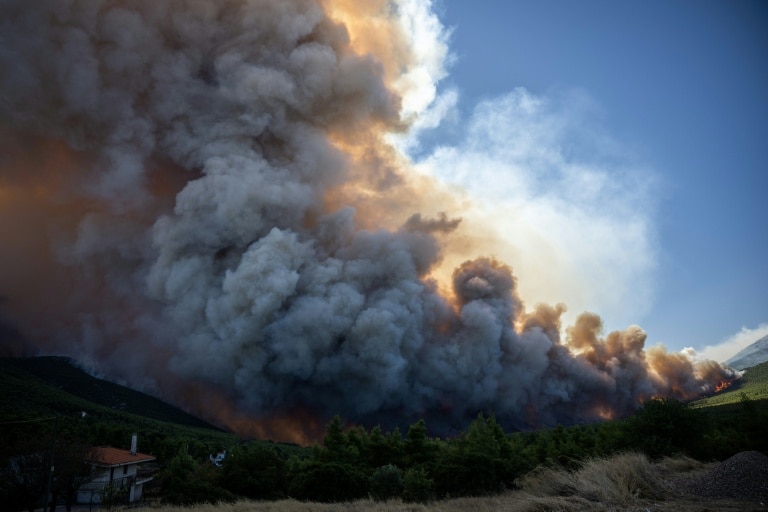
After a week of relentless, life-threatening blazes that have scorched thousands of hectares of land and claimed five lives, Greece has ramped up its wildfire response, with water-bombing aircraft returning to the skies Monday as dangerous high winds finally subsided.
Unlike neighboring France and Spain, which faced severe fire events early in the 2024 summer season, Greece escaped major wildfire activity for months. That luck ran out two weeks ago, however, and the country has now been locked in a desperate battle against multiple uncontrolled blazes for 14 straight days. The fires have consumed vast swathes of forest, coastal scrubland, and productive agricultural land west of the Greek capital Athens, as well as destroying areas on the islands of Crete and in the Peloponnese peninsula.
As of Monday, three major active fire fronts remained the most pressing concern for crews: the areas of Psatha, Kryo Pigadi and Kandyli, all located between 45 and 70 kilometers west of central Athens. With wind speeds dropping after days of gusts reaching up to 80 kilometers per hour — conditions that had forced aerial assets to ground, severely hampering containment efforts — nine water-bombing aircraft were able to rejoin the fight early Monday. They joined nine helicopters and roughly 450 ground-based firefighters working to contain the blazes across the Attica and Boeotia regions.
Even with the return of aerial support, Greek officials have stressed that the battle against the flames remains far from even. On Monday morning, the country’s Civil Protection agency ordered new mandatory evacuations for several small villages located near the Kandyli fire line, moving residents out of the path of advancing flames ahead of expected high temperatures through the day.
The crisis has already left a tragic toll. Since wildfires escalated last week, five people have been killed in fire-related incidents, all of them active responders. Three firefighters died last week while battling separate blazes in Crete and the Peloponnese. On Sunday, a mid-air collision between two Bell firefighting helicopters near Psatha killed a Danish pilot and a Greek co-pilot aboard one of the aircraft; the second helicopter’s pilot, a British national, and Greek co-pilot survived with injuries and were transported to a nearby hospital for treatment.
Following the collision, all Bell helicopters leased for the firefighting campaign have been grounded pending the outcome of a full official investigation, Greece’s public broadcaster ERT reported. The 15 Bell helicopters were leased from Australia’s McDermott Aviation, a company that has provided aerial support to Greek wildfire operations for seven years, according to the firm.
In a development that points to a potential human cause for one of the most destructive blazes, Greek police have arrested two employees of a national electricity utility in connection with a fire that broke out Friday near Porto Germeno, a coastal village on the Gulf of Corinth approximately 60 kilometers west of Athens. Investigators currently believe the blaze was sparked by a faulty or damaged electrical cable in the area.
Satellite data from the European Union’s Copernicus Earth observation programme, cited by Greek local media, shows that more than 12,000 hectares of forest and agricultural land have been burned since the outbreak of fires a week ago. That number is expected to rise as containment efforts continue.
Greek Prime Minister Kyriakos Mitsotakis has warned that the country faces “extremely difficult” days ahead, as sustained high temperatures and record-dry vegetation continue to create ideal conditions for fire ignition and spread. Civil Protection authorities have classified Attica and neighboring Boeotia — the regions currently facing the most active blazes — as level four on a five-point fire danger scale, meaning the threat of destructive fire remains “very high” as the country enters the peak of its summer tourist season. Climate scientists have long warned that the Mediterranean region will see increasingly frequent and intense wildfire seasons driven by rising global temperatures linked to anthropogenic climate change, a trend that is already evident in Greece’s ongoing crisis.