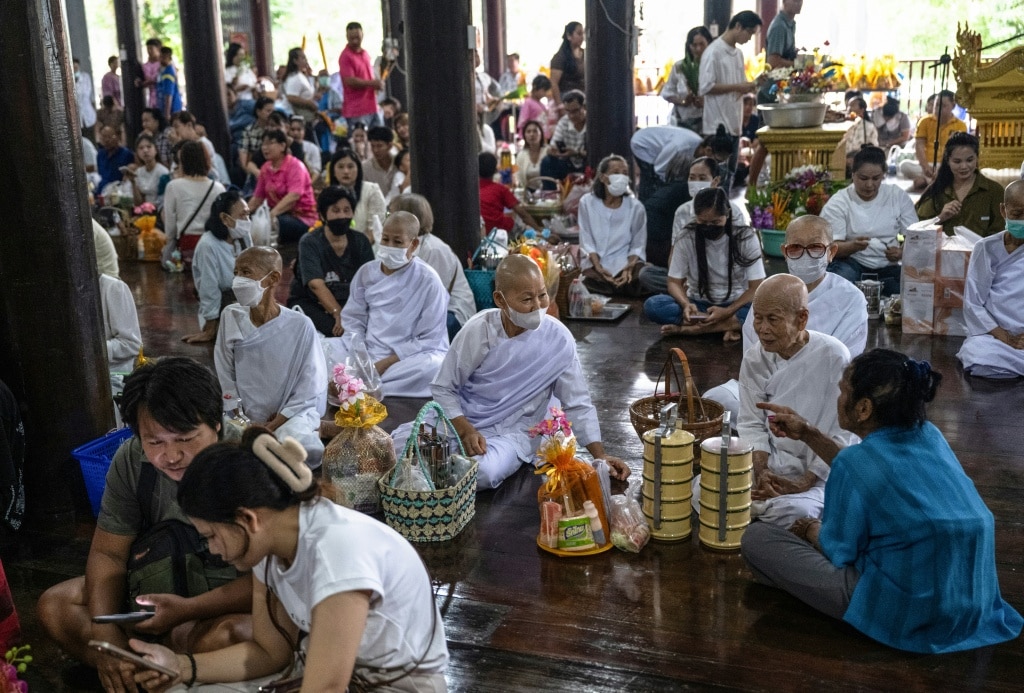
Across temples and community gatherings in Thailand this week, millions of people have joined a decades-old movement that merges Buddhist spiritual tradition with public health action: the annual three-month alcohol abstinence campaign tied to Khao Phansa, or Buddhist Lent. For participants, the ritual is more than a seasonal commitment — it is a life-changing opportunity to break harmful drinking habits rooted in widespread cultural acceptance of alcohol.
Wassana Nak-umma, a 42-year-old housewife who took her 2025 abstinence pledge at a temple in Samut Sakhon, a coastal province west of Bangkok, is one of millions returning to the campaign after experiencing its benefits firsthand. A self-described former heavy drinker, she recalled to Agence France-Presse how her addiction once left her so incapacitated that her own children had to clean up after her when she vomited from overconsumption. It was only after a concerned relative encouraged her to join the Khao Phansa campaign in 2024 that she was able to curb her habit. Though she returned to drinking after that first three-month abstinence, she now drinks only in moderation, and this marks her third year taking the pledge.
“I still craved it. Whenever I saw people buying liquor or beer at stores, I would look at them and want to drink like them,” she said. “But I held back, telling myself it was only three months. After that three-month period, I realised, ‘Hey, I can do this! Next year, I must do it again.’”
For 66-year-old former coconut farmer Phayom Raksa, the campaign led to a complete end to his daily drinking habit six years ago. Before joining, he told AFP, his addiction left his children ashamed of his constant drunkenness and drained all of his income on alcohol. Now, he encourages other community members to take the pledge, urging them to reframe their lives around positive goals.
The Khao Phansa abstinence campaign, which launched in 2003, was created to address a striking national paradox: more than 90% of Thailand’s population identifies as Buddhist, a faith that lists avoiding intoxicants as one of its core moral precepts, yet 2024 World Health Organization data ranks Thailand third highest in per capita alcohol consumption across Asia. Last year alone, more than eight million Thais signed up for the initiative, making it one of the largest voluntary public health campaigns in the country.
This year’s launch of the campaign, which coincided with the official start of Khao Phansa on Thursday, brought celebrations to Samut Sakhon, with traditional offerings to monks, cultural dance performances, and a community parade where participants rode coconut-transporting sidecar scooters called salengs, holding placards highlighting the benefits of healthy, alcohol-free living.
Unlike popular Western dry campaigns such as Dry January, which focus primarily on physical health benefits after holiday overconsumption, Thai organizers say the Khao Phansa initiative gains unique power from its spiritual and community roots. Ubolwan Kongsawang, a regional volunteer with Thailand’s Stop Drinking Network, explained that the public pledge taken in a religious or community setting creates a powerful accountability structure that individual attempts to cut back often lack.
“The Buddhist Lent campaign provides a ‘spiritual anchor’ that boosts motivation,” she said. “When individuals take a pledge before a Buddha image, at a temple, or within their community, they feel bound to honour their word.”
Organizers have updated their outreach strategy this year, shifting focus from strict total abstinence for all participants to highlighting the wide-ranging benefits of any reduction in alcohol consumption, including better physical health, stronger family relationships, and lower household spending. Dr. Pongthep Wongwatcharapaiboon, director of the government-run Thai Health Promotion Foundation, noted that even reduced consumption that leads to long-term health improvements counts as a win for the campaign.
“Our goal is not necessarily total abstinence for everyone,” he said. “Many reduce their consumption and discover the health benefits, which is already a success.”
The campaign comes as Thailand adjusts its long-standing alcohol regulations: in December 2024, the government relaxed decades-old rules that banned alcohol sales during afternoon hours, a policy originally implemented to prevent government employees from drinking on the job. Alcohol remains prohibited for sale on religious public holidays and around election periods.
Ultimately, campaign leaders say their work extends far beyond the three months of Lent, aiming to shift Thailand’s deep-rooted drinking culture that normalizes alcohol consumption at nearly every social gathering, from funerals to national festivals. “We are trying to transform the drinking culture itself, not just reduce individual consumption,” said Teera Wacharaprannee, head of the Stop Drinking Network. “Our strategy is to continue beyond Lent, supporting villages and communities to reduce alcohol in daily life.”