Deep in the heart of Rawalakot, a major city in Pakistan-administered Kashmir (PAK), a rudimentary emergency clinic sits just steps from the epicenter of months of escalating unrest between protestors and state security forces. What began as a campaign for basic economic and civil rights has devolved into deadly clashes that have left dozens dead, countless injured, and the region on edge as local elections unfold.
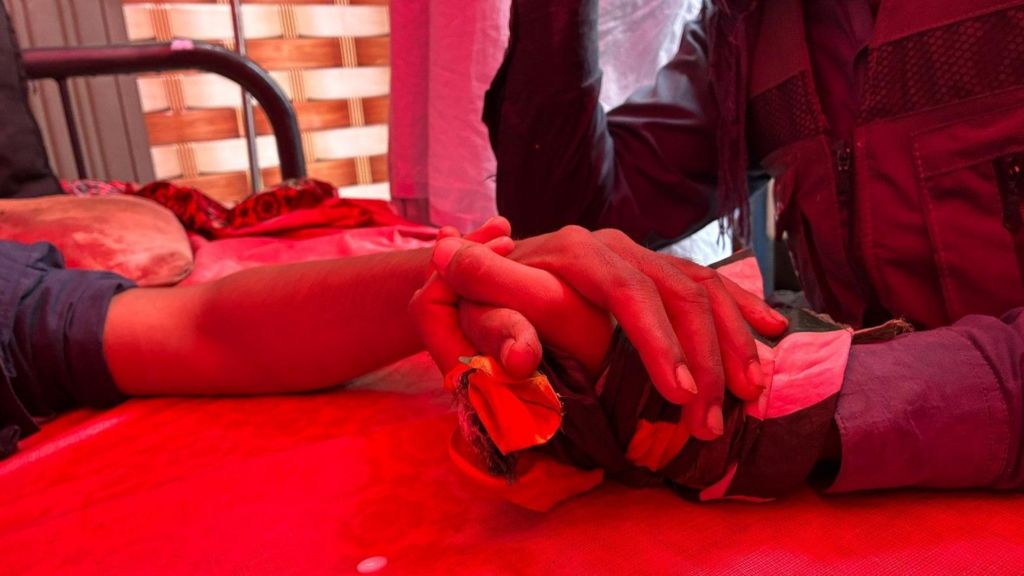
The clinic, operated by a physician identified only as Dr. Anwar for his safety, is cobbled together from spare domestic space: a converted bedroom stores limited medical stocks, while a single patient bed rests outdoors under a tattered red tarpaulin. On that bed lies Shafqat Hussain, a protester shot in the chest, lying on a sheet already stained by the blood of earlier casualties. With no access to advanced care, Hussain is slipping away.
Over the past two months, clashes between security personnel and demonstrators from the Joint Awami Action Committee (JAAC), the organizing group behind the protests, have killed dozens across the 4.5 million-person region. This violence has unfolded against the backdrop of ongoing regional elections, and the BBC became the first international media outlet to gain on-the-ground access to Rawalakot to document the crisis.
Dr. Anwar explained that his small clinic is only equipped to handle minor trauma: his team can stop bleeding, clean and bandage surface wounds, and remove bullets lodged just beneath the skin. But for patients with life-threatening injuries to vital organs like the chest, abdomen, or brain, advanced hospital care is the only option – and that care is out of reach for most injured protesters. He noted that even major regional hospitals would struggle to cope with a surge of critical gunshot wound patients, a surge his clinic has already faced: since July 27 alone, the makeshift facility has treated 50 to 60 critically injured people, 15 to 20 of whom suffered gunshot wounds treated personally by Dr. Anwar.
Injured demonstrators avoid formal public hospitals out of fear of arrest or extrajudicial violence, a claim local authorities have rejected as false. Dr. Anwar added that the vast majority of casualties are young people between the ages of 15 and 35, with very few patients over 40. The local administration says JAAC protesters have blocked major access routes into Rawalakot, cutting off connectivity and transit.
At Hussain’s bedside, his grieving friend Ali wiped away tears as he described the demonstrators’ core demands. “We only asked for affordable flour, electricity and our basic rights,” Ali said through sobs. “Instead, our brothers are being killed. What was our crime? Why are live bullets being fired at us?”
JAAC launched its protest movement after a 2023 agreement with the Pakistani and PAK governments, which was meant to address longstanding grievances including soaring energy costs, failing education systems, and inadequate healthcare. The group says the government has failed to implement the terms of the deal, prompting continued demonstrations. Protesters planned to march to the regional capital of Muzaffarabad, but authorities blocked the route.
Local government officials have pushed back against JAAC’s narrative, labeling the group as armed agitators seeking to disrupt the regional elections. The JAAC was officially banned in June, and has been branded as foreign-funded terrorists by the state. The group rejects this characterization, confirming it receives funding from the PAK diaspora abroad but denying it is sponsored by India, a common accusation from Pakistani authorities. JAAC insists it is a peaceful civil rights movement and that security forces initiated the violence, making protesters the primary victims.
With internet service cut across the region and major roads either blocked by protesters or guarded by security checkpoints, independent information about the unrest has been extremely hard to verify. During the BBC’s on-the-ground reporting, multiple grieving families shared accounts of losing loved ones to gunfire during demonstrations.
Asma, a woman whose only son was killed at a protest, said she was at the demonstration when she learned he had been shot. “We were only asking for our rights. We are not terrorists,” she said. “No mother could ask for a better son. He knew there were risks, but he believed standing up for justice was important. He used to say that dying for a just cause was an honour.”
Salman, who lost his younger brother in the violence, echoed her grief and pride. “He was the youngest in the family and was loved by everyone. It is a great loss for us,” he said. “At the same time I feel proud that he gave his life while standing up for the rights of the people. He was not fighting or attacking anyone.”
Ayub, a retired armed forces soldier who also lost his son, laid blame not at the feet of Pakistan’s national government or military, but with the PAK regional administration, which he said called in paramilitary forces to suppress the protests. “I am a retired soldier. I lived through the martial law periods of General Zia-ul-Haq and General Pervez Musharraf,” he said. “But I have never seen anything like what is happening now. In my opinion, it is extreme injustice. My son had done nothing wrong. None of the protesters had done anything wrong.”
PAK’s government has rejected claims that security forces opened fire indiscriminately on peaceful demonstrators, saying law enforcement only responded to individuals who attacked officers, threatened public order, or obstructed official actions.
The BBC documented widespread food shortages in Rawalakot, with nearly all shops closed and demonstrators sharing limited existing supplies among themselves. Some residents described smuggling small bags of rice into the city on the back of motorbikes to avoid checkpoints. While some access routes are blocked by felled trees – which authorities say were cut by JAAC protesters – other main entry points are controlled by armed security checkpoints. The PAK government denies blocking food or medical supplies from entering the city, saying it is actually facilitating the delivery of essential goods.
Authorities have repeatedly presented evidence they say proves JAAC is a violent group: they have released drone footage they claim shows armed JAAC members on city rooftops, and displayed weapons seized from the group to local media. Officials say several security personnel have been killed in clashes, and that a detained JAAC suspect confessed to being promised a reward of 10 million rupees (roughly £26,700) for every paramilitary officer killed.
Umar Nazir, a core JAAC committee member currently based in Rawalakot, did not deny that security personnel have died, but claimed without providing evidence that state agents have infiltrated the JAAC movement to carry out violence and discredit the group. “I believe that certain elements, who are under their control, were infiltrated into our ranks. Such people were certainly present among us,” Nazir said. “I believe they may have carried out such actions themselves in order to justify their own narrative. I am not making a definitive claim, but there is no evidence whatsoever that any such violence came from our side.”
Authorities reject this claim, saying JAAC has launched a disinformation campaign against the government across social media. During the BBC’s visit to a JAAC protest, reporters saw no visible weapons or gunfire from demonstrators, though repeated gunshots were heard overnight. It remains unclear who fired the shots and what their target was.
Today, Rawalakot remains in a state of tense, uncertain limbo. No one can predict when or if the violence will escalate further. Nazir says JAAC remains open to negotiations with authorities, but in the meantime, the group has more demonstrations planned in the coming weeks.