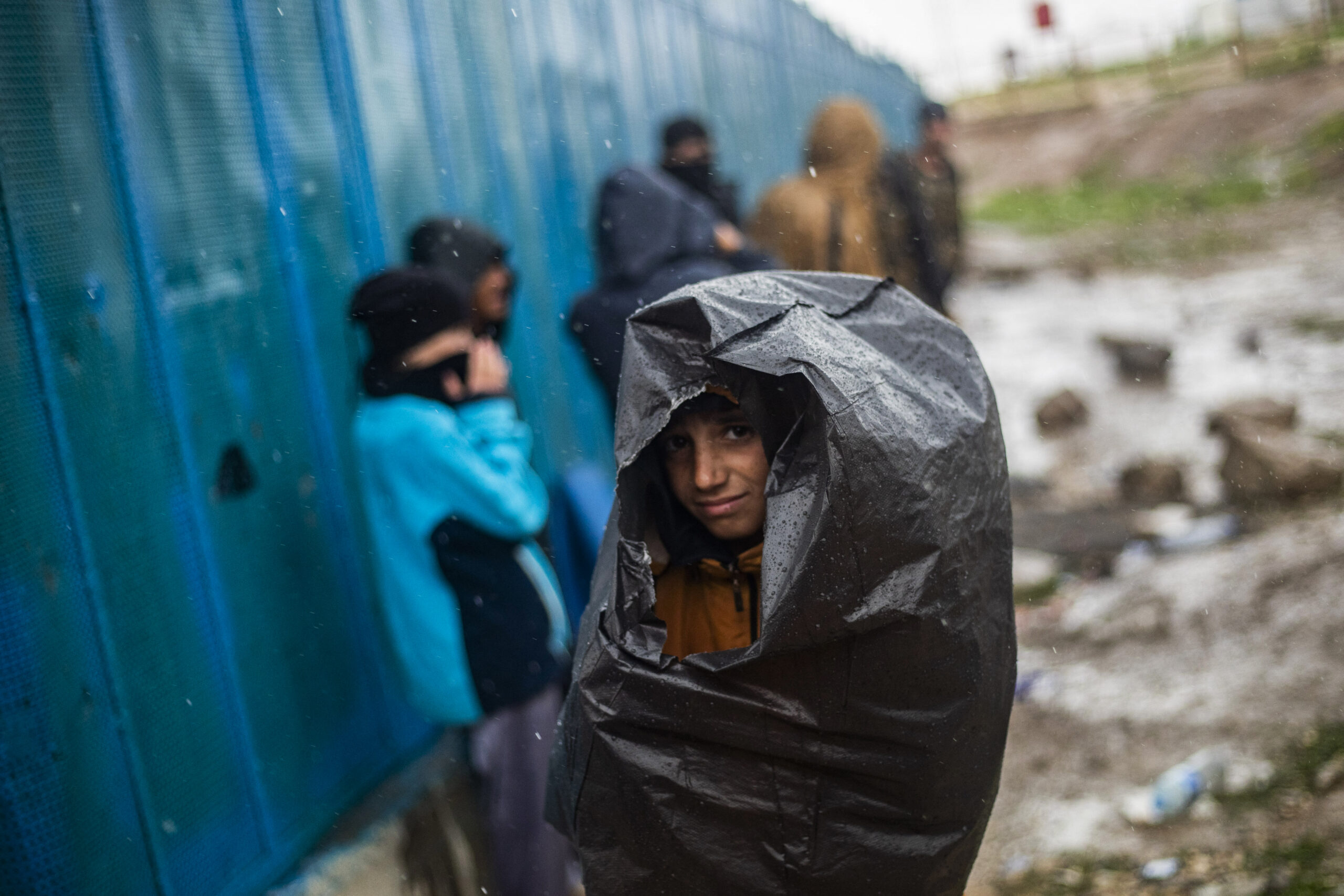
On a Friday evening in northeastern Syria, gunfire rang out across the sprawling Roj detention camp, a facility that holds thousands of foreign women and children linked to suspected Islamic State fighters, leaving detainees trapped in a night of terror that has renewed global scrutiny of the camp’s long-troubled conditions. Multiple firsthand testimonies collected by Middle East Eye (MEE) confirm that Kurdish-led Syrian Democratic Forces (SDF) opened fire during a confrontation with protesting detainees, with bullets piercing through fabric tents where children were sheltering. While no casualties were reported in the incident, detainees describe widespread psychological trauma from the episode, which capped off several days of peaceful demonstrations by camp residents demanding an end to systemic abuse and urgent repatriation to their home countries.
MEE has verified visual and audio evidence from inside the camp, including footage showing the immediate aftermath of the clash: scenes of panicked women and children fleeing for cover, and recordings capturing the crack of gunfire echoing across the facility. The unrest was not spontaneous: it grew out of months of escalating mistreatment, culminating in an early-week night raid where guards beat a Russian detainee who refused to surrender her personal cash and mobile phone, according to Dalal, a Bosnian detainee who requested anonymity for her safety. Dalal, who has been held in the camp since 2017 with her two children after her husband was killed in the conflict, said the violent assault was the final breaking point for residents who had endured repeated night raids, arbitrary beatings, and theft of personal belongings for years.
“That night they hit her so hard that it echoed through the camp,” Dalal told MEE. “That night the women gathered their courage for the first time, and everyone came out to see what was happening. Since then we haven’t let them enter the camp.”
According to multiple accounts, the Friday confrontation unfolded around 6 p.m., when SDF personnel entered the camp in armored vehicles and set up a defensive cordon on the camp’s main road. When curious women gathered to question the incursion, they were ordered to return to their tents immediately. Tensions boiled over when detainees challenged the SDF’s presence, leading forces to open fire, detainees say. Hoda Muthana, a high-profile detainee held in Roj, told MEE that the entire incident was a deliberate provocation designed for propaganda purposes.
“The Kurds provoked the women for their own propaganda. The women then reacted, and the Kurds began to shoot in the air, but one soldier shot through the tent,” Muthana said. The bullet passed through a neighboring tent belonging to an Indonesian family before coming within feet of Muthana’s own young son, who had been lying in his tent at the time. “If the shot had been one or two feet lower, it would have hit my child,” she added. “I couldn’t move from fear. We were only a few feet apart. They almost killed my child.”
Muthana and other detainees accuse the SDF of orchestrating the clash to frame the camp’s residents as dangerous and radical, in order to justify their continued detention and deter international pressure for repatriation. She said soldiers recorded the women’s panicked reactions on their mobile phones to craft a false narrative for international audiences. “The administration in Roj camp is propaganda con artists,” she said. “They are always thinking of ways to make us look inhumane and radical so the public and governments don’t sympathize with us.” Muthana added that the stand-off lasted roughly four hours, and several women who were closest to the guards were beaten during the clash.
One anonymous detainee, who spoke to MEE on condition of anonymity for security reasons, emphasized that the women who confronted the SDF were unarmed and overwhelmingly vulnerable, with many suffering from untreated chronic illnesses and injuries. “Those moms in the camp, the majority are sick – no medical attention for years – or [have] had injuries from before, overweight and unarmed,” she said. “All they do is just gather to protect a child and to speak with the soldiers.” She described the wave of fear that swept through the camp after gunfire broke out, noting that her 7-year-old daughter ran to hide under a plastic chair, and that decades of conflict and prolonged detention have left nearly all camp residents living with post-traumatic stress disorder. “It’s a moment you can’t control, especially when your whole family is already living with PTSD,” she said. “We are humans, and those innocent children have rights too. For a decade we’ve been seeing our children live in extreme danger. Please react before it’s too late.”
Detainees link the recent escalation of tensions to shifting political dynamics in northeastern Syria, as the Syrian government in Damascus gradually reasserts its authority over regions previously controlled by Kurdish-led forces. Many detainees believe that Kurdish-led administration officials are venting their frustration over the political transition on the vulnerable camp population. “I can tell the PKK [Kurdish Workers Party] and YPJ [Women’s Protection Units] are extremely angry with the coalition and the new government, and they take it out on unarmed, sick women and children,” one detainee told MEE.
Muthana echoed that analysis, arguing that the incident was deliberately staged to reinforce a narrative that justifies the SDF’s continued control of the camp. “They want to provoke us to create reactions, and these reactions are then shown to countries or the Syrian government to keep us under their control,” she said. She also condemned what she described as the collective punishment of all detainees, regardless of their individual circumstances. “The Kurds use a blanket judgement on us all and treat us inhumanely because they believe we came here to commit genocide against their people. I was 20 when I came to Syria and had never even heard of the Kurdish race before. Many younger women have said the same,” she said.
This is not the first reported incident of SDF forces opening fire on detainees at Roj. Human Rights Watch documented a nearly identical incident in January of this year, when security forces fired weapons in the air outside a detainee’s tent and forced women out into freezing temperatures.
Located in Syria’s Hasakah province near the Iraqi border, Roj camp is administered by the Democratic Autonomous Administration of North and East Syria and guarded by the SDF. It currently holds roughly 2,300 detainees, most of them foreign women and children who are relatives of suspected IS fighters, and became the country’s primary detention facility for this population after the larger al-Hol camp was dissolved in January. A 2024 report from Sweden-based advocacy group Repatriate the Children, which drew on testimony from more than 40 detainees between January and May, found that human rights violations inside the camp had increased “significantly in both frequency and severity” since the start of the year. Rights groups have repeatedly raised alarms about conditions at Roj and called for urgent international intervention to resolve the crisis.
As the Syrian government works to expand its control across northeastern Syria, most detainees in Roj say they now view Damascus as their best path out of unbearable conditions, and overwhelmingly support a transfer of authority for the camp to the Syrian state. “If the devil offered us a safe haven away from the Kurds, we would take it,” Muthana said. “All we want is to go home and be with our families.”
MEE reached out to the SDF for comment on the incident ahead of publication, but received no response by the time of reporting.