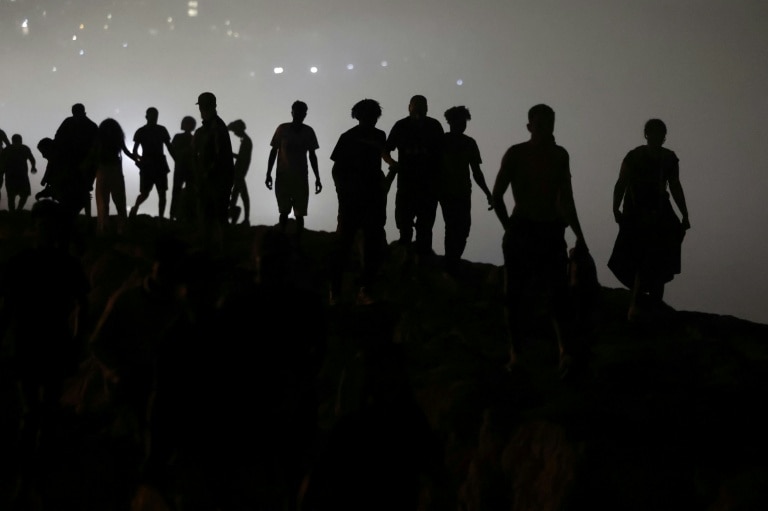
One of the largest uncontrolled mass migrant crossings in recent European history has left at least 72 people dead after tens of thousands of people, mostly swimming across the border from Morocco, flooded into Spain’s North African enclave of Ceuta over recent days, local government officials confirmed Sunday. The death toll, updated from an earlier count of 67, marks one of the deadliest recent migrant events on the European Union’s southern border.
An estimated 60,000 people crossed Ceuta’s lightly guarded border barrier between Wednesday and Friday, according to official estimates, but the vast majority have returned voluntarily to Morocco over the past 48 hours, leaving the small enclave gradually returning to normal operations by Sunday. By the end of the weekend, only small scattered groups of migrants remained in public spaces across Ceuta.
On Sunday, Spanish national police and military personnel patrolled Ceuta’s city streets as clean-up crews worked to clear trash, discarded clothing and other debris left behind along the border crossing during the mass movement. An AFP reporter on the ground witnessed Spanish soldiers detaining a group of nine exhausted migrants resting on a sidewalk near a port-side housing development, guarded by troops and an armored personnel carrier. Rescue teams deployed small inflatable vessels to patrol the Mediterranean waters surrounding the border barrier, where a new 500-meter floating security boom has been installed to reinforce border controls. Spain’s Civil Guard was also seen transporting groups of remaining migrants by bus back to the border crossing for repatriation to Morocco.
Many unaccompanied minor migrants remained in Ceuta over the weekend, gathered in a disused industrial park on the city’s outskirts. Aziz Dabch, a 41-year-old Moroccan man who was among the few adults staying with the group, told reporters that every child at the site shared the same goal: reaching mainland Spain to build new lives.
The unprecedented mass influx has already triggered an international diplomatic crisis, with many of Spain’s European Union partners criticizing Madrid’s handling of immigration and border policies. Multiple competing explanations have emerged for what led to the sudden surge in crossings. Spanish officials have blamed criminal smuggling networks for spreading false rumors across social media claiming that a recent Spanish Supreme Court immigration ruling would open a window for unimpeded access to the enclave and eventually mainland Europe. Multiple regional analysts have put forward an alternative theory: that Moroccan authorities intentionally relaxed border controls to place diplomatic pressure on Spain, which has recently moved to strengthen diplomatic and trade ties with Algeria, Morocco’s long-standing regional rival. This is not the first time Morocco has used this tactic: in 2021, roughly 10,000 migrants crossed into Ceuta after border controls were eased, in a widely documented move to pressure Madrid. To date, Moroccan officials have not issued any public comment on the current crisis. Migrants who crossed the border confirmed they had heard widespread claims the border was open, a rumor that spread rapidly across social media platforms to draw thousands to the crossing.
The European Union announced Sunday that it would hold an emergency video conference on Tuesday to address the crisis, after 22 of the bloc’s 27 member states signed a joint open letter calling for an urgent, coordinated EU-wide response to prevent additional uncontrolled border crossings. The crisis has already exposed deep divisions among EU member states: on Saturday, Italy implemented a one-month suspension of its Schengen Area commitments with Spain, pausing visa-free free movement across their shared border for the duration of the emergency. Spanish Prime Minister Pedro Sanchez publicly condemned the move in a letter sent to all EU leaders, labeling the decision “selfish” and highlighting the need for collective action rather than unilateral border restrictions.
Pope Leo XIV addressed the unfolding crisis during his regular Sunday daily prayers, saying he was following the situation in Ceuta “with deep concern” and called for a negotiated solution that delivers “peace, stability and justice” for all people affected by the crisis.