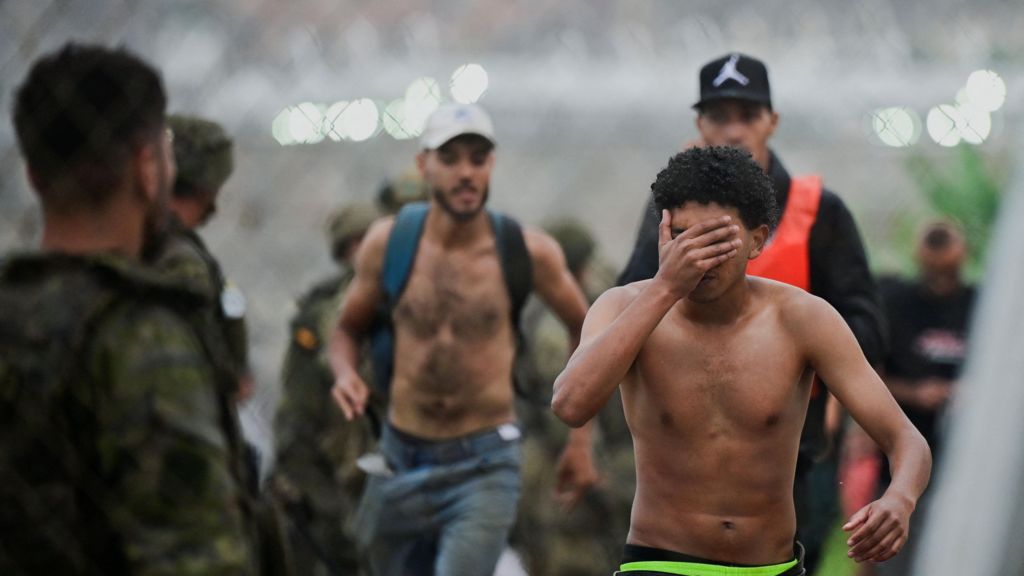
In an unprecedented migration event that has sent shockwaves across Europe, an estimated 49,000 migrants have crossed from Morocco into Spain’s North African exclave Ceuta over a 24-hour period, overwhelming local border authorities and triggering a major diplomatic and security emergency.
Visual evidence from the scene shows thousands of people swimming across the coastal border into Ceuta on Thursday, with local reports confirming unauthorized crossings continued through the night. The crisis has already claimed lives: Spanish officials confirm at least 18 migrants have died attempting to reach the territory in recent days, a stark reminder of the deadly risks many take in search of entry to the European Union.
The massive influx follows a landmark ruling from Spain’s Supreme Court earlier this month, which barred authorities from immediately summarily returning intercepted migrants to Morocco from Ceuta and its sister Spanish exclave Melilla. Located on Morocco’s northern coast and separated from mainland Spain by the Strait of Gibraltar, Ceuta has long been a primary gateway for migrants seeking to reach Europe, as it forms one of the EU’s only two land borders with the African continent. Both Ceuta and Melilla are claimed by Morocco, but Spain maintains the two territories are integral, semi-autonomous parts of Spanish territory, making their status a persistent flashpoint in Morocco-Spain diplomatic relations.
Local authorities had already warned of rising crossing attempts and appealed to the national government in Madrid for additional support, but border controls completely collapsed on Thursday, leading to widespread chaotic scenes across the enclave. Official estimates show the number of new arrivals equals more than half of Ceuta’s total current population of roughly 83,600, putting unprecedented strain on local housing, food, and public services. Of the 49,000 new arrivals, officials estimate at least 7,000 are children and minors, with the majority of migrants being young men alongside a significant number of women and even infants.
Unlike most crossing attempts that require migrants to swim several kilometers from distant coastal points, this surge allowed most migrants to approach within close range of Ceuta’s border fence with minimal interference. Many walked along coastal rock jetties before swimming short distances to Ceuta’s beaches, raising urgent questions about the absence of Moroccan border patrols and why the large groups were not dispersed or stopped before reaching the border.
The sudden large-scale crossing came after several days of gradual increases in arrivals, with word of successful crossings spreading rapidly through migrant communities. The last major surge of migration into Ceuta occurred in 2021, when Moroccan authorities allowed roughly 8,000 migrants to cross amid a diplomatic dispute with Madrid over Western Sahara sovereignty. That dispute has reignited in recent weeks after Spanish Prime Minister Pedro Sánchez traveled to Algeria, which supports Western Sahara’s independence movement.
In response to the crisis, Spain has deployed armed forces to reinforce security in both Ceuta and Melilla, where an additional 300 to 400 unauthorized crossings were reported overnight. Sánchez is scheduled to visit Ceuta on Friday to assess the situation, and the Spanish interior ministry says it is coordinating with Moroccan authorities to facilitate the return of all people who entered the territory illegally as quickly as possible.
Local media reports that clashes between migrants and Spanish police continued through the night Friday as crossings persisted, with one senior Spanish official describing the border as being in total collapse. The crisis has already sparked a diplomatic row between Spain and Italy, after Italian Prime Minister Giorgia Meloni called images from Ceuta “shocking” and labeled uncontrolled migration a critical security threat to the entire European Union. Meloni also announced Italy would consider suspending its Schengen Zone free movement agreement with Spain, a move that analysts note has little practical impact, as Ceuta is separated from mainland Spain and new arrivals are confined to the exclave, not the Spanish mainland.
Meloni’s comments were echoed by Italian Foreign Minister Antonio Tajani, prompting a sharp rebuke from Spanish Foreign Minister José Manuel Albares, who accused Italian officials of weaponizing the migration crisis for domestic political gain. Albares called the comments “improper” coming from a friendly European partner, saying Spain expected European solidarity rather than partisan political demagoguery. On Friday, Albares summoned the Italian ambassador to Madrid to protest the remarks. The Schengen Zone, which includes both Spain and Italy, is a 29-nation bloc that has abolished all internal border checks for free movement across member states.