A logistical and procedural crisis descended on London’s Westminster Crown Court Thursday, as more than 1,500 defendants facing terrorism-connected charges related to pro-Palestine protests were summoned for hearings amid conflicting guidance, widespread confusion, and widespread criticism of the UK government’s ban on the direct action group Palestine Action.
The chaos unfolded after hundreds of defendants had already received formal notifications that their trials, originally scheduled for July 30, would be adjourned until October. Yet despite the adjournment notices, court records published Wednesday listed all 1,579 cases for hearing on July 30 at Westminster Crown Court, leaving defendants with contradictory instructions about whether they were required to attend. One letter obtained by independent news outlet Middle East Eye simultaneously ordered a recipient to “must attend” the July 30 hearing, then immediately instructed them “Please do not attend court” on that same date.
Defend Our Juries (DOJ), a campaign group supporting the defendants, argues that this systemic confusion is a direct symptom of the disorder created by the government’s 2025 proscription of Palestine Action, which has pushed the UK’s criminal justice system into a state of “complete meltdown”. In a parallel development Thursday, the UK Supreme Court ruled that Palestine Action could legally challenge the ban, which was first implemented by former Prime Minister Keir Starmer’s administration in July 2025. Since the proscription took effect, thousands of people have been arrested over the past year, most simply for holding placards or wearing clothing expressing solidarity with the group.
Court records obtained by Middle East Eye show a printed list of roughly 2,000 cases spanning 82 pages pulled from the CourtServe listings service, with multiple defendants listed multiple times under different spelling variations of their names. When dozens of defendants traveled to London to attend their scheduled hearings Thursday, they wandered the court grounds with their conflicting notices, receiving inconsistent explanations from court staff. One defendant reported her hearing was assigned to a courtroom that does not exist at the Westminster complex. Upon arrival, attendees were generic “To Whomever It May Concern” leaflets stating all cases had been adjourned to October 26 for an administrative directions hearing, and that no attendance was required.
“That is crazy. That’s not how the court system is meant to work,” said Tim Crosland, a former government lawyer representing the defendants. “What a court normally does is send a clear letter to every person with a hearing, telling them exactly when and where to appear. That’s basic court communication, not generic flyers handed out to random people at the door. If you’re facing a terrorism charge, you have a right to be present for your case — you don’t want prosecutors discussing the future of your case without you there. It looks like the court is trying to avoid the logistical problem of hundreds of people arriving at once by turning the entire process into a mass-produced sausage machine, with no respect for individual cases.”
Middle East Eye reached out to the Crown Prosecution Service for comment ahead of publication, but received no response. Late Wednesday, London’s Metropolitan Police issued a public statement dismissing a planned protest outside the court as “nonsensical”, claiming no Palestine Action-related hearings would take place Thursday. In response, DOJ sent a formal letter to the Met demanding clarity on the source of the police’s information, arguing that “if court hearings have been postponed, that fact should be communicated by the court to the parties directly, not via a police statement the evening before the hearing.”
Multiple defendants who spoke to Middle East Eye, many of whom requested anonymity for legal reasons, described the deep disruption the charges and procedural chaos have caused to their daily lives. Steve, who traveled from Norwich for an 11 a.m. hearing, only to be told he did not need to attend, said: “That’s very polite of them, but I can’t imagine any other circumstance where they charge you with a crime — especially terrorism — and just tell you not to bother showing up.” Another defendant, Tony, said he had received multiple overlapping notices that said “the defendant need not come to court but they may do so if desired.” He added: “If you’re going to call me a terrorist, at least treat me like one and let me attend my own hearing.” Tony explained that the pending terrorism charge already bars him from traveling to the U.S. to visit family, and has damaged his ability to secure new contracts as a self-employed contractor.
Bernie and Heather traveled eight hours from mid-Wales to attend their hearings, after booking accommodation and receiving an initial adjournment notice, only to see their names reappear on the final court listing Wednesday. Marji, a 69-year-old DOJ spokesperson who traveled two hours from Chichester, told reporters she was listed for three separate hearings under two different spellings of her name, and held a court letter that simultaneously required her attendance on July 30 and forbade it. “I am legally entitled to attend every one of my hearings,” she said. “They say there is a hearing listed, they say I have a right to speak at every hearing, but they won’t let us in. Is this a secret court?” Miriam, a self-represented defendant from east London, faces five separate charges under the Terrorism Act, only received adjournment notices for three, and saw four of her five cases listed for Thursday. “I came because it’s all unclear, but also because I strongly object to the adjournment,” she said. “I don’t have a lawyer, I’m representing myself, so I need to be here in person to follow what’s happening.”
Clive Dolphin, a DOJ spokesperson, called the court’s mass handling of the cases unlawful. “There has been no clear individual communication to defendants. The court seems to be treating this as a single block booking, but that is not how justice works. All these cases are different, they involve different people in different circumstances. Under Section 13 of the Terrorism Act, an offense is only committed if the display of support arouses reasonable suspicion of membership — the circumstances of one person holding a sign are not the same as another. You cannot round up hundreds of people, treat them all as a single group, and arbitrarily move their hearings en masse. That is not how the justice system is supposed to operate.”
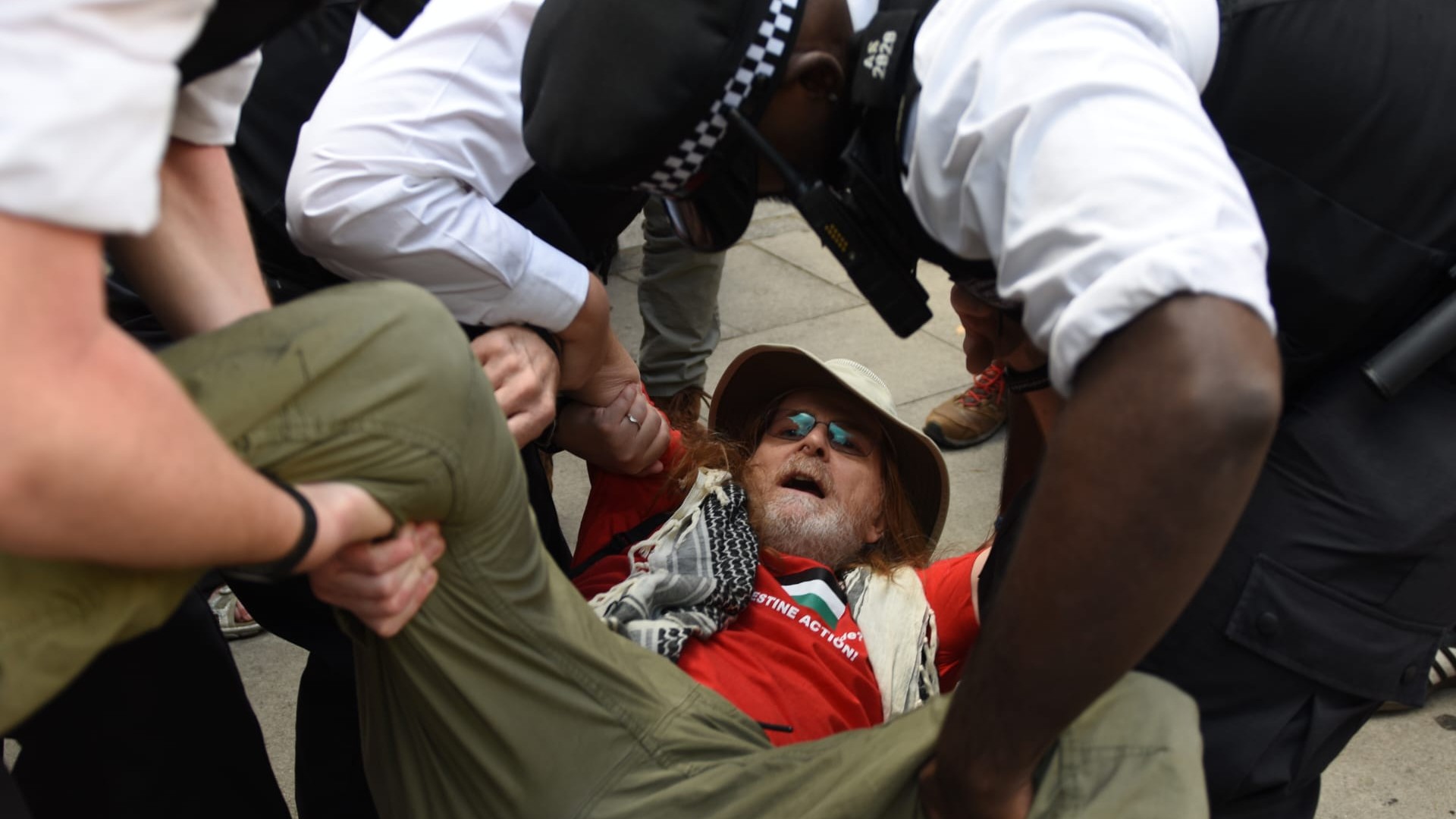
Outside the court, police arrested 77 people after around 200 protesters staged a sit-in, where they planned to read statements supporting Palestine Action, a act that can carry charges under Section 12 of the Terrorism Act — a more severe offense than the Section 13 charges most defendants face, that carries a maximum 14-year custodial sentence for inviting support for a proscribed organization. The Metropolitan Police confirmed most arrests were for expressing support for a proscribed organization, with four additional arrests for encouraging criminal offending. DOJ reported that two people were arrested a day early simply for setting up a podium for speakers, and that police were arresting people based solely on proximity to the protest, even if they had not expressed support for Palestine Action.
Among those arrested was Sir Jonathan Porritt, former director of Friends of the Earth and former Green Party co-chair. In footage shared on social media platform X, Porritt can be heard saying as he is escorted away by officers: “I am a supporter of Palestine Action. Trying to save lives is not terrorism. Exposing this government’s complicity in genocide is not terrorism.”
Human rights organizations have sharply condemned the use of counterterrorism legislation against peaceful protesters. Thomas Bell, acting UK director at Human Rights Watch, said: “Using terrorism legislation to arrest people, many of them older, just for peacefully supporting a direct-action protest group, is making a mockery of justice. Using counterterror powers to suppress dissent goes against core democratic values, and harms freedom of expression and assembly in this country. Prime Minister Andy Burnham must order a full reset. The government needs to end the misuse of terrorism powers and re-examine the pile of hardline anti-protest laws passed in recent years.”