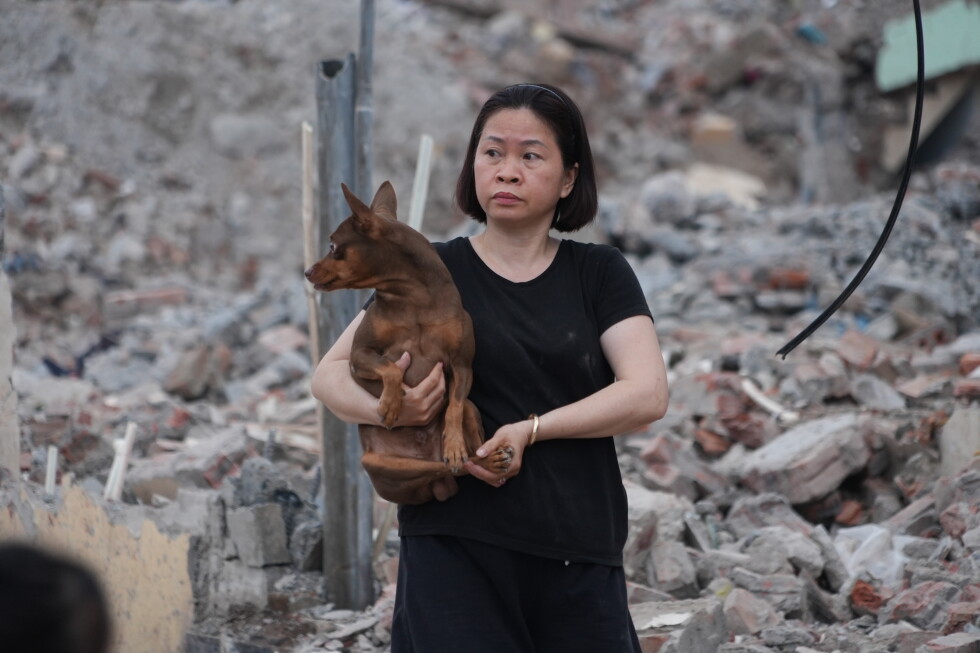
The constant roar of urban renewal echoes across Hanoi today: the sharp crack of hydraulic breakers splitting asphalt, the low groan of excavators shifting rubble, and the crunch of aging brick and concrete being torn from the ground. As Vietnam pursues an aggressive target of double-digit economic expansion, its capital city is racing to remake itself into a ultramodern global hub aligned with a 100-year urban vision.
In just the first six months of 2026, Hanoi has allocated $2.4 billion to clear land for nearly 1,500 separate infrastructure and development projects, a transformation that is rapidly reshaping one of the world’s oldest continuously inhabited capital cities. City officials frame the large-scale redevelopment as a critical adaptation to the growing threats of climate change: the plans integrate new flood control systems and air pollution reduction measures, addressing long-standing vulnerabilities for Vietnam, which ranks among the countries most at risk from climate-driven extreme weather, including increasingly frequent and intense typhoons, devastating seasonal floods, and record-breaking heatwaves. Hanoi itself has long struggled with severe seasonal smog, regularly ranking among the world’s most polluted capital cities.
But the promise of modern progress comes at a steep cost for thousands of residents, who have lost homes, family businesses, and generations-old community ties. Fine demolition dust drifts through working-class neighborhoods, coating rooftops, tree canopies, and the few remaining standing structures. For Nguyen Thi Nhan, a former street fruit vendor who lost her 300-square-meter street-front home to make way for a new arterial road, the upheaval has upended her family’s stability. She has yet to receive promised compensation for her lost property, and now pays rent to house her extended family, including her elderly parents. “We just have to wait. I don’t know where they will relocate us,” she said.
Large billboards dot cleared construction zones, painting a glossy vision of Hanoi’s future: gleaming steel-and-glass skyscrapers in new business and industrial districts, wide tree-lined boulevards, expansive public parks, and scenic waterfront promenades. To make room for this new skyline, the city plans to demolish hundreds of heritage colonial villas, traditional narrow shophouses, and densely packed low-rise residential blocks. The blueprint calls for dozens of new roads, bridges, and mass transit links connecting the city center to Noi Bai International Airport and fast-growing neighboring provinces.
The centerpiece of the transformation is a $28 billion redevelopment project stretching along both banks of the silty Red River that cuts through the heart of Hanoi. Spanning 11,400 hectares — an area larger than central Paris — the project will deliver new residential districts, commercial hubs, public green space, and most critically, expanded drainage and flood control infrastructure to address the city’s chronic riverine flooding. Another major landmark included in the plan is a $35.2 billion Olympic-level sports complex backed by Vingroup, Vietnam’s largest private conglomerate, anchored by a 135,000-seat drum-shaped soccer stadium, one of the largest in the world.
City officials also note that a complete transport overhaul is designed to rebalance Hanoi’s growth pattern, easing overcrowding and pressure on the crowded historic core by developing new distributed transport hubs across the metropolitan area.
While experts acknowledge that modern infrastructure is critical to Vietnam’s push to attract foreign direct investment and expand economic opportunity for both residents and domestic businesses, they warn that the breakneck construction boom carries significant systemic risks. “There are huge economic opportunities arising from those projects, but at the same time, there are risks that need to be considered,” said Nguyen Khac Giang, a visiting fellow at the ISEAS–Yusof Ishak Institute in Singapore. Giang cautioned that massive public and private investment in large-scale construction risks diverting much-needed capital from the high-tech manufacturing and digital industries that Vietnam has prioritized for long-term growth. The boom has also driven a sharp spike in residential and commercial property prices, leaving many ordinary buyers priced out of the market, while leaving domestic banks heavily exposed to a potential market correction. A 2025 S&P Global report found that Vietnamese real estate developers carry far higher debt levels than their peers in regional economies such as Indonesia and the Philippines, and the real estate sector, while accounting for just 3.5% of national GDP, makes up roughly a quarter of all outstanding bank lending in Vietnam.
Beyond economic risks, the rapid transformation has sparked growing anxiety over what Hanoi will lose as it remakes its urban fabric. For small business owners and long-time residents, even minor adjustments to street life have created major disruptions. Since November, city authorities have waged a citywide crackdown to clear sidewalks of illegal parking, unlicensed street vendors, and commercial encroachment, with police vans patrolling the iconic Old Quarter in the evenings, using loudspeakers to order vendors to remove outdoor seating that spills onto public walkways. For Thuy, a local beef noodle soup vendor who only shared her first name over concerns of official pushback, the crackdown has cut her income dramatically: she used to be able to serve four additional customers per hour using four outdoor stools and a small table, but now is forced to turn customers away, leaving her barely breaking even. “My profits are already small to begin with,” she said.
In a rare act of public dissent, hundreds of residents from the Bac Cau community along the Red River have hung public banners imploring city officials to scrap plans that would displace thousands of families to make way for new riverfront development. Villagers say the planned arterial roads will erase their generations-old community entirely. “We want to continue to live here, we’ve been here for generations,” said Van, a local resident who also only shared her first name over fears of official repercussions for speaking out.
While Hanoi has formal rules in place outlining compensation and resettlement support for residents displaced by land acquisition, including payments for damaged structures, relocation allowances, and support for families moving ancestral graves, dozens of displaced residents report they have yet to receive owed compensation, and remain uncertain about their long-term housing and livelihoods.
Giang argues that the core challenge is not modernization itself, but the breakneck pace of redevelopment and the consistent lack of meaningful consultation with affected residents and urban planning experts. He points to precedent across the region: in the 1960s, Beijing demolished nearly all of its centuries-old imperial city walls to make way for its first subway line and a major inner-city ring road, a loss that urban planners have lamented ever since. Large-scale redevelopment drives in other major Asian cities have repeatedly sparked public disputes, as displaced residents are often relocated to far-flung suburban areas lacking basic services and employment opportunities, tearing apart tightly woven communities that have existed for centuries. “Once we depart from the city’s history, it’s very hard to revert or to turn back,” Giang said.
Linh Nguyen, lead analyst at global risk consultancy Control Risks, notes that Hanoi’s current transformation marks a fundamental shift from the urban growth of the past two decades, which focused on expanding outward by building new greenfield development on the city’s periphery. Today’s reconstruction targets the existing built-up urban core, requiring the redevelopment of established neighborhoods and the relocation of long-time residents — a far more complex process that raises thorny questions of property rights, fair compensation, and inter-agency coordination. The outcome will also test whether Vietnam’s increasingly centralized state can deliver on decades-old planned infrastructure projects that have never been implemented. “The last 20 years were about building a bigger Hanoi. The next 20 years will be rebuilding the Hanoi that already exists. That’s a fundamentally different challenge,” she said.